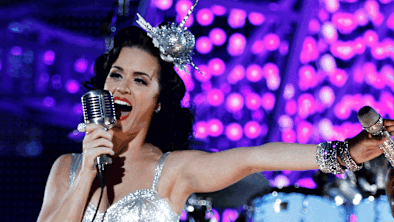
The song begins with a heartbeat. A synthetic pulse that accelerates, demanding attention before the drums crash in and a voice cuts through the silence like a flare over a blackened ocean.
Firework. For an alternative view, consider: this related article.
You know the melody. It has drifted out of rolled-down car windows on sticky July nights. It has played over scratchy gym speakers while middle schoolers bounce on polished basketball courts, screaming the chorus until their throats are raw. It was built for catharsis. Written as an anthem of self-worth, a musical rescue line thrown to anyone who has ever felt like a plastic bag, drifting through the wind, wanting to start again.
Now, imagine hearing that exact melody. But the wind is not blowing through a suburban park. The air smells of cordite and ozone. And the sky is not lit by festival sparklers, but by the jagged, terrifying flash of incoming munitions over a tense horizon. Similar reporting regarding this has been published by Wall Street Journal.
That is the strange, jarring reality that unfolded when a piece of digital media emerged, marrying Katy Perry’s explosive pop masterpiece with the brutal mechanics of geopolitical conflict.
And she was appalled.
To understand why that reaction matters, you have to look past the flashing lights of celebrity culture and step into the strange psychological space where art meets propaganda. Music is not neutral. A song does not exist in a vacuum, waiting politely to be filed away under pure entertainment. Once a track is released into the wild, it stops belonging exclusively to the artist. It is adopted. It is weaponized. It is twisted into something unrecognizable by anyone with an editing bay, an internet connection, and an agenda.
Consider what happens next when a global pop star collides with the machinery of state power.
The White House—or at least the digital architectures orbiting official messaging spaces—became the focal point of a bizarre cultural collision. A video surfaced concerning tensions with Iran, utilizing the uplifting, stadium-filling chorus of Firework as the sonic backdrop for content that carried deadly, grave implications.
Pop music has always danced close to the fire of politics. Artists march in protests, perform at inaugurations, and write protest anthems that echo through history from Bob Dylan to Kendrick Lamar. But there is a yawning chasm between a musician choosing to lend their voice to a political movement and having their commercial art appropriated by a government entity to soundtrack the drums of war.
Consent is the casualty here.
Katy Perry did not record an ode to military escalation in the Middle East. She recorded a track about personal resilience. When that audio is lifted and dropped over footage of defense strategies, tactical displays, or military posturing, a strange alchemy occurs. The original meaning is hijacked. The joy is hollowed out. The empowerment is replaced by intimidation.
For the artist, this is a nightmare scenario. Creators pour years of emotional labor, sleepless nights in recording studios, and vulnerability into their work. They craft specific emotional environments. To watch your art—something meant to make a teenager feel less alone in their bedroom—get repurposed as background noise for international brinkmanship feels like a violation. It is the artistic equivalent of having your personal diary read aloud at a press conference, but with explosions added for dramatic effect.
The public reaction was swift, divided, and loud. On one side stood those who saw the use of the song as tone-deaf at best and chillingly cavalier at worst. War is not a music video. It is not an action movie trailer designed to get your heart rate up before the Marvel logo appears. Real people live in the regions targeted by these escalations. Real children cover their ears when the real fireworks are not made of paper and gunpowder launched from a backyard lawn, but of shrapnel and falling steel. To soundtrack that reality with a bubblegum pop hook feels like a profound moral detachment.
On the other side, the defenders of digital realpolitik shrugged. In the modern attention economy, everything is content. Soundtracks are clipped, memes are generated, and the boundaries between high-stakes diplomacy and TikTok trends have dissolved entirely. To this camp, a catchy song is just audio assets waiting to be deployed to maximize engagement, capture algorithms, and project power across screens glowing in the dark.
This is the landscape we navigate now. A world where the distance between a pop radio hit and a national security briefing is just a few keystrokes on an editing timeline.
When the news broke of her staunch disapproval, it served as a rare moment of friction between the untouchable machinery of government messaging and the fiercely guarded autonomy of modern pop royalty. It drew a sharp, undeniable line in the sand. You can borrow our infrastructure, our digital platforms, and our collective cultural memory, the reaction seemed to say, but you cannot draft our joy into your army.
Think about the sheer scale of cultural saturation required for a song like Firework to be recognized instantly by millions of people across linguistic and geographical divides. That reach is a superpower. But it is also a vulnerability. When you write a song that massive, you build a monument so large that anyone can walk up and plant their flag in its shadow, whether you invited them or not.
The controversy faded from the top headlines as the relentless news cycle marched forward, churning out new crises, new videos, and new digital battlegrounds. Yet, the echo remains.
The next time you hear that familiar synthesizer build in a grocery store aisle or a crowded bar, pay attention to the reflex in your chest. Notice how easily rhythm can manipulate emotion. Notice how quickly a song about feeling alive can be dragged into the shadow of conflict.
Art was always meant to move us. But as the boundaries blur between what we sing and what we fear, we are left standing in the crossfire of our own culture, wondering who is really holding the remote control, and what song they will play next.


