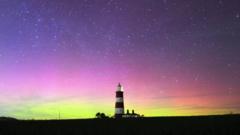
Tonight, a series of high-velocity solar eruptions will collide with the Earth's magnetic field, potentially igniting the most significant auroral display over the UK since the historic storms of late January. While most regional forecasts focus on the simple "where" and "when," the underlying mechanics of this specific event suggest a rare convergence of three distinct space weather phenomena that could push the Northern Lights much further south than the typical Scottish Highlands.
Between 22:00 and 02:00, the arrival of multiple Coronal Mass Ejections (CMEs) is expected to trigger a G3 "Strong" geomagnetic storm. This isn't a single wave of energy but a staggered bombardment. The sun has spent the last 72 hours shedding its outer atmosphere in a sequence of M-class flares, sending plumes of plasma hurtling toward our planet at speeds exceeding 600 kilometers per second. When these particles hit, they don't just "glow"—they transfer massive amounts of energy into the ionosphere, vibrating the Earth’s magnetic field lines like a struck bell.
The Equinox Factor
There is a specific reason why March produces more vivid displays than the dead of winter. It is known as the Russell-McPherron effect. During the weeks surrounding the Spring Equinox, the orientation of the Earth’s magnetic poles aligns in a way that creates "cracks" in our magnetosphere. This geometry allows solar wind to pour into the atmosphere with far less resistance than at any other time of year.
Even a moderate solar burp in March can outperform a massive eruption in December. Tonight, we are dealing with far more than a burp.
Why the Forecasts Often Fail
You have likely seen "Aurora Alerts" before that resulted in nothing but a cold night in a dark field. The frustration stems from the Bz component of the Interplanetary Magnetic Field. For the Northern Lights to become visible at mid-latitudes—think Manchester, Liverpool, or even the Midlands—the incoming solar magnetic field must point South. If the field points North, it essentially bounces off the Earth's shield.
Currently, satellite data from the Deep Space Climate Observatory (DSCOVR) indicates a sustained southward tilt. This is the green light for serious observers. It suggests that the plasma won't just skim the poles but will penetrate deep enough to produce the "overhead" coronas that turn a faint green smudge into a pulsing, multi-colored sky.
Breaking the Light Pollution Barrier
If you are waiting in a suburban garden, you are likely to be disappointed. The human eye struggles with "scotopic vision"—the ability to see color in low light—when competing with the orange haze of streetlights. To actually see the reds and purples of a G3 storm, you need a clear northern horizon devoid of artificial glow.
Photography vs. Reality
- The Camera: Modern sensors can "see" the aurora even when you cannot. A 5-second exposure on a smartphone will reveal vibrant greens because it accumulates light over time.
- The Eye: You are looking for movement. Real-time auroral activity looks like shifting curtains or "smoke" that moves against the wind. If the pillar of light is stationary for ten minutes, it is likely a cloud reflecting distant city lights.
The Grid Risk
While the public focuses on the aesthetics, National Grid engineers are watching the Geomagnetically Induced Currents (GICs). A G3 storm is powerful enough to induce currents in long-distance power lines and pipelines. In 1989, a similar event collapsed the entire Quebec power grid in seconds. While modern UK infrastructure is hardened against these "space hurricanes," the sheer volume of consecutive CMEs arriving tonight creates a cumulative stress on the transformers. This is the hidden side of the Northern Lights: they are the visual representation of a massive electrical surge hitting the planet.
As the sun approaches the absolute peak of Solar Cycle 25, these events are becoming the new normal rather than once-in-a-decade anomalies. The star at the center of our system is currently at its most volatile state in over twenty years, with sunspot groups like AR4392 acting as active cannons pointed directly at the Earth's orbital path.
Find a north-facing coast or a high peak. Turn off your phone screen to let your pupils dilate for at least fifteen minutes. The data suggests the peak window will hit shortly after midnight, as the core of the third CME makes contact.
Would you like me to track the real-time Kp-index data for your specific coordinate to narrow down the peak viewing window?