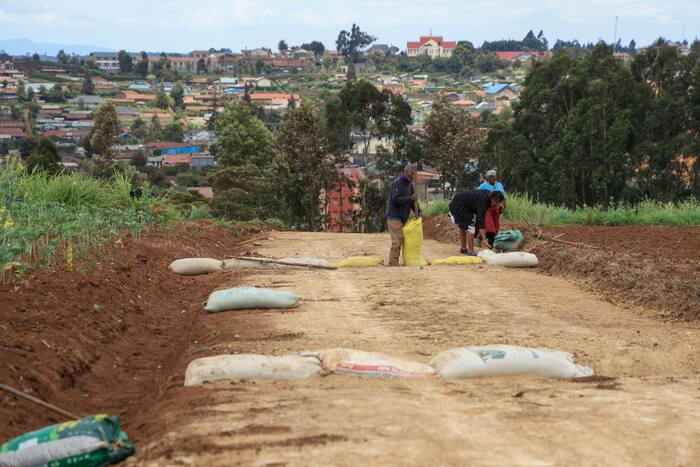
Soil erosion in East African agricultural zones is not a seasonal inconvenience; it is a direct capital depreciation event driven by kinetic energy transfer and hydraulic shear stress. When intense tropical precipitation strikes exposed topsoil, the resulting runoff strips away organic matter, nitrogen, phosphorus, and potassium faster than natural weathering or synthetic inputs can replace them. Kenyan smallholder farmers mitigate this asset loss through low-cost physical and biological engineering—specifically contour trenching, agroforestry root reinforcement, cover cropping, and vegetative filter strips. These interventions alter surface hydrology by reducing overland flow velocity, increasing infiltration capacity, and stabilizing soil aggregates against splash detachment.
The Physics of Tropical Soil Degradation
Standard agricultural reporting treats heavy rain as a monolithic threat, missing the two distinct physical mechanisms that destroy arable land. Understanding the efficacy of Kenyan erosion control requires separating splash erosion from sheet and rill erosion.
Kinetic Energy and Splash Detachment
Raindrops falling at terminal velocity carry substantial kinetic energy. Upon impacting bare soil, this energy transfers directly to soil aggregates, shattering them into constituent sand, silt, and clay particles. Fine clay and silt particles then clog surface pores—a process known as surface sealing or crusting. Once the soil crust forms, the infiltration rate plummets regardless of the underlying soil's permeability.
Hydraulic Shear Stress and Overland Flow
When precipitation intensity exceeds the soil's infiltration capacity, excess water accumulates on the surface and moves downslope as overland flow. As this water accelerates, it generates hydraulic shear stress against the soil bed. Once shear stress exceeds the critical shear stress of the soil—determined by particle size, cohesion, and root density—scouring begins. Sheet erosion removes uniform layers of topsoil, while concentrated flow carves rills and eventually gullies, permanently removing land from cultivation.
The economic consequence is immediate. Topsoil contains the highest concentration of soil organic carbon (SOC) and cation exchange capacity (CEC). Losing the top five centimeters of soil reduces crop yield potential exponentially, forcing smallholders into a debt trap of escalating fertilizer purchases to compensate for declining baseline fertility.
The Four-Pillar Engineering Framework
To counter these forces without capital-intensive heavy machinery, Kenyan farmers deploy four interlocking interventions. Each targets a specific variable in the Universal Soil Loss Equation ($A = R \times K \times LS \times C \times P$), altering slope length, surface roughness, or soil erodibility.
1. Contour Trenching and Fanya Juu Terracing
The primary physical intervention across Kenyan highlands and semi-arid regions is the construction of contour trenches, locally refined into the Fanya Juu (Swahili for "throw upwards") terracing system. Unlike conventional terraces where excavated soil is thrown downslope, farmers dig ditches along the contour line and throw the soil upslope to form an embankment.
- Slope Length Reduction ($LS$ factor): By segmenting a continuous slope into discrete hydraulic zones, trenches interrupt overland flow before it reaches erosive velocity.
- Retention Basin Mechanics: The trench acts as a detention pond, capturing runoff and holding it stationary until hydraulic head forces the water to infiltrate into the subsoil.
- Progressive Bench Formation: Over multiple rainy seasons, soil eroding from the upper section of the plot accumulates against the upslope embankment. Combined with the stabilizing effect of grass planted on the bund, the sloped field naturally levels into a series of flat bench terraces.
This method converts destructive runoff into stored soil moisture, extending the growing window into dry spells—a critical advantage in bimodal rainfall regimes.
2. Biological Reinforcement via Agroforestry
Physical earthworks fail if not stabilized by living root networks. Kenyan farmers integrate multipurpose trees—such as Grevillea robusta, Calliandra calothyrsus, and Sesbania sesban—along terrace bunds and field boundaries.
Roots reinforce soil through mechanical and hydrological pathways. Mechanically, fine roots act like rebar in concrete, increasing the soil's shear strength and binding aggregates together. Deep taproots anchor the upper soil horizons to more stable subsoil layers, preventing mass wasting and shallow landslides on steep gradients. Hydrologically, tree canopies intercept rainfall, dissipating kinetic energy before drops reach the ground, while transpiration lowers antecedent soil moisture levels, creating storage capacity in the soil profile ahead of major storm events.
3. Surface Roughness and Cover Cropping
Leaving soil bare between harvest and planting exposes it to maximum splash detachment during the onset of the long rains (March to May) and short rains (October to December). Farmers counter this by maintaining continuous ground cover using fast-growing legumes like Mucuna pruriens (velvet bean), Lablab purpureus, or sweet potato vines, alongside crop residue mulching.
Cover crops manipulate the $C$ (cover-management) factor of soil loss. A dense canopy absorbs raindrop impact, preventing surface crusting. At the soil-water interface, stems and surface litter increase hydraulic roughness (Manning's $n$). Higher surface roughness slows the velocity of overland flow, giving water more residence time to percolate through macropores created by earthworms and decaying roots. Leguminous cover crops simultaneously fix atmospheric nitrogen, offsetting the nutrient export caused by previous harvests.
4. Vegetative Filter Strips (VFS)
Where topography or labor constraints prevent full terrace construction, farmers plant narrow bands of dense, stiff-stemmed grasses—predominantly Napier grass (Cenchrus purpureus) or Vetiver grass (Chrysopogon zizanioides)—along contour lines.
Vetiver grass is uniquely suited for this function due to its physiological structure. It produces a dense, spongy root system that penetrates up to three meters vertically without spreading laterally to compete with adjacent cash crops. Above ground, its stiff culms form a living porous barrier. When sediment-laden runoff hits the strip, the flow velocity drops abruptly. Because sediment transport capacity is proportional to the velocity of water raised to the fifth or sixth power, even a minor reduction in flow speed forces suspended soil particles to drop out of suspension. Over time, silt builds up behind the grass hedge, creating natural micro-terraces while allowing filtered water to pass through safely.
Operational Execution: Step-by-Step Deployment
Implementing these controls requires strict adherence to topographical precision. Improperly aligned earthworks concentrate water rather than dispersing it, accelerating gully formation.
- Contour Mapping: Farmers establish true level lines across the slope using an A-frame level—a simple wooden triangular frame with a weighted plumb line suspended from the apex. By walking the frame across the slope and marking points where the string aligns with the center crossbar, operators map exact contour lines without optical surveying equipment.
- Excavation and Bund Construction: Along the marked contour, labor teams excavate trenches typically 60 centimeters wide and 60 centimeters deep, throwing soil upslope to form a bund roughly 40 to 50 centimeters high. Spacing between trenches is dictated by slope gradient; steeper slopes require tighter intervals (often 10 to 15 meters apart) to prevent runoff from reaching critical velocity between structures.
- Bund Stabilization: Immediately following excavation, before the first heavy rains strike the loose soil of the newly formed embankment, farmers plant Napier or Vetiver slips along the crest of the bund. The grass roots must establish before the structure experiences peak hydraulic load.
- In-Field Surface Management: Between the trenches, farmers transition from inversion tillage (which pulverizes soil structure and accelerates organic matter oxidation) to minimum tillage or planting basins (Zai pits). Crop residues are retained on the surface rather than burned or removed entirely for livestock fodder.
- Maintenance and Desilting: Following peak rainfall events, trapped sediment accumulates in the contour trenches, reducing their volumetric storage capacity. Farmers manually excavate this nutrient-rich silt and redistribute it upslope onto the cropping area, resetting the system's hydraulic capacity for the next storm cycle.
Economic Trade-offs and Systemic Limitations
While these techniques are technically sound, viewing them as frictionless solutions ignores severe operational bottlenecks faced by Kenyan smallholders. Adoption rates fluctuate based on labor economics, land tenure, and competing resource demands.
The Labor Bottleneck
Digging Fanya Juu terraces is exceptionally labor-intensive. Constructing trenches on a single hectare of sloped land can require between 100 and 150 person-days of manual labor using hand tools (jembes and shovels). For households reliant on family labor, this competes directly with time needed for land preparation, planting, and weeding. Without access to credit to hire casual labor, cash-constrained farmers often delay terrace construction until severe erosion has already degraded the plot.
Biomass Competition in Mixed Crop-Livestock Systems
Most Kenyan smallholders operate mixed farming systems where dairy cattle, goats, or sheep are central to household liquidity. This creates an acute resource allocation conflict: crop residues (maize stover, bean haulms) and Napier grass are primary sources of livestock feed. Retaining crop residues on the field as surface mulch directly reduces available fodder. Consequently, farmers frequently strip fields bare after harvest to feed livestock, leaving the soil vulnerable to erosion at the start of the next rainy season.
Land Tenure Insecurity
Soil conservation is a long-term capital investment; the yield benefits of terracing and agroforestry often take two to four seasons to fully materialize, while the labor costs are incurred upfront. Farmers operating on leased land or under insecure customary tenure arrangements lack the economic incentive to invest heavy labor into permanent earthworks if they cannot guarantee they will capture the future returns.
Hydraulic Failure Modes
Physical structures have finite design capacities. Under extreme precipitation events driven by shifting climate patterns—such as intense El Niño cycles—rainfall volume can exceed the storage capacity of contour trenches. If water overtops an unstabilized bund at a single low point, the concentrated discharge cuts rapidly through the embankment. This failure mode releases all stored water simultaneously, causing catastrophic downstream gully erosion worse than if no structures had been built at all.
Strategic Allocation for Maximum Yield Protection
For agricultural extension programs, development agencies, and farm managers operating in high-rainfall erosion zones, deploying these techniques indiscriminately wastes capital and labor. Interventions must be sequenced based on slope gradient and household resource constraints.
On gentle slopes (under 5 percent gradient), physical earthworks yield a poor return on labor. Management should focus entirely on biological controls: minimum tillage, mulching, and dense cover cropping to eliminate splash detachment. On moderate slopes (5 to 15 percent), Vegetative Filter Strips using Vetiver grass provide the optimal balance between installation cost and sediment trapping efficiency, bypassing the heavy labor cost of excavation.
Full Fanya Juu terracing combined with deep-rooted agroforestry must be reserved for steep slopes (exceeding 15 percent) where hydraulic shear stress threatens total topsoil loss. To overcome the biomass trade-off on these farms, extension strategies should prioritize high-yielding fodder grasses like Napier on the terrace bunds themselves. This aligns immediate economic incentives with structural engineering: farmers gain a renewable, cut-and-carry livestock feed source that simultaneously anchors the soil embankments protecting their primary food crops.



