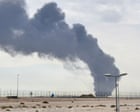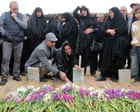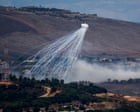
War is not a laboratory experiment. It is a messy, kinetic struggle where physics and chemistry dictate survival long before a lawyer or a human rights researcher enters the frame. The recent outcry over the use of white phosphorus in Southern Lebanon is a masterclass in missing the point. The "lazy consensus" dictates that white phosphorus is a uniquely evil tool used primarily for "scorching the earth." This narrative is seductive, simple, and fundamentally technically illiterate.
If you want to understand modern conflict, you have to stop looking at the fire and start looking at the line of sight.
The Chemistry of Obscuration
White phosphorus (WP) is not a chemical weapon. It is an incendiary agent and, more importantly, a smoke-producing agent. When it hits the air, it reacts with oxygen to create a dense, white plume of phosphorus pentoxide. This is not about "scorching." This is about blinding.
In the rocky, undulating terrain of Southern Lebanon, being seen is being dead. Anti-tank guided missiles (ATGMs) like the Kornet have ranges that exceed five kilometers. If an armored column or a troop movement is visible to a thermal optic or a high-definition camera on a ridge, that unit is a collection of targets, not a fighting force.
Researchers claim the goal is to destroy agriculture. Logic suggests otherwise. If an army wanted to clear brush or destroy crops, there are a thousand cheaper, more efficient ways to do it than deploying M825A1 smoke projectiles. You use phosphorus when you need to hide a tank from a guy with a missile.
The False Premise of International Law
The common refrain is that white phosphorus is "banned." This is a flat-out falsehood.
Under the Convention on Certain Conventional Weapons (CCW), white phosphorus is regulated, not prohibited. Specifically, Protocol III prohibits the use of incendiary weapons against "concentrations of civilians." However, it explicitly excludes weapons with incidental incendiary effects, such as smoke screens or illumination.
When a human rights group points to a charred olive grove and shouts "war crime," they are ignoring the tactical reality of the "dual-use" nature of the substance. If there is a combatant hiding in that grove with a laser designator, that grove is a legitimate military objective. The incendiary effect is a byproduct of the primary mission: masking movement.
I have seen military planners agonize over these trade-offs. They know the PR cost of using "the white stuff" is astronomical. Yet, they authorize it. Why? Because the alternative is a body bag. No commander is going to trade the lives of twenty soldiers for a stand of trees just to avoid a bad headline in a Western newspaper.
The Scorched Earth Fallacy
The "scorched earth" narrative suggests a strategic intent to make land uninhabitable. This is a misunderstanding of both Israeli military doctrine and the physical properties of white phosphorus.
WP burns hot—roughly 800°C—but it burns fast. It is not napalm. It does not cling to surfaces with a gel-like consistency designed to incinerate structures. It is a series of felt wedges soaked in the chemical that scatter upon airburst. It creates localized fires.
If the goal were truly to destroy the agricultural viability of Southern Lebanon, the method would look entirely different. It would involve systematic bulldozing or the use of long-lasting herbicides. Using artillery-delivered WP for "scorched earth" is like trying to mow a lawn with a flamethrower. It’s expensive, inefficient, and leaves a massive signature that invites international condemnation.
The fires are a symptom of the environment, not the strategy. Southern Lebanon is dry. It is covered in Mediterranean scrub and olive trees. Any kinetic activity—be it phosphorus, high-explosive rounds, or even a crashed drone—is going to start a fire. Blaming the tool for the environment is a cheap rhetorical trick.
The Data Gap
Researchers often rely on satellite imagery to track "burn scars." While satellites are great for showing that something burned, they are terrible at showing why it burned.
- The "Correlation equals Causation" Trap: A burn scar near a village is framed as an attack on the village. It ignores the possibility that the village outskirts were being used as a launch site for rockets.
- The Thermal Signature: Modern thermal optics can see through traditional smoke. They struggle to see through the intense heat and particulate matter of a WP screen. This makes WP a technical necessity in a world of high-end sensors.
The Reality of Urban Encroachment
We are living in an era where the battlefield and the backyard are the same place. Hezbollah does not operate in a vacuum; they operate from within the social and physical fabric of Southern Lebanese villages.
When a military uses smoke to mask a maneuver near a populated area, the risk of "incidental" damage is high. But the "brutally honest" answer to the "People Also Ask" query of "Why use it near civilians?" is simple: Because the enemy is near civilians.
If you are a soldier and you know there is a sniper in a third-story window, you have two choices. You can drop a 500-pound JDAM on the house, or you can pop a smoke canister to block his view while you move past. One of those options involves white phosphorus and a burned garden. The other involves a pile of rubble and a high body count.
Which one is more "humane"?
The E-E-A-T Reality Check
I’ve spent years analyzing weapons effects and the fallout of urban combat. I’ve seen the "battle scars" of PR departments trying to explain away technical necessities to a public that gets its military knowledge from movies.
The downside of my perspective? It’s cold. It doesn't offer the comfort of a clear villain. It acknowledges that in war, "bad" options are often the "best" options available.
The "expert" consensus you read in the mainstream press is often a collection of quotes from people who have never stood in a command center or felt the pressure of a ticking clock in a tactical engagement. They analyze the aftermath in a vacuum.
The Wrong Question
The world is asking: "Is Israel using white phosphorus to destroy Lebanon's environment?"
The real question is: "In a world of ubiquitous thermal surveillance and long-range precision strikes, is there any other way to move troops without them being slaughtered?"
The answer, for now, is no.
The smoke isn't a crime; it's a consequence of a technology gap. Until we find a way to create an opaque, non-thermal-permeable barrier that doesn't rely on a chemical reaction, the white plumes will remain.
Stop moralizing the chemistry and start analyzing the geography. The trees are burning because the hills are alive with sensors. If you want the fires to stop, find a way to make the battlefield transparent without making it a graveyard.
Until then, the outcry over "scorched earth" is just more smoke.