Ash tastes like burnt plastic and wet limestone.
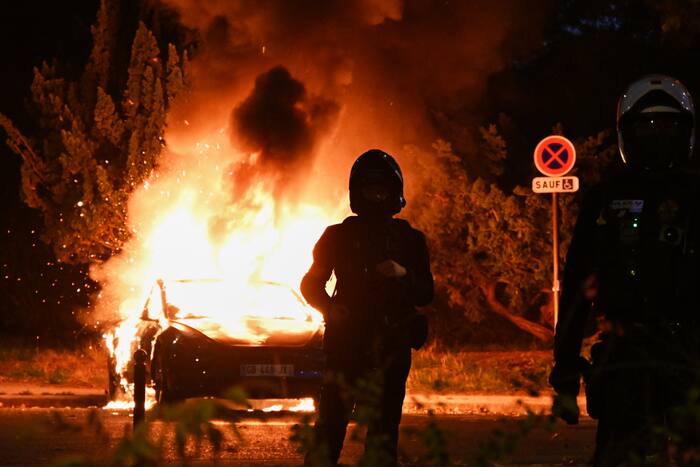
Anyone who has ever stood at the edge of a cordon in central Paris after midnight knows that specific metallic tang in the back of the throat, the lingering residue of tear gas canisters and torched municipal bins mixing with the damp chill of a late-summer European night. For weeks, that acrid air hung over French boulevards like an uninvited tenant. Shops stayed shuttered behind sheets of raw plywood. Commuters learned to read the geography of their own cities not by metro stops, but by police barricades and shattered bus shelters. Discover more on a related issue: this related article.
Then, almost abruptly, the fever in France began to break.
The sirens grew sparser. Street sweepers returned to the avenues before dawn, their rotating amber lights reflecting off wet cobblestones as they cleared away the charred skeletons of scooters and barricades. Across the border in Germany, however, a different kind of tremor was just beginning—scattered, restless, and timed to the exact week millions of parents were buying notebooks and packing schoolbags. Additional reporting by TIME delves into similar views on the subject.
Quiet. That is the first thing you notice when unrest recedes, and it is also the most deceptive thing in European politics.
To read standard wire reports about civil unrest is to absorb numbers stripped of pulse: arrest tallies, property damage estimates, deployment figures for riot police. Those figures matter, of course, because broken glass costs real money and injured officers and protesters bleed real blood. Yet numbers alone miss the invisible thread connecting a cooling French street to a sudden flare-up in a German district just before the school bells ring. When rage moves across a border without a passport, it rarely travels by ideology alone. It travels through exhaustion, economic pinch, generational friction, and the strange vulnerability of late August, when summer's temporary truce collides with the hard realities of autumn.
The Anatomy of a Cooling Boulevard
Imagine—purely as a composite drawn from countless real Parisian shopkeepers—a baker named Laurent in a working-class arrondissement on the eastern edge of Paris.
For days during the height of the French unrest, Laurent rolled his metal shutters down at four in the afternoon instead of seven. Every evening he watched live feeds on his phone while listening to the distant percussion of flashbangs echoing off Haussmann facades. His flour deliveries arrived late because arterial roads were blocked; his regulars stopped lingering over morning espresso because the neighborhood felt brittle, as though one shouted insult or one thrown bottle could turn an ordinary Tuesday into another night of sirens.
By the time French protest violence began to ease, Laurent did not celebrate. He simply unlocked his door at five in the morning, swept soot from his threshold, and counted the coins in his register.
That exhaustion is the secret engine behind most de-escalations. Street movements rarely end because everyone suddenly agrees with the government. They ease because human beings cannot sustain peak adrenaline indefinitely. Protesters have jobs to return to, court dates to face, bruised ribs to nurse, and families begging them to stay home. Meanwhile, state authorities adjust—flooding flashpoints with mobile gendarmerie units, tightening curfews, making rapid arrests that raise the personal cost of staying on the street after dark.
France has rehearsed this choreography for generations. From the student barricades of May 1968 to the suburban uprisings of 2005, through the yellow vest roundabouts and pension protests of recent years, French civic life operates like a pressure cooker with a loud, familiar whistle. When the steam vents violently, the shock is real, yet the institutional memory of how to contain it—and how society absorbs the aftermath—is deeply ingrained.
So when the headlines declare that French protest violence is easing, the truth underneath is layered. The immediate flames subside. Insurance adjusters walk the avenues with clipboards. Politicians claim firmness restored order, while activists insist the underlying grievances merely went underground. Both claims can be true at the exact same time. A street can be calm while the kitchen tables behind its shuttered windows remain full of quiet fury.
Across the Rhine, a Different Kind of Spark
Drive five hours northeast from Paris, cross the Rhine where cargo barges slide silently past vineyards and industrial ports, and the emotional architecture changes completely.
Germany has long prided itself on consensus, procedural order, and predictable rhythms. Postwar German democracy was built almost explicitly as an antidote to street chaos—a system of negotiated wage agreements, coalition compromises, and careful federalism where friction is supposed to be absorbed in committee rooms rather than on asphalt.
Which is why scattered riots in German cities hit the national psyche with a particular kind of chill.
Consider what happens when unrest breaks out not as a single unified ideological march, but in scattered pockets across urban neighborhoods just as the school year prepares to restart. Picture—again, as an illustrative composite of families across German cities from North Rhine-Westphalia to Berlin—a mother named Katrin standing at her kitchen counter on a Sunday evening. Beside a stack of freshly labeled exercise books and a half-packed backpack, her phone buzzes with neighborhood alerts: burning dumpsters three tram stops away, fireworks aimed at patrol cars, streets cordoned off until morning.
She does not live in a war zone. Germany is not collapsing into anarchy. That distinction matters enormously, because panic distorts reality just as badly as denial does. The incidents are scattered, localized, and quickly contained by state police forces.
Yet for Katrin, the timing turns an isolated disturbance into an intimate anxiety.
Why the School Calendar Changes Everything
There is a reason the phrase "ahead of school return" carries so much quiet weight in news dispatches, even when editors tuck it into the second half of a headline.
Summer in Europe operates as an informal social suspension. Millions travel; universities empty; parliamentary sessions pause; routines loosen their grip. Even households squeezed by high rent, grocery inflation, and stagnant wages experience a brief seasonal buffer when daylight stretches past nine at night and children are out of classrooms.
Then comes the return to school.
In psychological and economic terms, the end of summer holidays is one of the sharpest stress points of the entire year. Suddenly, every abstract macroeconomic pressure acquires an itemized receipt:
- New shoes for feet that grew two sizes since June.
- Transit passes, laptops, sports fees, and lunch accounts.
- The abrupt return of rigid schedules for teenagers who spent weeks drifting through hot afternoons with nowhere to go and very little money to spend.
Think of the end of summer like low tide pulling back from a harbor. While the water is high, jagged rocks stay hidden beneath the surface; once the tide recedes, every sharp edge is exposed at once.
For young people on the margins—whether in banlieues outside Lyon or housing blocks in German industrial cities—the days right before school resumes carry a volatile mix of boredom, peer bravado, and dread. Returning to classrooms often means returning to institutions where many already feel sorted, judged, or left behind. Add viral social media clips glorifying clashes in neighboring countries, stir in local grievances over policing, housing, or cost of living, and a handful of teenagers with pyrotechnics and stones can ignite a block in minutes.
It is messy. Sometimes it is not even coherent.
Anyone who claims to know the single neat cause behind scattered youth riots is selling certainty they do not possess. Sometimes unrest is an explicit political protest against state policy. Sometimes it is copycat spectacle fueled by algorithmic video feeds that reward flames with views. Often, it is a collision of both—a wordless roar from young men who lack the vocabulary or the power to negotiate their place in an expensive, aging continent.
The Contagion of Images
Years ago, unrest traveled slowly. It took newspapers, radio broadcasts, and organizational networks to carry the mood of one city into another.
Today, a teenager in Frankfurt or Essen watches raw vertical video from a Parisian boulevard within seconds of a flare hitting the pavement. The soundtrack is universal: sirens, shouting, glass breaking, bass-heavy music laid over shaky camera pans. Context disappears completely in a fifteen-second clip. Viewers do not see the union negotiations, the municipal council hearings, the arrests that follow at dawn, or the baker sweeping ash off his doorstep. They see only the intoxicating illusion of power—the moment when a crowd briefly makes authority flinch.
That visual contagion works across borders far faster than any political manifesto ever could.
At the same time, it creates an optical illusion for ordinary citizens watching from their living rooms. When scattered riots flare in a few German districts during the same week that French cities quiet down, the human brain instinctively draws a straight line between them, as though a single storm cloud simply drifted northeast across the map.
Reality is subtler and more stubborn. France and Germany are wrestling with distinct domestic pressures, distinct policing traditions, and distinct social fractures. France's centralized state often turns local anger directly toward national symbols; Germany's decentralized structure disperses tension across municipalities and federal states, making outbreaks look fragmented rather than monolithic.
Yet both countries share an underlying vulnerability that no border checkpoint can filter out: a widening gap between official economic reassurance and lived household strain.
What Stability Actually Costs
It is tempting, when street violence subsides in one country and remains contained in another, to breathe out and move on to the next news cycle. Politicians love the moment when graphs of incidents bend downward. Commentary quickly shifts from alarm to amnesia.
That reflex is dangerous because quiet streets are not the same thing as healed communities.
Walk through a neighborhood a week after riots end and look closely at what remains invisible in official statistics. Look at the small business owner whose insurance deductible wipes out a year of profit. Look at the rookie police officer sitting in a patrol van at two in the morning, hyper-vigilant and exhausted, trying to distinguish between a rowdy teenager walking home and someone carrying an incendiary device. Look at the high school teacher standing in front of thirty restless students on the first Monday of term, asked to somehow teach algebra or literature while carrying the unspoken weight of social cohesion on a modest public salary.
I remember standing once near a cordoned intersection the morning after a night of unrest in Western Europe, watching an elderly woman carefully step around melted plastic traffic cones to reach a pharmacy. She did not look angry. She looked tired in a way that went straight into her bones—the tiredness of someone who had spent a lifetime playing by rules that suddenly felt fragile.
That fragility is the real story behind headlines about easing violence in France and scattered unrest in Germany.
Modern democracies depend on an unspoken agreement that millions of strangers renew every single morning without thinking about it: that buses will run, storefronts will stay intact, disputes will be settled with ballots or contracts rather than bricks, and children will walk into schools safely each September. Most days, that agreement feels as natural and permanent as gravity.
It is neither. It is maintained by trust, fair opportunity, competent policing, and the quiet belief that tomorrow will be slightly better—or at least no worse—than today.
Before the First Bell Rings
Back in that composite German kitchen on Sunday night, Katrin checks the transit app one final time before turning off the light. The tram line is running normally again. Municipal crews have already hauled away the burned bins; the asphalt has been hosed clean; the morning paper will mention the overnight disturbances in three tight paragraphs on page four.
Tomorrow morning, millions of children across France and Germany will shoulder their backpacks, complain about waking up early, and walk through school gates into bright fluorescent hallways. Teachers will take attendance. Coffee machines will hiss in corner cafes. From the outside, Europe will look entirely composed—orderly, prosperous, back on schedule.
Yet beneath the freshly swept pavement, the embers of late summer never quite turn completely cold; they simply wait to see whether the coming season offers young hands something better to build than a barricade.