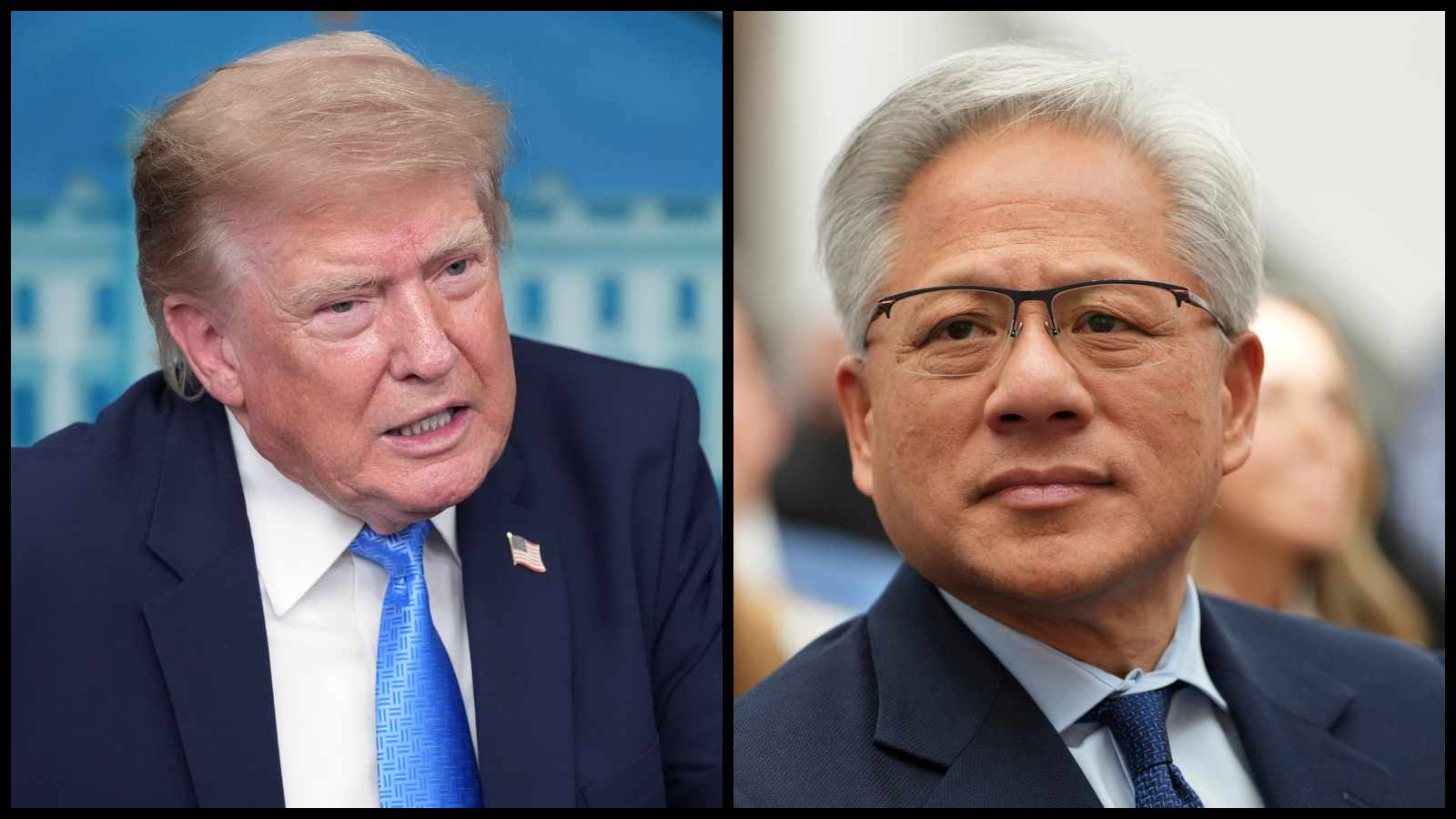
Trust is fragile. Especially when power wears a friendly face.
When Donald Trump steps up to a microphone to say that Jensen Huang had no idea the woman in question was a Chinese spy, the words sound almost simple on paper. A defense. A dismissal. A neat little line drawn between an American tech titan and an alleged intelligence operative. Yet when you sit with that claim long enough, the neatness frays. High-stakes geopolitics rarely comes with nametags that read Spy in bold red ink. Real espionage looks like a warm handshake in a fluorescent-lit hallway, a shared laugh over lukewarm coffee, a polite question about a project timeline that seems completely ordinary until three years later when someone connects the dots you never even knew existed. In related developments, take a look at: The Electoral Calculus of Alexandria Ocasio-Cortez Across Statewide and National Markets.
I have spent years watching how smart people get blindsided in rooms full of sharp minds. Not because they are careless. Often because they are busy building things, keeping schedules, managing hundreds or thousands of moving parts while someone else's primary job is watching every blink. The smell of overheated servers and dry-erase markers fills the background of so many modern power struggles, while the real friction happens quietly between two human beings deciding how much weight to put on another person's word.
Truthfully, I find this territory unsettling. Whenever national security collides with corporate leadership and political theater, the ground shifts under your feet before you can name what changed. You want clean villains and clean alibis. You rarely get either. NBC News has also covered this important issue in great detail.
The Anatomy of a Blind Spot
Consider a hypothetical scenario. Imagine a mid-level specialist—let us call her "Mei"—working inside an orbit adjacent to a major chipmaker. Nothing cinematic. No trench coats, no dead drops behind dumpsters. Just steady competence, arriving early, staying late, asking thoughtful questions that make managers feel heard. If a leader like Jensen Huang crosses paths with dozens or hundreds of people across conferences, briefings, partnerships, and dinners, how much of that interaction is actual assessment versus routine human grace?
Grace is efficient. You cannot run a multi-trillion-dollar enterprise by treating every colleague, contractor, or acquaintance like a hostile asset. If you interrogate every smile, you freeze the room. If you never question anything, you leave the back door unlatched.
That tension is the true engine beneath the headlines surrounding Nvidia and the accusation of espionage. Publicly, the story centers on a clash of narratives: a high-profile defense from Trump asserting that Huang was kept in the dark, set against the nagging anxiety that intelligence threats are slipping into the nervous system of artificial intelligence. AI chips are no longer mere hardware components tucked inside data centers; they are leverage, currency, and strategic muscle. Anyone orbiting them draws scrutiny.
Consider what happens next: once a spy allegation enters the frame, hindsight becomes a ruthless editor. Every past meeting gets replayed in slow motion. Every casual remark suddenly looks like a probe. An executive who genuinely knew nothing faces the maddening task of proving a negative—proving that an empty room inside their own awareness was truly empty.
Why Smart Leaders Miss What Is Right in Front of Them
History is crowded with capable people who missed quiet infiltrators. During the Cold War, counterintelligence officers repeatedly warned that the most dangerous operatives were not frantic, suspicious figures skulking in shadows, but disciplined professionals who blended seamlessly into routine bureaucracies. People liked them. People trusted them. Because trust is a shortcut our brains love.
Think of trust like a locked front door with a glass pane. You can see the person standing on the porch. You see their posture, their coat, the way they hold their bag. Seeing feels like knowing. Yet glass only separates you from the weather; it does not tell you what is inside a closed briefcase or what instructions were memorized on a train ride an hour ago.
A leader at Huang's level operates at velocity. Decisions stack up like freight trains. When someone tells you a person is vetted, useful, or aligned with a legitimate initiative, you rely on layers of institutional filtering. You assume security protocols, background checks, compliance teams, and basic norms are doing their jobs so you can focus on architecture, supply chains, and vision.
That is where doubt creeps in for the rest of us watching from the sidelines. Could a chief executive truly have no clue? Yes—human cognition has hard limits, and deception thrives inside routine. Could political actors use a defense of ignorance to protect a strategic asset, score points, or shape public perception? Also yes. When both possibilities are plausible at once, certainty becomes a luxury nobody can afford.
Power, Politics, and the Weight of a Single Sentence
Words spoken at the top of politics rarely land in a vacuum. When Trump defends Huang by saying he had no idea she was a Chinese spy, that sentence does two things at once. It shields an iconic American company and its leader from the taint of complicity, while also framing the alleged spy as an actor operating behind a mask rather than a partner welcomed in with eyes wide open.
Yet defense can sound like deflection if the underlying questions remain unanswered. How did she get close enough to matter? What access did she have, or seek? How long did the blind spot last?
We tend to imagine espionage as a master chess match between two geniuses staring across a board. Most of the time, it looks more like fog rolling over a harbor. You hear a horn in the distance. You see a faint silhouette. By the time the outline sharpens, the tide has already moved.
In technology and geopolitical competition, the stakes are heavy because the tools being built shape everything from defense systems to economic dominance. Even a rumor of compromise rattles markets and nerves alike. Investors wonder about regulatory blowback. Policymakers wonder about vulnerabilities they have not mapped yet. Ordinary citizens—people just trying to understand why the news feels perpetually on edge—wonder whether anyone is truly in control of forces moving faster than law and tradition.
Living With Uncertainty Without Losing Your Mind
I do not pretend to hold secret intelligence files. I am not sitting in a briefing room reading classified cables. What I do know—from watching institutions strain under pressure and from making my own misjudgments when I wanted to believe the best in someone—is that human blind spots are real, stubborn, and universal.
We all have moments where we misread motives. Maybe it was a business partner whose enthusiasm hid an agenda, or a colleague whose friendliness masked quiet competition. The sting is not just being wrong. The sting is realizing how effortlessly our desire for normalcy smoothed over small warning signs.
When a defense like Trump's arrives in the middle of an espionage controversy, it invites us to pick a side before all the facts are settled. Quick certainty feels comforting. It quiets the noise. Still, there is real value in holding two thoughts gently side by side: a leader can be genuinely unaware of covert espionage, and systems built around high-value technology still need sharper guardrails than good intentions alone.
No press release settles human nature. No soundbite erases the quiet work of counterintelligence or the messy reality of corporate life.
A single phrase can clear the air for a moment. Shadows still move where nobody is looking.


