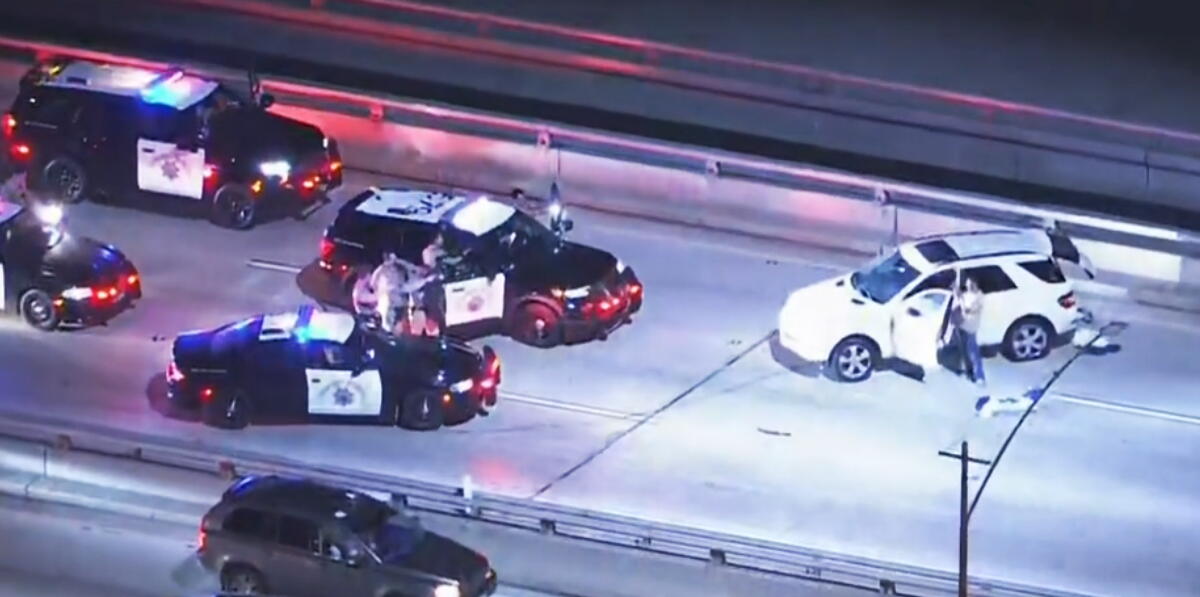
Every single local news anchor lost their mind over the South Los Angeles Mercedes pursuit. You watched the footage. A stolen luxury sedan crawling down Florence Avenue at fifteen miles per hour, hazard lights blinking, flanked by half a police department like it was a presidential motorcade. The pundits called it farcical. The armchair quarterbacks on social media screamed about incompetence, demanding pit maneuvers, armored tactical vehicles, and instant kinetic resolution.
They are entirely wrong.
What looked like a low-stakes comedy of errors was actually an object lesson in asymmetrical urban containment. When an erratic driver crawls through a densely populated grid at sub-highway speeds, you do not force a high-velocity collision just to satisfy the bloodlust of a television audience. You bleed them out.
The Lazy Consensus of Speed Obsession
The public narrative surrounding police pursuits is poisoned by Hollywood brain rot. We expect every chase to mirror an action movie climax where vehicles flip, tires screech, and suspects are dragged from smoking wrecks within three minutes.
When reality intrudes with a crawl, people panic. They assume patience equals weakness.
Consider the physics of urban density. South L.A. is not a vacant stretch of Nevada interstate. It is a dense web of pedestrians, narrow residential corridors, children, and unyielding concrete infrastructure. Initiating a high-speed intervention in that environment transforms a property crime into a mass casualty event.
I have spent two decades analyzing tactical response and municipal risk management. I have watched cities hemorrhage tens of millions of dollars in liability settlements because a supervisor yielded to optic-driven pressure and ordered a premature, aggressive takedown on a crowded surface street.
The department that tracked that Mercedes at twenty miles per hour did not fail. They exercised the rarest commodity in modern policing: restraint under the glare of a news helicopter.
The Economics of Exhaustion
Let us look at the mechanics of what was actually happening on that asphalt.
A suspect driving a stolen vehicle at low speeds in a heavy police fishbowl experiences a very specific psychological collapse. Adrenaline is a finite resource. You cannot sustain peak hyper-vigilance for hours while watching three patrol units in your rearview mirror and a chopper overhead.
- Sensory Overload: The continuous drone of aviation units, the flashing light patterns bouncing off windshields, and the inescapable realization of total visibility destroy decision-making capacity.
- Fuel and Mechanical Wear: High-end European sedans are temperamental. Operating under continuous surveillance with specialized containment units dictating the pacing prevents the driver from executing any tactical pivot.
- The Inevitability Trap: When you cannot speed up because traffic and cruisers block your lane, and you cannot stop because the exit path is permanently sealed, time becomes your primary adversary.
The driver thought they were in control because the car was moving forward. In reality, they were trapped in a mobile cage designed to do one thing: wait for the fuel gauge to drop and the panic to set in.
Dismantling the People Also Ask Fallacy
Every time one of these viral chases hits the airwaves, the search engines light up with the same frantic queries. Let us address them with brutal honesty.
Why do police not just shoot out the tires? Because a punctured tire on a heavy vehicle traveling through a pedestrian zone turns a controlled crawl into an uncontrollable missile. Bullets miss. Shrapnel ricochets. Asphalt is unforgiving.
Why not use a spike strip? Spike strips require a stationary deployment window ahead of the vehicle. In a chaotic urban grid without fixed bottlenecks, setting up a foot deployment puts officers directly in the path of an unpredictable operator.
Why let them go at all? Because letting a contained vehicle bleed its momentum safely is infinitely superior to chasing it into a school zone.
The public wants immediate satisfaction. Modern media consumption has trained us to demand 30-second resolutions to systemic friction. But public safety is not a TikTok video. It is an exercise in boring, methodical risk mitigation.
The Real Danger Is Not the Suspect
The most glaring flaw in the mainstream outrage over this slow-speed pursuit is the misplaced target of the anger. The public directs its fury at the suspect or the cautious officers, completely ignoring the structural rot that makes these incidents routine.
Property crime in major metropolitan areas has evolved into a high-volume, low-consequence enterprise. When enforcement is bottlenecked by overloaded court systems and revolving-door sentencing, criminals treat luxury car theft like a temporary rental agreement with extra steps.
Focusing on whether a chase was fast enough or flashy enough is missing the forest for the burning tires. We are debating the aesthetics of the containment while ignoring the systemic failure that put the driver behind the wheel in the first place.
Stop judging police tactics by how entertaining they are to watch from your couch.
Next time a stolen sedan creeps down a boulevard at twenty miles per hour while twenty cruisers watch its every move, do not laugh at the speed. Recognize it for what it is: a slow-motion trap that prioritizes human lives over your afternoon entertainment.