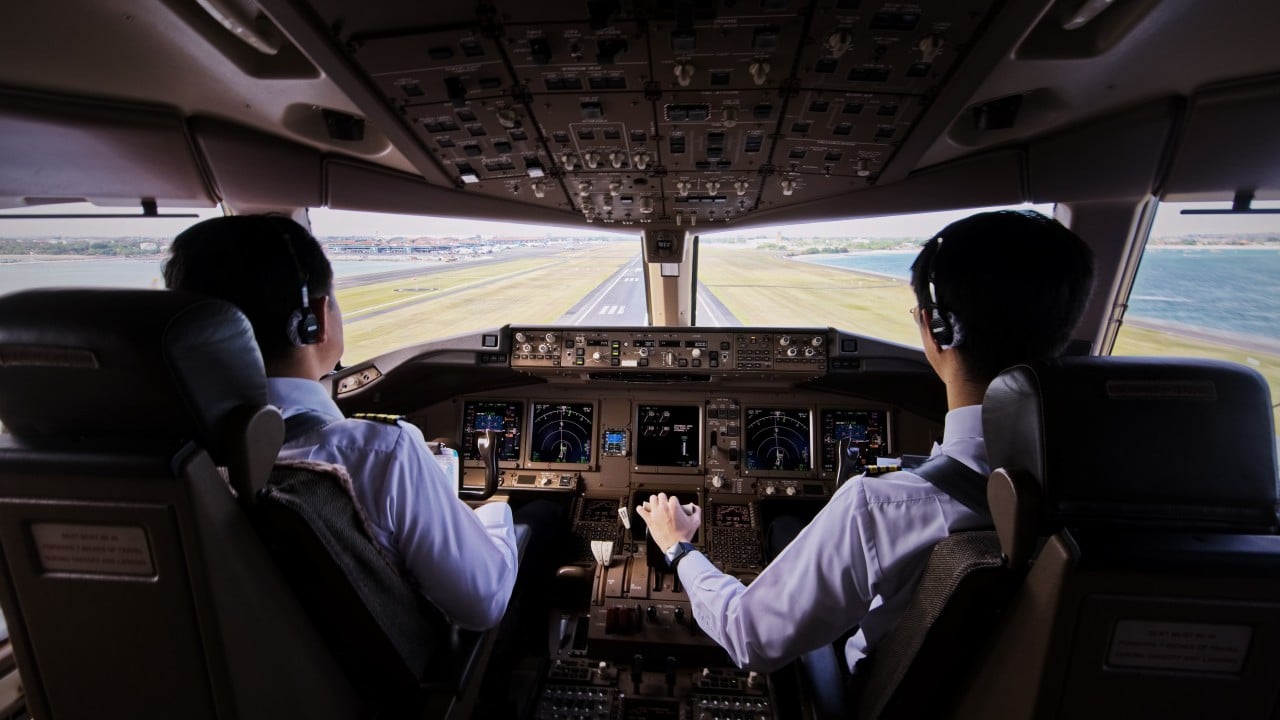
You smell jet fuel and stale coffee before you see the sunrise.
At thirty-eight thousand feet, the world looks small, orderly, and entirely benign. The clouds stretch out beneath the wings like a vast, untrodden field of snow. The engines hum a steady, hypnotic bass note that has lulled millions of passengers to sleep. Up here, above the weather, you feel untouchable. You feel as though you have escaped the messy, gravity-bound friction of existence down below. Expanding on this theme, you can also read: The Brutal Reality Behind The Miracle Of Bilateral Leg Reattachment.
I know that feeling intimately. For years, my office had no walls, just a shifting panorama of continents, time zones, and endless blue.
We talk endlessly about the romance of flight. We romanticize the window seat, the golden hour light hitting the fuselage, the circadian rhythm permanently broken by choice. We trade sleep for sunrises. We accept the swollen ankles, the dry cabin air, and the quiet erosion of our internal clocks as the price of admission to a nomadic life. Experts at WebMD have shared their thoughts on this matter.
Yet, there is an invisible passenger sharing the cockpit and the cabin with every flight crew member. It does not need a boarding pass. It does not take up weight in the cargo hold.
Radiation.
The Invisible Current
To understand what happens to the human body at cruising altitude, you have to forget everything you know about the air around you.
Down on the surface, the Earth acts as a protective mother. Our thick atmosphere and the planet's magnetic field shield us from the relentless cosmic ray bombardment raining down from deep space and our own sun. We are cocooned. We are safe.
Step up into a modern commercial jetliner, and you step out of that cocoon.
At typical cruising altitudes, the atmospheric shield thins out by roughly seventy-five percent. The air is thinner, colder, and far more porous. Energetic particles—remnants of ancient supernovas, solar flares, and galactic radiation—slam into the upper atmosphere, creating a cascade of ionizing radiation.
(Note: When I speak of a cascade here, I am using it as a literal description of subatomic particle showers—neutrons, protons, and gamma rays colliding with atmospheric atoms and multiplying as they penetrate downward.)
Pilots and flight attendants are occupationally exposed to this ionizing radiation more than almost any other workers on Earth, often outstripping workers in nuclear power plants. We are talking about cosmic radiation, a silent and imperceptible energy that passes right through aluminum hulls, leather seats, and human flesh as if they were made of glass.
For a long time, the aviation industry treated this as a footnote. A curiosity for meteorologists. A minor variable in a stack of safety regulations.
Then the data caught up.
The Cost of the Horizon
Recent epidemiological findings paint a sobering portrait of what happens when human biology meets high-altitude physics over a thirty-year career.
A comprehensive body of research tracking flight crews reveals a statistically elevated risk of dying from certain types of cancer, most notably melanoma and other malignancies tied to chronic occupational exposure. The relative risk climbs steadily with every transatlantic crossing, every polar route, every red-eye flight logged in the logbook.
Let us ground this in a hypothetical scenario to make the abstract concrete.
Imagine Sarah, a veteran purser with twenty-two years on wide-body aircraft. She knows the layout of every Boeing and Airbus variant by heart. Her skin bears the subtle, dry texture of someone who has spent thousands of hours breathing cabin air with a humidity level lower than the Sahara Desert. Sarah does not worry about the weather radar; she worries about turbulence and unruly passengers.
Yet, every time Sarah flies from New York to Tokyo over the Arctic circle—where the Earth's magnetic field dips and offers less protection—her body absorbs a dose of radiation equivalent to multiple chest X-rays in a single journey.
Multiply that single journey by two thousand flights.
The human body is remarkably resilient. It repairs DNA damage constantly. Every second of every day, cellular machinery mends micro-tears caused by background radiation. But biological repair kits have limits. When the bombardment is relentless, chronic, and decades-long, the margin for error narrows. A single mispaired strand of DNA during cell division can be the spark that starts a fire.
Living in the Shadow
When the studies come out, the reaction from the ground is often clinical. Percentages. Confidence intervals. Hazard ratios.
The reaction from the flight deck is different. It is quiet.
We do not talk about radiation during the pre-flight briefing. We talk about fuel loads, MEL items, weather minimums, and NOTAMs. We check the hydraulics. We test the radios. We do not look out at the cobalt-blue sky and whisper to the co-pilot about ionizing particles. To do so would be to invite a ghost into the cockpit.
Ignorance was never bliss, but it was a coping mechanism. Now that the veil has lifted, ignoring the reality is no longer an option.
Airlines and regulatory bodies have guidelines. They monitor solar flare activity. They reroute polar flights during severe space weather events. Some carriers adjust schedules to rotate crews out of high-exposure routes.
These measures help. They blunt the sharpest edges of the risk. But they do not erase the fundamental geometry of the job. You cannot put lead lining into the fuselage of a commercial airliner without making it too heavy to leave the ground. You cannot outrun the cosmos.
The Final Descent
So why do we stay?
Ask any pilot who has handed over the controls at sunset, or any flight attendant who has watched the lights of a million tiny homes twinkle below like a fallen galaxy.
We stay because the pull of the horizon is an ancient human malady. We are creatures compelled to look over the next hill, to cross the next ocean, to touch the upper limits of what is possible. The risk is real, measurable, and soberingly permanent. But so is the wonder.
The next time you board an aircraft, look at the crew standing by the forward galley, greeting passengers with practiced warmth and steady smiles. They know the bargain they have made with the sky. They carry the sun in their cells, trading a piece of their tomorrows for the magic of today.
The engines spool up. The brakes release. The runway centerlines begin to blur, rushing past the cabin window until gravity loses its grip, and we rise once more into the quiet, radiant dark.