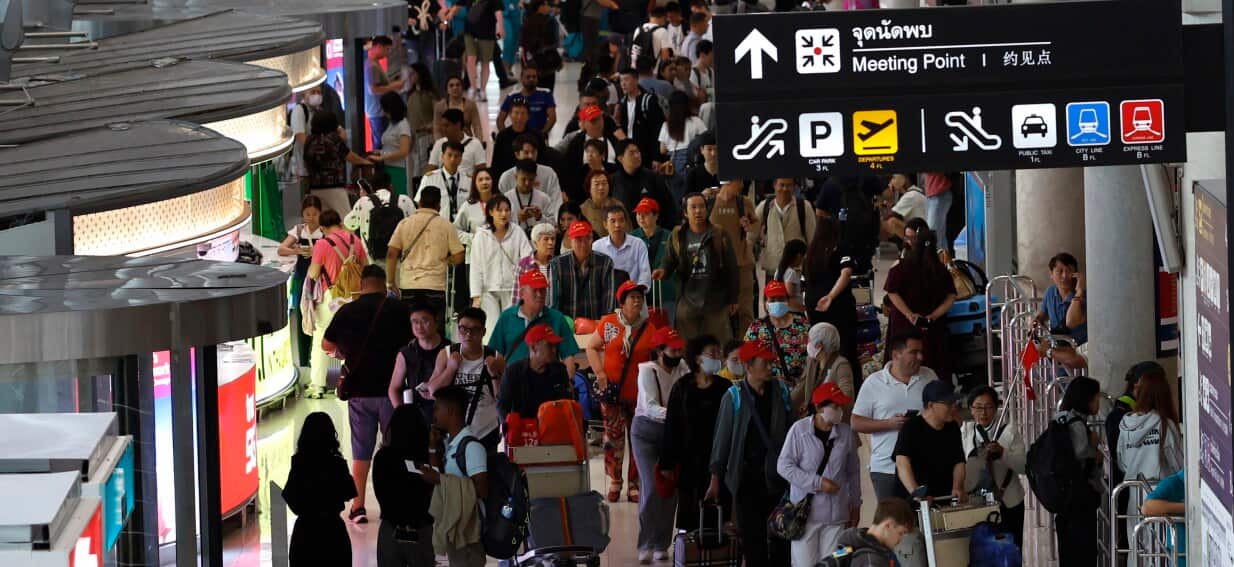
The coffee in Terminal B was lukewarm, but it was the only thing keeping Sarah awake. She sat on her carry-on suitcase, her back pressed against a concrete pillar, watching the departure board turn into a wall of bleeding red text. Delayed. Delayed. Cancelled. Around her, the collective hum of thousands of stranded travelers morphed from ambient irritation into a heavy, suffocating despair.
Business travelers paced like caged animals into their Bluetooth headsets. Parents bartered with toddlers using the last crushed goldfish crackers in their bags. You might also find this related story useful: The Microeconomics of Resort Sunbed Wars Capital Misallocation and Behavioral Friction in Zero-Sum Hospitality Environments.
Everyone was trapped in Queens.
The cause of this massive, multi-state logistical paralysis was not a blizzard. It was not a cyberattack, a union strike, or a technical glitch in the air traffic control towers. It was a hole. Specifically, a sinkhole on Runway 22 at LaGuardia Airport. As discussed in recent articles by The Points Guy, the implications are widespread.
We tend to think of modern aviation as a triumph of the ethereal. We talk about cloud computing, satellite navigation, and thrust-to-weight ratios. We view flight as an escape from the earth. But aviation is entirely captive to the dirt beneath it. When a tiny patch of asphalt gives way, the illusion of seamless global connectivity shatters.
The Physics of a Sudden Halt
Runway 22 is a workhorse. On a normal afternoon, asphalt bears the brutal, repetitive trauma of commercial jets slamming their sixty-ton frames onto the ground at 140 miles per hour. The friction generates scorching heat. The weight exerts thousands of pounds of pressure per square inch.
Beneath that asphalt lies a complex infrastructure of sub-base, drainage pipes, and soil. If water infiltrates the lower layers—often from a leaking pipe or heavy rains—it quietly hollows out the foundation. The surface looks perfectly fine. It looks solid.
Then, a localized collapse occurs.
To the untrained eye, the resulting crater might look like a standard pothole you would swerve to avoid on the Brooklyn-Queens Expressway. But on an airport runway, a six-inch depression is an existential threat. If a nose wheel hits that void during a high-speed takeoff roll, the landing gear can collapse. Fuel tanks can rupture. The entire aircraft can veer off the tarmac.
The moment ground crew spotted the structural failure on Runway 22, the machinery of the American travel network ground to an immediate halt.
The Federal Aviation Administration issued a ground stop. In the world of air travel, those words carry the weight of an executioner's axe. Planes bound for New York were held at their gates in Chicago, Atlanta, and Miami. Aircraft already aloft were forced into holding patterns, circling endlessly over the Atlantic and the Hudson Valley, burning precious fuel while dispatchers scrambled to find alternative tarmac in Newark or JFK.
The Human Ripple Effect
Consider the invisible stakes of a delayed flight.
A few gates down from Sarah sat a man named David, though that name is a placeholder for the thousands of stories playing out simultaneously across the terminal. David wasn't traveling for business. He wasn't going on vacation. He was trying to reach a hospital in Ohio before his father was taken off life support.
As the hours ticked away, David watched his chances evaporate. He didn't care about FAA regulations, runway maintenance schedules, or asphalt curing times. He cared about time. The most brutal aspect of a major airport disruption is that it robs people of moments they can never buy back.
The airline gate agents bore the brunt of this collective agony. They stood behind their desks, typing furiously, facing a wall of desperate, angry faces. They didn't dig the hole. They couldn't patch it. Yet, they were the human faces assigned to absorb the friction of a broken system.
By mid-afternoon, the delays stretched past three hours. The ripple effect traveled along the eastern seaboard. Because commercial aviation relies on a tight, interlocking schedule, a plane stuck on the tarmac at LaGuardia meant a missing plane for a evening flight in Boston, which meant a crew time-out in Washington, D.C.
The system is highly optimized, which means it is incredibly fragile. We have eliminated redundancy in the name of efficiency, creating a reality where a patch of bad dirt in New York causes a family to miss a cruise departure in Fort Lauderdale.
The Art of the Emergency Patch
While the terminal boiled with frustration, a different kind of drama unfolded on the tarmac.
Fixing a runway sinkhole isn't like fixing a residential street. You cannot simply dump cold patch asphalt into the hole, roll over it with a truck, and call it a day. The repair requires precision engineering under immense time pressure.
Engineering crews had to excavate the site immediately, digging out the compromised sub-grade material to find the source of the void. They had to fill the cavity with fast-setting concrete or specialized hot-mix asphalt capable of withstanding extreme loads almost instantly. Every minute the runway remained closed cost the aviation industry millions of dollars. More importantly, it pushed the surrounding airspace closer to total gridlock.
The workers labored under the gaze of control towers and parked pilots, operating heavy machinery on a strip of land that is usually the exclusive domain of roaring jet engines. They fought against the clock, knowing that the structural integrity of their work would be tested within minutes of completion by a massive metal cylinder filled with human lives.
The Vulnerability of Our Gateways
LaGuardia has long been the target of jokes. It was famously compared to a "third-world country" by politicians, a critique that sparked a massive, multi-billion-dollar redevelopment project. The brand-new terminals are stunning. They feature soaring ceilings, high-end restaurants, and local art installations.
But this incident exposed a deeper, uncomfortable truth about our infrastructure. You can build a palace of glass and steel for passengers to wait in, but the entire apparatus still relies on the dirt and asphalt outside. The invisible, unsexy components of transit—the drainage systems, the foundational soil, the runway underlayment—matter infinitely more than the quality of the terminal's artisanal coffee shops.
We live in an era obsessed with digital transformation. We talk about AI-driven scheduling, biometrics, and contactless boarding. Yet, we remain stubbornly physical creatures. We still need smooth, unbroken stretches of earth to launch ourselves into the sky.
As night fell over New York, the red text on the departure boards slowly began to revert to green. The crews completed the patch. The inspectors gave their approval. The ground stop lifted.
The roaring engines spun back to life. A line of planes, miles long, began the slow, agonizing crawl toward Runway 22. One by one, they accelerated over the newly repaired ground, their wheels leaving the earth at the exact spot where the void had been.
Sarah finally boarded her flight, her body aching from hours on the terminal floor. David managed to get rerouted through Detroit, embarking on a desperate midnight drive to reach his family. The crisis passed, recorded only as a spike in the daily statistics of flight delays and an angry blip on social media feeds.
The city moved on, completely oblivious to how easily its connection to the rest of the world could be severed by a few inches of missing dirt.