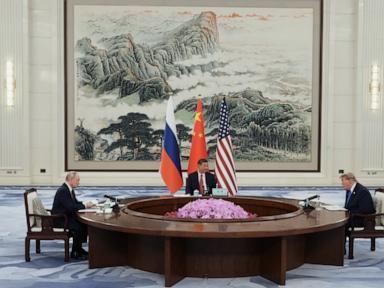
Shenzhen does not look like a place where history pauses to catch its breath. It hums with glass towers, electric buses, and the quiet confidence of a city built from fishing villages into a tech powerhouse in a single human lifetime. Yet on November 19, 2026, behind the manicured grounds of Kylin Villa on the sidelines of the Asia-Pacific Economic Cooperation summit, three men sat down together for the first time as heads of state of the United States, China, and Russia.
Donald Trump. Xi Jinping. Vladimir Putin.
Ninety minutes. That was all the clock gave them.
Most news reports will tell you what happened in those ninety minutes as if it were a ledger entry. A four-point joint declaration. Talk of reforming the United Nations. Promises to boost refined petroleum output. Sharp words aimed at international court jurisdiction over state officials. A pledge to talk about reducing nuclear risks. Thin on binding commitments, heavy on symbolism, leaving unresolved wars and fragile trade truces hanging in the humid southern air.
Ledgers are neat. Human lives are not.
When three leaders holding immense military, economic, and energy weight share a room, the real story is never just the communiqué printed afterward. The real story is the quiet tremor felt thousands of miles away by people who never received an invitation to Shenzhen.
Consider a hypothetical scenario to picture what that distance feels like. Imagine an engineer in Warsaw staring at a map of eastern borders while scrolling through translated excerpts of a bilateral talk between Washington and Moscow. Imagine a small-business owner in Osaka or Seoul watching currency screens flicker as signals emerge from southern China about how predictable American security commitments really are. Imagine a refinery worker in Texas or a family in Kyiv listening to every word about energy flows and territorial security, knowing that high-level diplomacy often treats distant towns as bargaining chips rather than homes. This scenario is hypothetical, built to trace how abstract diplomacy lands on real shoulders, yet it mirrors the very real anxieties analysts and diplomats have wrestled with since the Shenzhen gathering.
I have spent years watching summits up close and from afar, sitting in press pens where officials speak in polished riddles while ordinary people outside wait to see if their rent, their safety, or their children's futures just grew heavier. You learn quickly that cameras love handshakes, while history remembers what was left unsaid.
Why Three Voices in One Room Changes the Air
For decades, global power politics has felt like a crowded room where everyone shouts across tables, alliances harden into rival camps, and major powers speak to one another mostly through intermediaries, sanctions, tariffs, and warnings. When Trump, Xi, and Putin gathered at Kylin Villa, the novelty itself altered the room's gravity.
Trump framed the moment in plain, transactional language about showing up rather than walking away, declaring that the three leaders were making history and arguing that no peace comes from refusing to speak. Earlier that day, he had met bilaterally with Putin with Ukraine at the center of the conversation, and he also spoke warmly to Xi about keeping their relationship on an even keel.
Xi stood as host on home ground, projecting calm authority and calling for mutual respect, peaceful coexistence, and dialogue over confrontation. Hosting a trilateral meeting in Shenzhen allowed Beijing to look like a central convener of global affairs, sitting alongside a closer partner in Moscow while engaging Washington directly after months of trade friction and export-control clashes.
Putin arrived leaning on historical memory and sovereignty themes, pointing back to World War II ties among the three powers and pressing language around state consent, official immunities, and skepticism toward international legal bodies like the International Criminal Court.
Let us use a metaphor here, explicitly as a metaphor. Think of international order not as a rigid iron cage, nor as a fragile glass vase, but as a suspension bridge swaying over a wide canyon. Every cable is tensioned by rival interests, domestic politics, and old grievances. A summit like Shenzhen does not rebuild the bridge overnight, especially when major flashpoints—including the war in Ukraine, tensions around Iran, and a looming January 2027 deadline on the U.S.-China trade truce—remain stubbornly unresolved. Still, stepping onto the same span together changes how the cables vibrate.
Some observers called the declaration thin. That criticism has weight. A short statement promising to study or pursue dialogue on nuclear risk reduction is not a binding arms-control treaty, especially when China's nuclear arsenal has been expanding while Beijing has long resisted being folded into formal bilateral arms-control frameworks built for Washington and Moscow. Calling for more refined petroleum production sounds reassuring at a gas pump, yet global energy markets respond to supply chains, shipping lanes, and sanctions far more than diplomatic phrasing.
Still, dismissing symbolism altogether is a mistake I have seen seasoned commentators make too often. Symbolism is often the first draft of leverage.
What the Communiqué Left in the Shadows
Read the four points of the Shenzhen declaration side by side, and you can almost hear three different priorities negotiating for space.
First came reforming the United Nations so it can respond more effectively to global crises. Every major power complains about multilateral gridlock when convenient, yet each guards its own veto and influence fiercely. Agreeing on the word "reform" is easy; agreeing on what changes is where friction begins.
Second came boosting refined petroleum production and supply. Energy is lifeblood. To a factory owner in Guangdong, a truck driver in Ohio, or a household heating a flat through winter, fuel prices are not an abstract statistic. They are the daily tax of living in a connected economy.
Third came state consent, immunities for state officials, and pushing back against perceived overreach by international courts. Here the subtext is unmistakable. Powerful states frequently bristle when international legal mechanisms claim authority over sovereign actions or leaders, framing their resistance around sovereignty and non-interference.
Fourth came nuclear risk reduction and non-proliferation dialogue. Even modest talk of reducing nuclear risks matters when global flashpoints multiply. Nobody sane wants miscalculation with atomic weapons. Yet words about dialogue do not erase mutual distrust.
Notice what did not land in the joint text. No breakthrough ending the war in Ukraine. No clear settlement on broader regional conflicts such as Iran. No permanent fix to the economic rivalries that have tested supply chains and technology controls.
That omission hurts. Honestly, it is confusing and unsettling to watch three of the world's heaviest hitters shake hands over broad principles while wars grind on and trade deadlines tick closer. If you feel a flicker of skepticism—or even fatigue—when reading grand diplomatic headlines, you are not alone. I feel that skepticism too. Grandeur at the summit table often coexists with grit and grief far away.
The Invisible Stakes for Allies and Neighbors
When big powers talk directly to one another, smaller or mid-sized nations often lean forward in their chairs.
For Washington's partners across Europe and the Indo-Pacific, a trilateral moment in China raises quiet questions about predictability. Will great-power accommodation sideline regional allies? Will security guarantees feel firmer or more conditional after meetings in Shenzhen and ahead of future gatherings like the G20 in Miami? Analysts have pointed out that Beijing has every reason to want Asian neighbors to wonder how steady Washington's posture toward China will be after midterm politics and high-level summits.
Imagine—again, as a hypothetical character study to ground the human stakes—a mid-level diplomat in Tokyo or Seoul drafting a briefing note at midnight. Every phrase about "peaceful coexistence" and "major-country interactions" carries weight when your country sits near contested waters and depends on both trade and deterrence. That diplomat is not looking for theatrical speeches. They are looking for whether the ground beneath their country's security is shifting an inch to the left or right.
At the same time, the meeting revealed asymmetries inside the trio itself. Putin came to Shenzhen needing visibility and room to maneuver amid prolonged war and diplomatic pressure over Ukraine. Xi sat at the center as host, holding substantial economic weight over Moscow while testing where Washington's pressure and accommodation meet. Trump operated with a leader's instinct for personal rapport and deal-making, betting that direct contact with both Xi and Putin creates openings that cold distance never yields.
One room. Three calculations. Zero illusions that ninety minutes could erase decades of rivalry.
Power, Memory, and the Trap of Inevitability
History has a habit of tempting people into fatalism. We hear phrases about inevitable clashes between rising and ruling powers, or permanent blocs locked in zero-sum combat. Xi himself pushed back against the idea that rival powers are fated to collide, arguing that conflict is a choice rather than destiny.
Whether you agree with his framing or read it through the lens of statecraft, the underlying point deserves a hard look. Fatalism is lazy. It convinces people that diplomacy is pointless and escalation is already written in stone.
Yet optimism without accountability is just as dangerous. A polite summit statement does not feed displaced families, rebuild shattered infrastructure, or resolve disputes over sovereignty and security guarantees. Real stability requires follow-through—hard, unglamorous work on trade terms before deadlines expire, serious guardrails on nuclear risks, and credible steps toward ending bloodshed rather than merely managing headlines.
Think of it like tending a wildfire watchtower. Spotting smoke and agreeing to keep watch is useful. Putting out the embers takes water, wind shifts, and discipline.
That is why the Shenzhen summit matters as a signal rather than a settlement. It showed that even amid deep strategic competition, the leaders of the United States, China, and Russia are willing to sit at the same table—and that each believes doing so serves its own hand.
What Stays With You After the Cameras Leave
Motorcades clear out. Press pools file their dispatches. The manicured lawns of Kylin Villa return to quiet.
What remains is a sharper view of the world we actually live in—not a tidy textbook diagram of alliances, but a messy, high-stakes negotiation among powerful states whose choices ripple into every port, market, and household on earth.
Watch the calendar after Shenzhen: upcoming multilateral gatherings like the G20 in Miami, the countdown toward the January 10, 2027 trade truce expiration, and ongoing diplomatic efforts over conflicts that refuse to fade. Those dates will test whether ninety minutes of shared spotlight becomes a stepping stone or just another photograph in a turbulent decade.
Listen.
Behind every diplomatic communiqué stands a human question that no protocol officer can write away: when the most powerful men in the world meet behind closed doors, who speaks for the people whose lives hang in the balance?