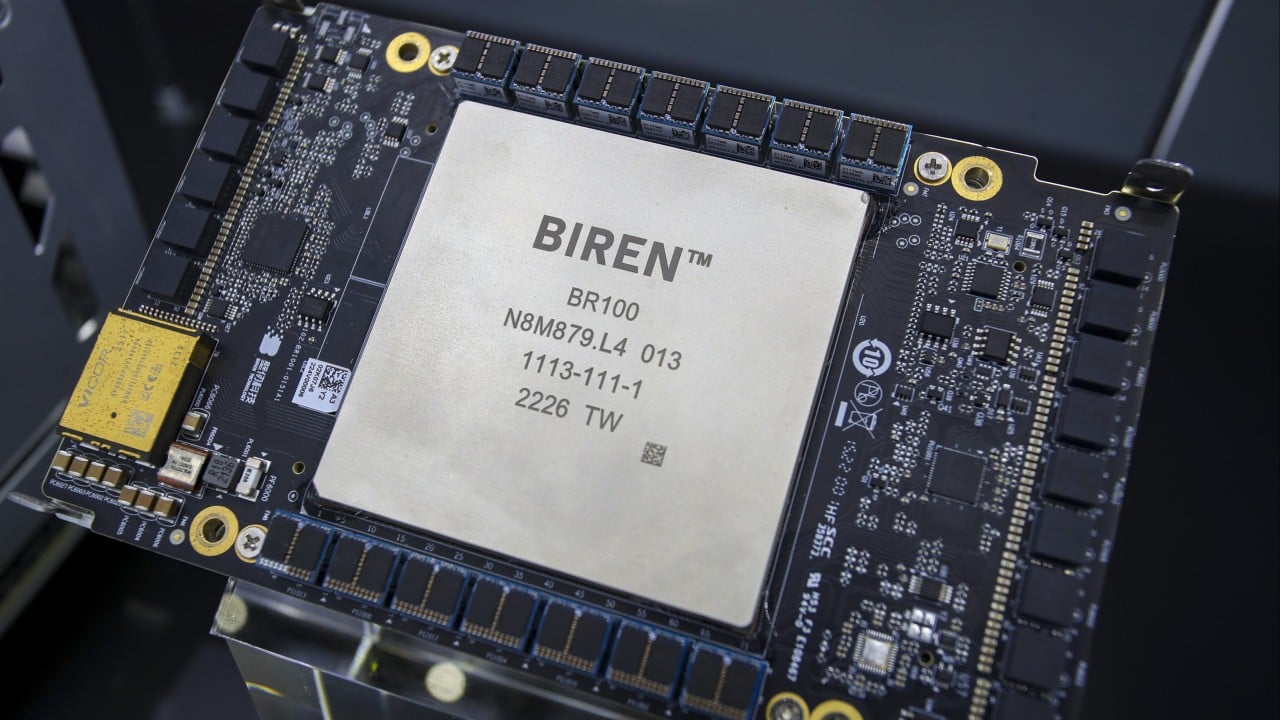
The air inside the assembly cleanroom smells faintly of ozone and heated plastic. It is a sterile, quiet place, far removed from the neon pulse of Shanghai or the sprawling concrete arteries of Shenzhen. Here, technicians move with the slow, deliberate grace of surgeons, their bodies sealed inside white bunny suits, their eyes the only visible part of their humanity. They are watching a monitor display a dance of microscopic currents.
Outside these walls, an invisible war is being fought. It is not waged with bullets or blockades, but with etched silicon and logic gates.
For years, the narrative of global technology has been written in a few familiar dialects. We heard about clusters of design houses in California and foundries casting marvels on distant islands. But history has a way of turning the page when the ink runs dry. When geopolitical pressure tightened like a tourniquet around the flow of advanced microprocessors into mainland China, the immediate expectation was a freeze. Stagnation. A digital dark age.
Instead, something entirely different happened. Pressure created momentum.
Consider the trajectory of Biren Technology. Founded only a few years ago by industry veterans who had spent decades watching others build the engines of the digital age, the company set out to design general-purpose graphics processing units. These are not mere chips; they are the heavy lifters of modern computation. They train neural networks, render complex simulations, and crunch the mountains of data required to make artificial intelligence feel less like a tool and more like an intellect.
When international supply chains slammed shut, Biren did not fold. They accelerated. Recent internal projections point toward an astonishing twenty-two-fold revenue surge, a meteoric leap fueled by a domestic market starved for high-end computing power and desperate to secure its own technological destiny.
To understand why this matters, you have to step away from the corporate balance sheets and look at the engineer sitting at a desk at three in the morning, nursing a cold cup of tea, staring at a compiler error that has resisted solution for six hours.
Imagine a hypothetical lead architect named Chen. Chen spent fifteen years working on architectures that powered global servers, believing deeply in a borderless world of open technological exchange. When those borders hardened into steel walls, Chen’s world shrank to the dimensions of a single workstation. The stakes changed overnight. It was no longer about optimizing a benchmark score by a fraction of a percent. It was about whether the domestic server farms powering hospital diagnostics, financial clearinghouses, and weather prediction models would go dark in five years.
Chen’s story is multiplied by thousands across the tech hubs of Beijing and Hangzhou.
The Chinese high-tech boom is driven by a profound, existential urgency. When you are told you cannot have the tools to build your future, you are forced to forge them yourself. This is the engine behind the massive capital injection and state-backed momentum lifting domestic semiconductor firms. Billions of yuan are pouring into research and development, not as speculative venture capital chasing the latest internet fad, but as sovereign survival insurance.
Yet, building an advanced AI chip is one of the hardest things humanity has ever attempted. It is a symphony of quantum physics, material science, and ultra-precise manufacturing. A modern processor is composed of billions of transistors packed onto a piece of silicon no larger than a postage stamp. To etch pathways smaller than a wavelength of light requires lithography machines so complex they seem like artifacts from an advanced civilization.
This is where the reality check meets the ambition. While revenue projections soar and local demand is virtually bottomless, the physical supply chain remains a labyrinth. Design is only half the battle. Fabrication requires access to advanced nodes, specialized chemical gases, and extreme ultraviolet equipment that remains heavily restricted. Domestic foundries are closing the gap with astonishing speed, but the climb is steep and unforgiving. Every micron of progress is bought with sweat, trial, error, and immense financial backing.
When Biren projects a massive commercial expansion, it represents a gamble on self-reliance. It is a statement that the world's second-largest economy refuses to be locked out of the cognitive era.
We have seen this script before. History is littered with nations forced into autarky by circumstance, turning inward to build indigenous industrial bases. Sometimes it breeds stagnation behind bureaucratic walls. Other times, it creates lean, fiercely competitive giants that eventually challenge incumbents on the global stage.
The transformation happening right now in domestic processor design suggests the latter. The sheer volume of engineering talent graduating from top-tier universities, combined with a captive, hungry market of enterprises eager to adopt artificial intelligence, creates a pressurized incubator. When you combine unlimited demand with an urgent mandate to innovate, capital stops being a luxury and becomes gravity.
Walk down the corridors of any major tech park in Shenzhen today, and you can feel the current in the air. It is the hum of server racks running day and night, the urgent chatter of code sprints, the quiet confidence of teams who know they are writing a new chapter in industrial history. They are not waiting for permission from Silicon Valley. They are building their own horizon, one etched wafer at a time.
The silicon rush is real. The stakes are absolute. And the glow from the cleanroom monitor illuminates a path from which there is no turning back.