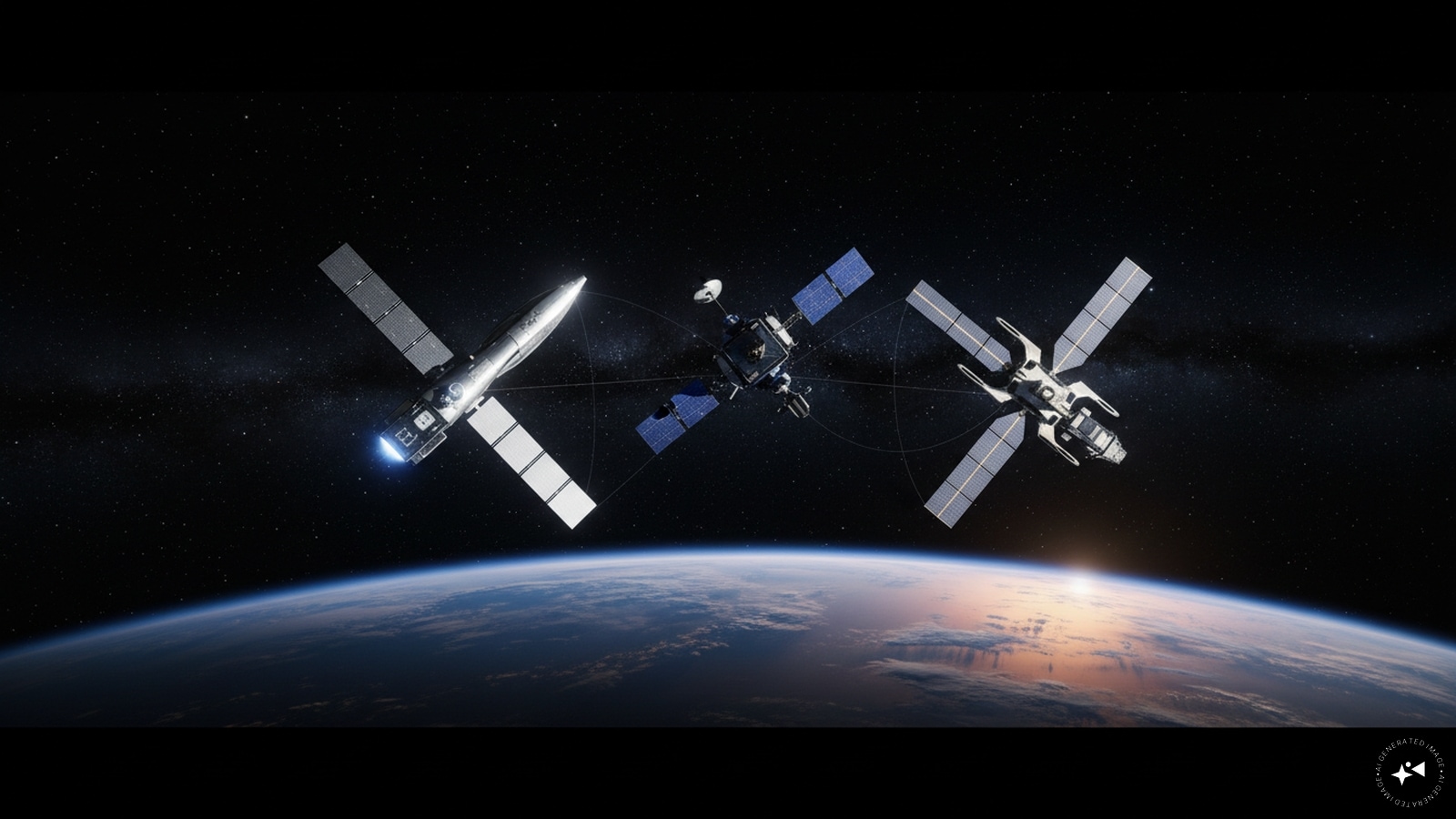
Look up on a clear, moonless night far from the city lights. Millions of stars blur into a quiet river of silver. Most people see timeless wonder in that black expanse. Today, that view carries something new.
For decades, the boundary between Earth and the blackness of space was defined by treaties, scientific cooperation, and a fragile understanding that the cosmos belonged to everyone and no one. That boundary just shifted. Governments have crossed an invisible line. The quiet realm of scientific satellites and weather trackers now shares an orbit with systems built for a very different purpose.
Space is no longer empty. It is guarded.
The Quiet Shift in the Heavens
To understand how we arrived here, we have to look back at how the atmosphere became crowded. For generations, rockets were rare, expensive events. Launching a payload required the combined might of national space agencies and billions of dollars.
Then came the shift. Reusable rockets dropped the cost of entry. Low Earth orbit began to fill with thousands of blinking lights, commercial constellations beaming internet signals down to remote valleys, and high-resolution cameras watching every square mile of the planet below.
In this crowded traffic, anonymity vanished. Every nation with a telescope could see what every other nation was launching. If a satellite changed its altitude, ground stations tracked it. If an object maneuvered too close to another, algorithms sounded alarms in control rooms from Colorado to Beijing.
Military planners watched this transparency unfold with growing unease. In a conflict on Earth, an adversary can hide behind mountains, camouflage tanks in forests, or submerge submarines in the deep ocean. In orbit, physics strips away cover. Satellites move on predictable paths dictated by gravity. They are bright targets against a dark background, completely exposed to anyone looking up with an optical sensor or radar.
That exposure created a dangerous vulnerability. If your entire command and control network, your navigation systems, and your early-warning missile sensors rely on a fleet of vulnerable spacecraft overhead, what happens when a rival decides to blind you?
The First Step Across the Line
Governments do not typically announce changes in military posture with fanfare. They do it in quiet administrative updates, in budget line items tucked deep inside defense appropriations bills, and in carefully worded acknowledgments that slip past the evening news.
The recent confirmation that a space weapon has been deployed in orbit represents a fundamental pivot. It moves orbital defense from theoretical tabletop exercises into active deployment.
Imagine an ordinary control room late at night. The fluorescent lights hum a low, sterile tone. Technicians stare at banks of monitors tracking orbital debris and active constellations. On one screen, a flashing telemetry alert shows an anomaly. A spacecraft—one designed not just to observe, but to manipulate, disable, or intercept—has altered its vector. It is no longer just drifting along its calculated Keplerian path. It is station-keeping near a high-value asset belonging to another superpower.
This is not science fiction. It is the new geometry of deterrence.
When nations deploy offensive or defensive capabilities into orbit, the calculus of war changes instantly. On Earth, a missile strike has a clear origin, a traceable flight path, and a distinct impact zone. In space, attribution is notoriously difficult. If a critical reconnaissance satellite suddenly stops functioning, was it a solar flare? A malfunction in ancient onboard computer systems? Or did a silent, maneuvering spacecraft drift close enough to disable its sensors with a directed energy pulse or a robotic arm?
Uncertainty is the enemy of stability. When leaders cannot immediately verify who caused a system failure, miscalculation becomes dangerously easy.
The Human Cost of Orbital Tensions
We tend to treat space as an abstract realm, far removed from daily life. We talk about megahertz, orbital inclinations, and delta-v as if they exist in a vacuum devoid of human consequence.
They do not.
Every financial transaction you make, every weather forecast that warns farmers of an oncoming frost, every commercial flight crossing an ocean, and every emergency response coordination effort relies entirely on invisible hardware circling hundreds of miles above our heads.
If orbital escalation leads to active conflict, the consequences will not be confined to the void. A chain reaction of destroyed satellites could trigger a catastrophic cascade of high-speed debris known as the Kessler syndrome. Thousands of shrapnel fragments, each moving at seventeen thousand miles per hour, would rip through operational spacecraft in a self-sustaining cycle of destruction.
In an instant, the digital nervous system of modern civilization could go dark. GPS would fail. Global communications would shatter. Financial markets would freeze as time synchronization across international servers collapsed.
The people building these systems know this. The engineers working in cleanrooms are acutely aware that the hardware they assemble with microscopic precision could one day become a target. They feel the weight of a paradox: they are building technologies to secure peace through strength, knowing that the very presence of these weapons increases the fragility of the skies.
Navigating the Dark
We are standing at a historic crossroads. The treaties drafted during the Cold War—most notably the Outer Space Treaty of 1967, which banned weapons of mass destruction in orbit—were written for an era when the primary actors were two superpowers operating a handful of primitive capsules.
Today, dozens of nations and powerful private corporations share the orbital commons. The rules of the road are outdated, vague, and largely unenforced.
When an acknowledgement like this surfaces, it should not be read merely as a military update. It is a warning flare. It tells us that the geopolitical rivalries defining life on the surface have officially broken containment, spilling out into the quiet dark that envelops our world.
The next chapter of human history will not be decided solely by what happens on the continents and oceans we call home. It will be shaped in the silent corridors above us, where machines built by human hands watch one another in the dark, waiting to see who blinks first.
Look up tonight. The stars are still there, shining with ancient light. But between them, moving fast and silent, are the new sentinels of our fragile age.


