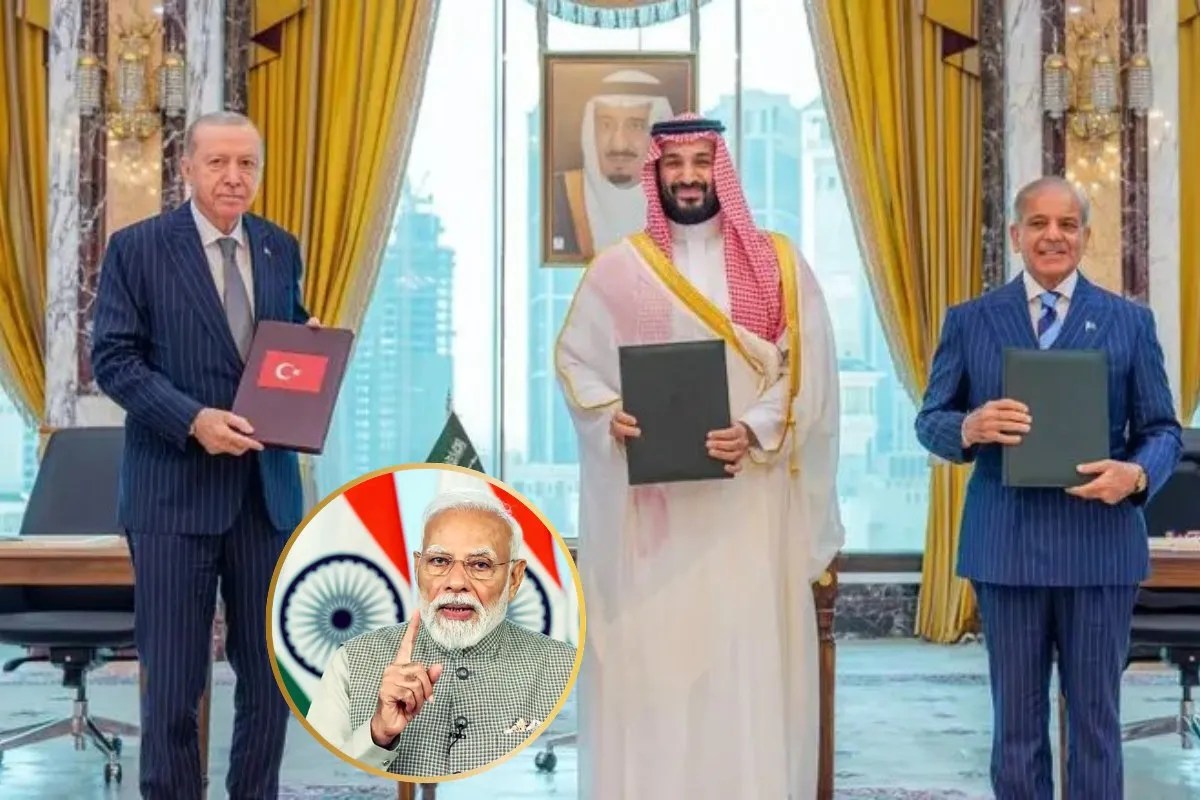
Geopolitics rarely smells like gunpowder. Most days, it smells like lukewarm cardamom tea in a wood-paneled conference room, or the quiet rustle of heavy cardstock agreements being slid across a mahogany table.
New Delhi, Tuesday morning. The air outside carries the sharp bite of approaching winter, but inside the Ministry of External Affairs, the climate is measured, cool, and hyper-vigilant. Officials are staring at a new diplomatic contour forming far to the west. A conversation has sparked between Saudi Arabia, Pakistan, and Turkey regarding Mecca—a convergence that sounds abstract to an office worker in Mumbai or a farmer in Punjab, but carries tremors felt deep within the corridors of South Block. You might also find this related coverage interesting: Inside the Pakistan-administered Kashmir Crisis and the Unyielding Demand for Accountability.
India has spoken. The response was not loud. It never is when caution dictates strategy. New Delhi announced it is keeping a sharp eye on these developments.
Why? Because history taught us to watch the shadows. As discussed in detailed articles by The Guardian, the effects are worth noting.
The Architecture of Whispers
Consider what happens when nations that rarely dance begin stepping to the same rhythm.
Saudi Arabia holds the spiritual axis of the Islamic world. Turkey looks back toward the sprawling administrative memory of the Ottoman Caliphate, its leadership eager to project influence far beyond the Bosporus. Pakistan, wrestling with domestic fractures and economic fragility, constantly searches for external validation and diplomatic heft. When these three intersect over a symbol as potent as Mecca, the implications ripple outward in concentric circles.
Imagine a veteran diplomat sitting by a rain-streaked window in Delhi. Let us call him Mishra. Mishra has spent forty years watching alliances form and fracture like seafoam. He does not panic when he reads foreign communiqués. He looks for the omissions. He looks for what is left unsaid in the joint press conferences.
"An agreement involving Mecca is never just about brick, mortar, or administration," Mishra might murmur, swirling the dregs of his tea. "It touches the emotional nerve center of billions. When new axes of influence touch that nerve, every major capital has to calculate the weight of the pressure."
India houses the world's second-largest Muslim population. Our domestic fabric is vast, pluralistic, and deeply intertwined with the cultural currents of West Asia. Every diplomatic tremor in that region sends microscopic shifts through our own neighborhoods, schools, and marketplaces.
The Weight of a Watchful Eye
Diplomacy is often less about what you stop and more about what you anticipate.
When India's official spokesperson states that New Delhi is maintaining a close watch on the Mecca pact developments, it translates to a very specific operational reality. Intelligence desks are humming. External affairs analysts are cross-referencing past treaties, economic dependencies, and military cooperation vectors between Ankara, Islamabad, and Riyadh.
It is easy to dismiss this as routine bureaucratic paranoia. After all, nations talk to nations every day. Treaties are signed. Ink dries. Photos are taken under bright chandeliers.
Yet, trust is a scarce currency in international relations.
Think back to the shifting alliances of the mid-twentieth century. Small understandings hatched in backrooms eventually redrew maps, rerouted trade corridors, and altered the security calculus of entire subcontinents. Turkey’s growing footprint in defense manufacturing and its assertive foreign policy posture have not gone unnoticed in global capitals. Pakistan’s historical reliance on Riyadh for financial cushioning is well-documented. Add a trilateral framework to the mix, and the geometry changes.
India’s foreign policy today is defined by strategic autonomy. We buy oil from Russia, technology from the United States, engage in economic partnerships across Europe, and maintain vital diaspora ties throughout the Gulf. But autonomy requires alertness. You cannot dance with everyone if you are not watching where their feet land.
The Invisible Stakes
To understand why a diplomatic note from New Delhi matters, you have to look beyond the headlines and into the human pulse of the region.
Millions of Indian citizens live and work across the Gulf. Their remittances build homes in Kerala, fund education in Uttar Pradesh, and fuel the economic engine of small towns across the nation. Their safety, their dignity, and their operational freedom depend on stable, predictable relations between India and the Gulf monarchies.
If a new diplomatic bloc begins to institutionalize priorities that marginalize Indian interests or create friction in multilateral forums—such as the Organisation of Islamic Cooperation—New Delhi cannot afford to be caught flat-footed.
A sharp eye is not an act of hostility. It is an act of preservation.
Consider the ordinary citizen sipping tea in a roadside stall in Lucknow, reading a smartphone alert about the new trilateral agreement. They will likely scroll past it, chasing news of cricket scores or local elections. They do not need to memorize the text of the pact. That is what institutions are for. That is why professional diplomats spend sleepless nights parsing syntax, translating nuances from Arabic and Turkish, and advising political leadership on when to speak and when to remain silent.
The Road Ahead
The world is accelerating. Alliances are becoming transactional, fluid, and fiercely competitive.
The trilateral conversation surrounding Mecca is just one symptom of a shifting global order where old structures are fraying and new coalitions are desperate for legitimacy. Turkey wants its historical weight back. Pakistan wants strategic breathing room. Saudi Arabia wants to diversify its partnerships in a multipolar century.
India’s response is a masterclass in calculated stillness. Not every statement requires a counter-statement. Not every maneuver requires a military deployment. Sometimes, the most powerful signal a nation can send is simply letting the world know: We see you. We understand the game. And we are prepared.
The tea grows cold on the desk in South Block. The rain continues to tap against the glass. Somewhere in Ankara, a pen touches paper. Somewhere in Islamabad, a cheer goes up. And somewhere in New Delhi, an analyst makes a quiet note in a margin, turning the page toward tomorrow.