The Smell of Warm Oil and Uncertainty
The air inside the plant always carried a specific weight. It smelled of cutting fluid, hot steel, and the distinct, ozone bite of welding arcs. For decades, this factory floor in the West Midlands had a pulse. You could measure time by the steady, metronomic cadence of the stamping presses—a deep, chest-vibrating thump that rattled the coffee cups on the foremen's desks.
Arthur knew that rhythm in his bones. He had walked these concrete aisles for thirty-two years, starting as an apprentice with grease permanently etched into his fingernails, working his way up to a senior line supervisor. He had seen models come and go. He had survived recessions, supply chain shocks, and the endless anxiety of shifting global markets.
Right now, though, the silence was heavier than the noise used to be.
The presses were still running, but the output felt ghostlike. On the other side of the partition wall, the new section sat bathed in an eerie, fluorescent quiet. Millions of pounds of fresh concrete and robotics had been poured into that expansion, designed specifically to pivot the plant toward a purely electric future. It was supposed to be the horizon. It was supposed to guarantee Arthur’s grandson a job in the same building that kept food on the table for three generations.
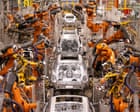
Instead, the lights in the new wing were dimmed. The robots stood frozen mid-gesture, their mechanical arms like the limbs of dormant spiders.
Automakers are hitting the brakes. Across Britain, boardrooms are quietly freezing capital expenditure, holding back the billions needed to retool factories for electric vehicles. The reason is not a sudden lack of faith in batteries or electric motors. The hesitation comes from a rigid, ticking clock: the Zero Emission Vehicle mandate. Under current rules, manufacturers must hit escalating annual percentages of electric car sales, or face steep financial penalties.
And the market is simply not moving at the speed the legislation demands.
Consider David, a fictional plant manager dealing with the real math of this crisis. David does not care about political speech or lofty climate targets during his 6:00 AM production meetings. He cares about ledger lines. He looks at showrooms where traditional buyers are hesitating, choked by high interest rates, patchy public charging infrastructure, and the lingering shock of living costs. He looks at the penalty thresholds set by the mandate.
If he forces his factories to churn out electric vehicles that sit on dealership lots gathering dust, the losses will cascade through the entire supply chain. Small component makers in Coventry and Sunderland, the guys stamping out bracket bolts and wiring harnesses, will fold.
So, the spreadsheets stay red. The investments are delayed. The boardrooms hold their breath.
The Arithmetic of Ambition
To understand why British assembly lines are stalling, you have to look past the political posturing and stare at the ledger.
Building a car is not like updating software. You cannot simply patch an assembly line overnight. A modern automotive plant requires a massive, multi-year outlay of capital. Millions go into re-engineering paint shops to handle different weights, retraining line workers to handle high-voltage battery packs safely, and restructuring entire logistics webs that span continents.
When a carmaker announces a delay in UK factory investment, they are not rebelling against a cleaner future. They are reacting to a fundamental mismatch between regulatory acceleration and consumer reality.
Imagine steering a massive cargo ship down a narrow channel. The captain knows the destination is straight ahead. The engine room is ready to push full throttle. But suddenly, the harbor master shifts the channel markers three miles to the left, demanding an impossible turn. If the captain yanks the wheel too hard, the ship runs aground.
That is what automotive executives feel right now. The UK government set ambitious targets to phase out new petrol and diesel cars. On paper, the trajectory looks clean and linear. In the messy reality of the showroom floor, consumer adoption curves are bumpy, hesitant, and stubbornly resistant to government fiat.
When showroom traffic for electric models slows down because charging a vehicle on a Victorian terraced street remains a logistical nightmare for ordinary families, the downstream effects are immediate. Dealerships get overstocked. Discounts deepen. Profit margins evaporate.
And when margins vanish, capital expenditure is the first casualty.
The penalty structure of the mandate acts like a tripwire. If a manufacturer sells too many petrol cars relative to their electric quota, the fines run into hundreds of millions of pounds. For global corporations with choices, capital is liquid. It flows to whichever region offers the most stable, predictable path forward. If British rules impose penalties that outstrip what the domestic market can organically absorb, those billions of pounds of investment quietly slip away across the English Channel to plants in mainland Europe or North America, where regulatory pressure might be balanced with more aggressive demand-side incentives.
Arthur does not know the macroeconomic jargon for capital flight. He just knows that the expansion bay next to his line has been dark for three weeks.
The Human Cost of Hesitation
Behind every delayed balance sheet is a human friction that spreadsheets cannot capture.
When investment freezes, uncertainty bleeds into the daily lives of thousands of workers. It is the quiet conversation in the breakroom over lukewarm tea. It is the apprentice who wonders if he should finish his qualifications or switch to a trade in plumbing. It is the logistics coordinator who spends her evenings refreshing industry news feeds, looking for signs that the multi-billion-pound retooling contract for the next-generation platform has been given the green light or scrapped entirely.
The UK automotive sector is not just an industry; it is an ecosystem of deeply intertwined dependencies. A single vehicle relies on roughly thirty thousand components, sourced from hundreds of tier-one and tier-two suppliers.
When a major manufacturer presses pause on a factory transformation, the shockwave ripples outward with terrifying speed. A stamping plant in the Midlands that invested in specialized presses for aluminum battery casings suddenly finds itself with idle capacity. To survive, they lay off shift workers. They trim maintenance budgets.
The public debate often frames this as a battle between environmental progress and corporate greed. That framing is a dangerous simplification. It ignores the workers caught in the crossfire of a transition that everyone agrees is necessary, but few agree on how to pace.
If the rules are too lenient, the industry drags its feet, missing the crucial window to combat global emissions and losing its competitive edge in a rapidly electrifying world market. If the rules are too punitive, disconnected from the gritty reality of consumer adoption and infrastructure readiness, the industry strangles itself before it can cross the finish line.
The factories do not want a free pass. They want a bridge. They want infrastructure spending that matches sales mandates. They want consumer incentives that give ordinary working families the confidence to make the leap to a battery-electric vehicle without fearing range anxiety or prohibitive charging costs.
Without that bridge, the hesitation deepens.
The Crossroads Ahead
Back on the factory floor, the afternoon shift change brings a surge of noise and motion. Boots shuffle across the epoxy-coated floors. High-visibility jackets reflect the harsh overhead lights.
Arthur stands by the master control panel, watching the current model roll down the line. It is a good car. It has a combustion engine that purrs with mechanical precision, a technology refined over more than a century of human ingenuity. He is proud of it. But he also looks toward the dark, silent expansion bay with a lingering sense of unease.
The metal is waiting. The robotics are waiting. The blueprints for the electric future are sitting in a drawer in the engineering office, fully drawn, fully costed, and entirely locked in place.
Everything is ready. Except the moment.
As the last shift of the week powers down and the roar of the factory fades into a low, echoing hum, the question remains hanging in the stale air. Whether the rules will bend enough to let the assembly lines wake up, or whether the silence in the new wing will become permanent, is a choice that will echo far beyond the boardroom doors.
The presses stopped. For now.