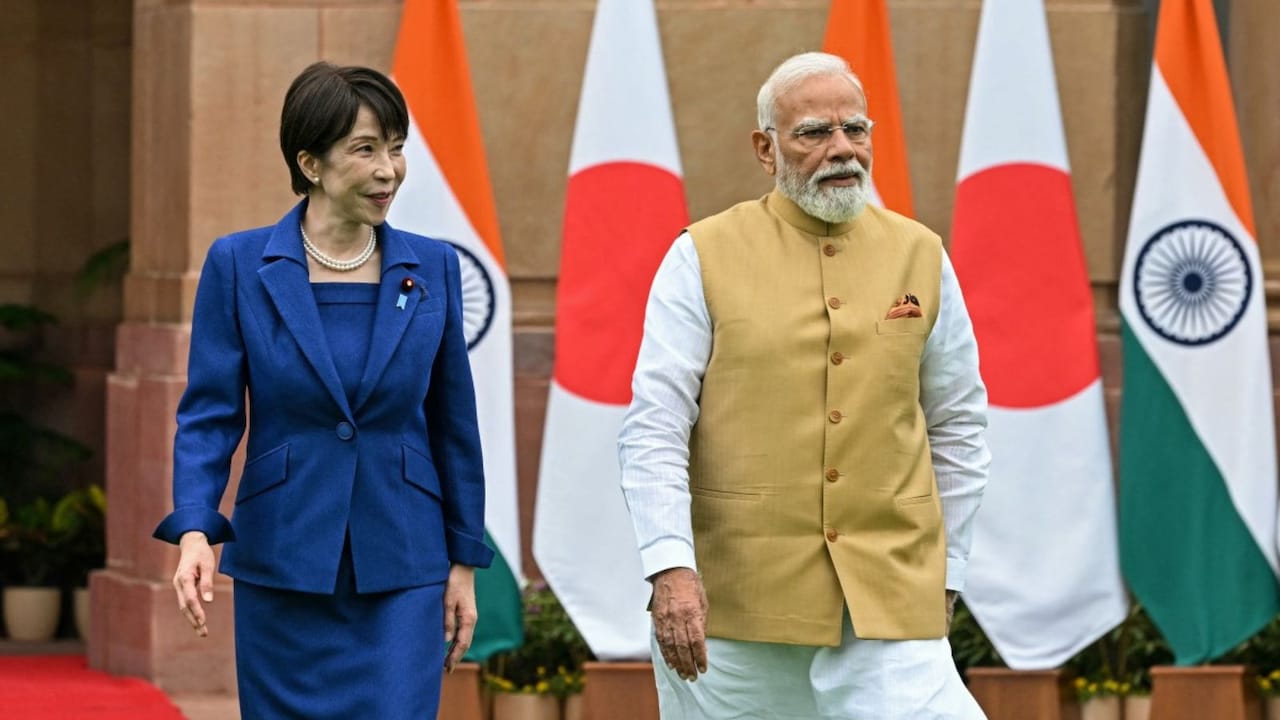
Tokyo and New Delhi are quietly redrawing the security architecture of the Indo-Pacific, moving far beyond standard diplomatic pleasantries. While public communiqués focus on bullet trains and supply chain resilience, the underlying reality is a calculated, mutual anxiety over Beijing's maritime expansion. This partnership has evolved from a hesitant economic courtship into a hard-nosed defense alignment designed to counter a shared existential threat.
The strategy hinges on reciprocal access agreements, joint military exercises, and the co-development of military hardware. For Japan, India represents a massive democratic counterweight on China’s southern flank. For India, Japan is a vital source of advanced technology and a key financier for infrastructure in highly sensitive border regions. Together, they are building a network of containment that does not rely entirely on Washington's unpredictable political whims.
The Geography of Containment
Look at a map of the Indian Ocean and the South China Sea. The choke points governing global trade are becoming highly contested zones. India sits astride the sea lanes that carry the bulk of Japan’s energy imports from the Middle East. If those lanes are disrupted, Tokyo’s economy faces immediate strangulation.
This geographic reality explains why New Delhi and Tokyo have prioritized maritime domain awareness. The two nations have integrated their radar and surveillance data, allowing them to track Chinese submarine movements from the Malacca Strait to the Western Pacific. This is not about passive observation. It is a coordinated effort to ensure that any hostile naval push into the Indian Ocean can be detected and intercepted long before it reaches critical shipping lanes.
The cooperation extends to physical infrastructure. Japan is funding major development projects in India’s northeast region, a sensitive area bordering China, as well as the Andaman and Nicobar Islands. These islands act as a natural barrier at the mouth of the Malacca Strait. By upgrading ports and airfields here, India gains the ability to bottle up foreign warships during a crisis, backed by Japanese capital that western banks deemed too politically risky to provide.
Moving Past the Pacifist Friction
For decades, Japan’s constitutional pacifism acted as a hard ceiling on any meaningful defense cooperation. Tokyo could talk about peace, but it could not sell weapons or participate in aggressive military maneuvers. That ceiling has cracked.
Driven by the acute threat of regional hegemony, Tokyo has systematically reinterpreted its defense guidelines. The policy shift allows for the export of defense equipment and deeper integration with foreign militaries. India has been a primary beneficiary of this bureaucratic thaw. The two countries regularly conduct the Malabar and Veer Guardian exercises, which have transitioned from symbolic flybys into highly complex anti-submarine and air combat simulations.
Military bureaucracies are notoriously slow to change. Yet, the acquisition managers in Tokyo and New Delhi are forcing integration. They are working toward a Reciprocal Provision of Supplies and Services Agreement, effectively allowing their respective workforces to share fuel, ammunition, and bases. A Japanese destroyer can now pull into an Indian naval base in the Andaman Sea, refuel, swap data, and return to patrol without needing to head back to its home port.
The Defense Industrial Reality Check
Building an alliance requires more than signed treaties; it requires compatible hardware. This is where the partnership faces its most stubborn hurdle. India’s defense procurement process is a legendary bureaucratic morass, plagued by delays and a fierce insistence on local manufacturing.
The attempt to finalize India’s purchase of Japanese US-2 amphibious aircraft serves as a stark example. The deal has languished for years over pricing, technology transfer, and domestic production mandates. Tokyo, unaccustomed to the bare-knuckle world of international arms sales, struggled to meet New Delhi's rigid demands.
This friction has forced a shift in tactics. Instead of chasing headline-grabbing, multi-billion-dollar platform sales, the focus has quietly shifted to component-level integration and dual-use technology. Joint ventures are now targeting unmanned ground vehicles, robotics, and artificial intelligence for surveillance. By focusing on subsystems and software, both nations bypass the political landmines of major arms deals while still achieving the technical integration required for modern warfare.
Weaponizing Economic Interdependence
True strategic alignment requires deep financial integration. For Japan, India is the ultimate hedge against its dangerous economic reliance on Chinese factories. The Japanese corporate sector spent decades pouring billions into the Chinese market, creating a vulnerability that Beijing can exploit during a political standoff.
Tokyo is actively subsidizing Japanese companies to move their manufacturing hubs out of China and into South India. This capital flight matches New Delhi's desire to build a viable manufacturing base to absorb its massive, underemployed youth population. It is a marriage of convenience driven by mutual vulnerability.
| Strategic Sector | Japanese Input | Indian Objective |
|---|---|---|
| Semiconductors | Material supply chains & lithography expertise | Domestic fabrication plants and design hubs |
| 5G/6G Telecom | Secure, non-Chinese hardware architecture | Nation-wide digital network modernization |
| Rare Earths | Advanced processing technology | Diversified sourcing to bypass Chinese monopoly |
This economic restructuring goes beyond simple supply chain diversification. It represents a deliberate decoupling of critical infrastructure from adversarial networks. When India bans Chinese applications or excludes Chinese vendors from its 5G rollouts, it relies on Japanese alternatives to fill the technical vacuum. This creates a closed loop of trusted capital and technology that hardens both societies against economic coercion.
The Washington Variable
No analysis of Indo-Pacific security can ignore the United States. Both New Delhi and Tokyo are key pillars of the Quad, alongside Australia. However, neither nation is entirely confident in the long-term reliability of American commitments.
Political polarization in Washington and the fluctuating nature of American foreign policy have signaled to regional powers that they must possess independent capabilities. Japan fears being drawn into a conflict over Taiwan without sufficient regional support, while India remains fiercely protective of its strategic autonomy, refusing to become a formal treaty ally of any western nation.
The bilateral relationship between India and Japan serves as an insurance policy. It creates a secondary axis of power that can function independently of American leadership. If a future US administration decides to scale back its commitments in Asia, the Tokyo-New Delhi axis ensures that China does not inherit an empty playing field. They are building a partnership capable of deterring aggression on its own merits.
Unresolved Contradictions
Despite the alignment of interests, significant diplomatic gaps remain. The most glaring friction point is Russia. New Delhi maintains a deep, historic dependency on Moscow for military hardware and cheap energy, a relationship that has grown more complicated but remains unbroken.
Tokyo, strictly aligned with the G7, views Moscow’s actions as a direct assault on the international order. During global summits, Japanese diplomats must look past India's abstentions on UN resolutions and its ongoing purchases of Russian crude oil. It is a glaring contradiction that would derail a standard alliance.
They manage this friction through pragmatic silence. Tokyo understands that forcing India to choose between the West and Russia will only push New Delhi into isolation. India recognizes that Japan’s security anxieties are focused on the Pacific, not Eastern Europe. Both leaderships have decided that their shared fear of a dominant Beijing outweighs their disagreements over Moscow. They have compartmentalized their foreign policies to protect the core military cooperation occurring in the Indo-Pacific.
The true test of this alliance will not be found in the language of diplomatic agreements. It will be measured in the depth of their industrial integration, the compatibility of their data networks, and their willingness to deploy hard power in defiance of regional hegemony. As Chinese naval vessels push further into the Indian Ocean, the quiet militarization of the India-Japan partnership is transforming from an ambitious diplomatic project into a matter of national survival.