The air in Jerusalem during Holy Week doesn't just sit; it vibrates. It carries the scent of crushed rosemary, ancient limestone dust, and the electric tension of a city where three worlds collide in a single square mile. On Palm Sunday, that vibration usually finds its voice in a sea of fronds and the rhythmic chanting of the faithful. This year, however, the song met a wall.
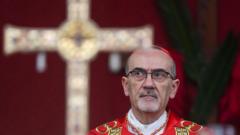
Imagine a man who has spent his entire life preparing for a single walk. Pierbattista Pizzaballa, the Latin Patriarch of Jerusalem, carries a title that sounds heavy with gold and history, but his role is fundamentally about a path. His job is to lead. To move from the Mount of Olives, down through the Kidron Valley, and into the heart of the Old City. It is a walk that retraces footsteps two thousand years old. It is a physical manifestation of hope for thousands of Palestinian Christians and pilgrims from every corner of the map.
But history is often interrupted by a clipboard and a barricade.
The geography of Jerusalem is a map of checkpoints. Usually, these are hurdles to be cleared with a nod or a permit. On this particular Sunday, the hurdles became a definitive "no." Israeli security forces, citing "security concerns"—the catch-all phrase that serves as both a shield and a shroud—halted the procession. The Patriarch, the highest-ranking Catholic official in the Holy Land, found himself standing before a line of blue uniforms and metal railings.
He wasn't alone. Behind him stood a crowd that had traveled across borders, some physical and some political, just to touch the stones of the Holy Sepulchre. There were grandmothers from Bethlehem who had navigated three different checkpoints just to reach the starting line. there were Italian monks with sun-reddened necks. There were local scouts in crisp uniforms, their drums silenced.
The irony is as thick as the incense in the Church of the Holy Sepulchre. In a city marketed to the world as a beacon of religious freedom, the literal path to prayer was severed. This wasn't a sudden riot or a structural collapse. It was a bureaucratic strangulation.
Consider the logistics of a blocked soul. When a religious leader is stopped from entering his own cathedral, it sends a ripple far beyond the immediate street corner. It tells the shopkeeper in the Christian Quarter that his heritage is negotiable. It tells the pilgrim that their faith is subject to a temporary permit. It tells the world that the "status quo"—that fragile, unwritten agreement that keeps the peace in Jerusalem’s holy sites—is fraying at the edges.
Security is the primary currency in this region. No one argues that the streets of Jerusalem are safe by accident. The police face a monumental task in balancing the safety of millions with the volatile passions of the devout. Yet, there is a point where security measures stop being a protective shell and start becoming a cage. When the Latin Patriarch is turned away, the message isn't about safety. It's about sovereignty.
The facts are stark. The Israeli police restricted access to the Old City, limiting the number of people who could participate in the traditional march. They pointed to the "overwhelming" crowds and the potential for friction. But those who have lived in Jerusalem for decades see a different pattern. They see a gradual tightening. A slow, methodical narrowing of the space available for anyone who doesn't fit a specific national narrative.
The streets of the Old City are narrow. They are built for donkeys and footsteps, not for the armored vehicles and heavy-handed crowd control of the 21st century. When you shove a thousand years of tradition into a space hemmed in by modern weaponry, something has to give. Usually, it is the dignity of the worshipper.
"We just want to pray," a young woman from Ramallah said, her voice lost in the wind. She held a palm frond that was starting to brown at the edges. She didn't have a political manifesto. She didn't have a weapon. She had a piece of dried leaf and a desire to stand in a specific spot at a specific time.
The blockade of the Patriarch is a symptom of a much larger fever. For months, the Christian community in Jerusalem has reported an uptick in harassment—spitting, verbal abuse, and the desecration of cemeteries. When the state adds its own layer of restriction to this atmosphere of hostility, the "security" argument starts to feel like a thin veil.
Jerusalem is a city of echoes. Every shout today sounds like a shout from a century ago. When the gates are closed, the echoes grow louder, bouncing off the walls until the pressure becomes unbearable. The Latin Patriarch did eventually make it to the church, but the damage was done. The procession was fractured. The joy was clinical, moderated by the presence of rifles and the hum of surveillance drones.
Think about what happens to a community when its most sacred moments are treated as security threats. The psychological toll is immense. It breeds a sense of permanent displacement. Even when you are home, you are a guest whose invitation can be revoked at any moment by a man in a vest who doesn't know your name.
This isn't just about a Sunday afternoon in the sun. It is about the soul of a city that claims to be the center of the world. If Jerusalem cannot hold the weight of a few thousand people carrying branches, how can it hope to hold the weight of its own history?
The metal railings were eventually moved. The crowds dispersed into the labyrinth of the souk. The Patriarch retreated behind the heavy wooden doors of the Latin Patriarchate. But the image remains: a man of peace, dressed in the robes of his office, standing still because a political machine decided that his prayer was a problem.
The stones of Jerusalem have seen empires rise and fall. They have been washed in blood and anointed with oil. They are indifferent to the temporary barriers of men. But the people living among those stones are not. They remember every closed gate. They count every denied permit. And they wait for a Sunday when the only thing they have to carry is a branch, and the only path they have to follow is the one that leads home.
The sun set over the Golden Gate, casting long, jagged shadows across the valley. The city grew quiet, but it was the silence of a held breath, not the silence of peace.


