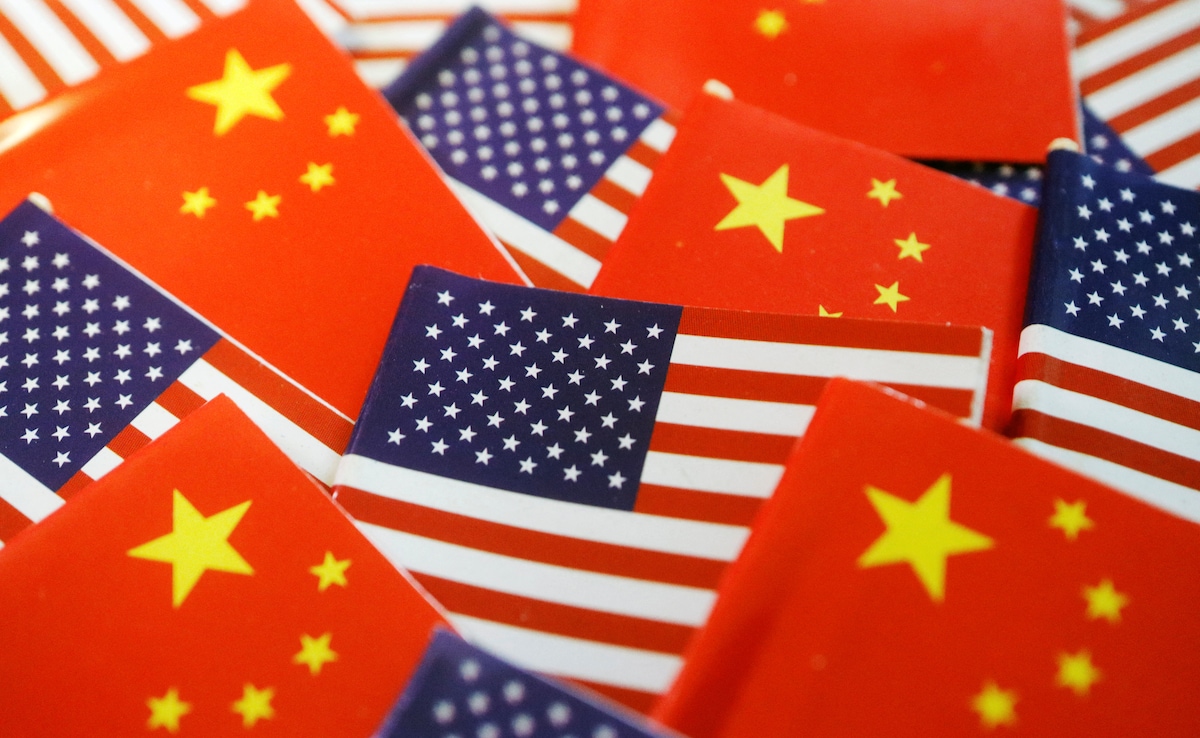
High above the Pacific, far beyond the reach of birds or breathable air, a satellite the size of a school bus begins a slow, deliberate pirouette. To a casual observer with a powerful enough telescope, it looks like a graceful dance of titanium and solar foil. To the men and women sitting in windowless rooms in Colorado Springs and Beijing, it is a move in a high-stakes chess match where the board is three hundred miles wide and the pieces cost a billion dollars each.
For decades, we looked at the stars and saw a frontier for discovery. Now, we see a theater for a tragedy.
The friction between the United States and China has finally outgrown the Earth. It has spilled over the atmosphere, leaking into the vacuum of space like a pressurized gas finding a crack in a hull. This isn't the Apollo era. There is no ticker-tape parade waiting at the end of this journey. Instead, we are witnessing the birth of a cold war where the frontline is invisible, the weapons are silent, and the collateral damage could be the very foundation of modern life.
The Girl in the Simulation
Let’s step away from the jargon of "geopolitical rivalry" and "orbital mechanics" for a moment. Consider a hypothetical woman named Sarah.
Sarah lives in a mid-sized city in the American Midwest. She wakes up to a phone that synchronized its clock via a GPS satellite. She drives to work using turn-by-turn directions provided by a constellation of thirty-one satellites. Her bank confirms her paycheck via a high-speed orbital handshake. When she buys a coffee, the transaction travels through a vacuum at the speed of light before her card even leaves the reader.
Sarah doesn't think about space. She shouldn't have to.
But in a low-lit command center halfway across the world, a technician is testing a "dual-use" satellite. On paper, this machine is designed to clear space debris—a celestial garbage truck meant to keep the lanes clear. In practice, it has a robotic arm capable of reaching out and snapping the antenna off the very GPS satellite Sarah depends on.
If that arm moves just a few inches to the left, Sarah’s world stops. The ATMs freeze. The power grid, which relies on satellite-provided timing signals to stay synchronized, begins to drift and eventually fail. Emergency services lose their ability to locate callers. This is the human element of the space race. It isn't about flags on the moon; it’s about whether Sarah can call an ambulance or buy a gallon of milk.
The New High Ground
History is a relentless teacher. Every time humans have discovered a new "high ground," we have immediately used it to look down on our enemies with a clearer aim. We did it with hills, then with airplanes, and now we are doing it with the stars.
The United States has enjoyed undisputed mastery of the heavens since the fall of the Soviet Union. This dominance wasn't just about pride. It was about a military that could see everything, talk to anyone, and hit a target with surgical precision from the other side of the globe. But that dominance created a vulnerability. The U.S. military became so dependent on its "eyes in the sky" that it essentially developed a glass chin.
China watched this happen. They recognized that the American way of war has a single, fragile point of failure.
Over the last decade, Beijing has accelerated its space program at a pace that defies traditional logic. They aren't just building rockets; they are building an entire infrastructure. They have their own GPS equivalent, Beidou. They have their own space station. Most significantly, they have developed a suite of "counter-space" capabilities. This includes ground-based lasers designed to "dazzle" or blind spy satellites and kinetic interceptors—missiles designed to smash into a satellite and turn it into a cloud of shrapnel.
The Physics of Disaster
When two cars collide on a highway, the mess is cleared in an hour. When two objects collide in orbit, the mess lasts for a century.
In 2007, China conducted a test of an anti-satellite missile, blowing up one of its own weather satellites. The impact created a debris cloud of thousands of trackable pieces and hundreds of thousands of smaller fragments. Each of these pieces, even one the size of a marble, travels at roughly 17,500 miles per hour. At that speed, a fleck of paint has the kinetic energy of a bowling ball dropped from a skyscraper.
$E_k = \frac{1}{2}mv^2$
The math of orbital warfare is unforgiving. Because the velocity ($v$) is so high, the energy ($E_k$) released in even a minor collision is catastrophic.
This leads us to a terrifying concept known as the Kessler Syndrome. It is a theoretical scenario where the density of objects in low Earth orbit is high enough that one collision sets off a chain reaction. One satellite explodes, its fragments hit three more, those fragments hit ten more, and within weeks, the Earth is encased in a shell of whirling titanium shards.
If this happens, the "Space Age" is over. We would be trapped on this planet, unable to launch anything for generations. No more weather forecasting. No more global communication. No more Mars rovers. We would be a civilization that looked at the stars and then blinded ourselves.
The Lunar Land Grab
While the immediate danger lies in the orbits just above our heads, the long-term struggle is focusing on a much older target: the Moon.
For a long time, the Moon was seen as a barren rock, a trophy for the Cold War. That perception changed with the discovery of water ice in the permanently shadowed craters of the lunar south pole. Water isn't just for drinking. Water is oxygen. Water is hydrogen. Water is rocket fuel.
The Moon is no longer a destination; it is a gas station on the way to the rest of the solar system.
The United States is pushing the Artemis Accords, a set of principles intended to govern lunar exploration and resource extraction. China, meanwhile, is partnering with Russia to build its own International Lunar Research Station. We are seeing the map of the Moon being drawn in real-time, with both sides eyeing the same "prime real estate" near the lunar poles.
Whoever controls the water controls the gateway.
This isn't a friendly competition between scientists. It is a race to establish "norms" through presence. If China establishes a base and declares a "safety zone" around it, they effectively claim that territory. If the U.S. does the same, we have a border on a world that was supposed to belong to all of humanity.
The Risk of a Spark
The most dangerous part of this confrontation isn't the technology. It’s the lack of rules.
On Earth, we have centuries of tradition, treaties, and "hotlines" to prevent a misunderstanding from turning into a nuclear war. In space, there is almost nothing. There are no clear definitions of what constitutes an act of war in orbit.
If an American satellite suddenly stops functioning, was it a solar flare? A mechanical failure? Or did a Chinese "inspector" satellite nudge it out of position? In the vacuum of space, it is incredibly difficult to prove intent. This ambiguity is a breeding ground for paranoia.
When both sides are afraid of losing their eyes in the sky, they are more likely to strike first. It is a "use it or lose it" dilemma that keeps generals awake at night. The speed of space warfare is so fast that by the time a human leader is briefed on a problem, the battle might already be over. Decisions that could decide the fate of our digital civilization are being handed over to algorithms and automated response systems.
The Mirror in the Sky
We often talk about space as if it's "out there," separate from us. We treat it like a movie we are watching from the safety of our living rooms.
But space is not a movie. It is a mirror.
Everything we do up there reflects who we are down here. Our greed, our fear, our inability to trust our neighbors—we are carrying all of it with us into the void. The "Battle for Space" isn't really about satellites or lunar ice. It’s about whether we can outrun our own history.
If the United States and China cannot find a way to manage this "New Battleground," the cost won't just be measured in billions of dollars or lost technology. The cost will be the loss of our greatest common heritage.
Tonight, if the sky is clear, go outside and look up. You might see a steady point of light moving across the stars. It could be the International Space Station, a rare miracle of global cooperation. Or it could be a hunter-killer satellite, waiting for a signal to start a fire that no one can put out.
The stars are still there, cold and indifferent. They have watched empires rise and fall for eons. They aren't worried about who owns the Moon. They are simply waiting to see if we are smart enough to stay among them, or if we will pave the way to our own isolation with the wreckage of our ambition.