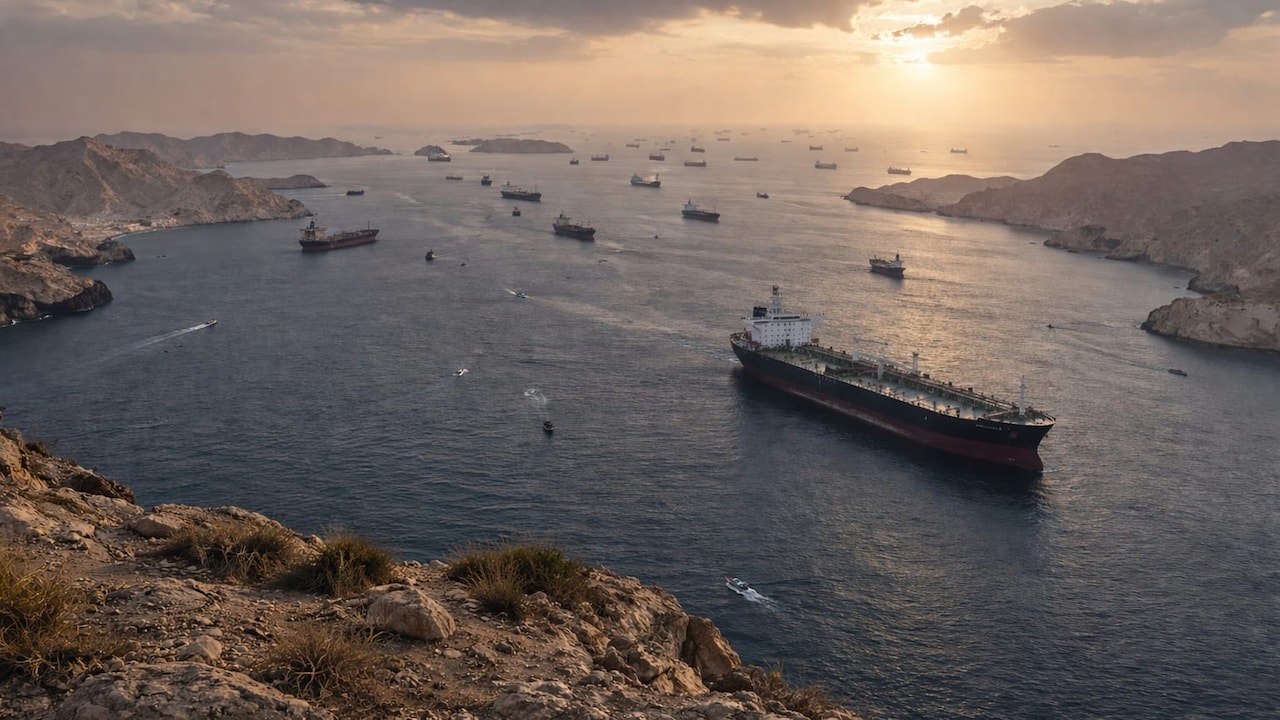
The heat in Bandar Abbas does not merely rise from the asphalt; it settles on your chest like a wet wool blanket. By mid-afternoon, the air smells of sulfur, low tide, and the sour tang of heavy crude.
On the concrete edge of the jetty, Farid squints into the glare of the Strait of Hormuz. He is fifty-four, with hands cured to leather by forty years of sea salt and diesel. For three generations, his family has run dhows—wooden cargo boats—across these shallow green waters, carrying everything from heavy carpets to cheap plastic basins. Today, Farid is not loading cargo. He is watching the horizon.
Somewhere just beyond the shimmering blue line where the sky meets the gulf, steel gray warships are shifting into position.
In Washington, the policy is announced with the sterile precision of a press release. The words are clean: "resuming maritime enforcement," "disrupting illicit supply chains," "targeted interdiction." But on the water, those words translate into concrete, physical obstacles. A blockade is not a line drawn on a map. It is a wall of gray hulls, radar sweeps, and loaded deck guns. It is the sudden, jarring silence of a port where the cranes have stopped moving.
To understand what is happening today in the Persian Gulf, you have to look past the political posturing and look at the water.
The Cold Math of the Strait
The geography of global trade is surprisingly fragile. If you look at a globe, the world’s oceans seem vast and limitless. But the global economy relies on a few tiny, high-stakes choke points. The Strait of Hormuz is the narrowest, most volatile neck of them all. At its tightest point, the shipping lanes are only two miles wide. Through this tiny corridor passes roughly a fifth of the world’s petroleum.
When the United States decides to resume a port blockade, it does not mean they are park-benching a fleet directly in Iranian harbors. That would be an act of outright war. Instead, they play a high-stakes game of economic pressure at sea.
Consider how this works in practice.
A rusty tanker, flying a flag of convenience from a tiny island nation half a world away, slips out of an Iranian terminal under the cover of a moonless night. Its transponder—the digital heartbeat that tells the world its name, speed, and destination—has been switched off. In the jargon of maritime security, this is a "dark ship."
But the darkness is an illusion.
A hundred miles away, aboard a US Navy destroyer, a young radar technician watches a green sweep track the tanker's ghost. Thermal imaging cameras miles above the earth capture the heat signature of its engines. The order is given. A helicopter rises from the flight deck, its rotors churning the salt air. A voice crackles over the international hailing frequency, demanding the captain state their cargo, origin, and destination.
This is the invisible friction of economic warfare. It is slow. It is tedious. It is incredibly dangerous.
One miscalculation, one panicked turn of a helm by a tired merchant captain, or one overeager finger on a trigger, and the economic standoff transforms into a shooting war.
The Human Ledger of Economic Warfare
We often talk about nations as if they are monolithic blocks on a Risk board. We say "Washington decided" or "Tehran responded." But nations do not feel the sting of a blockade. People do.
For Farid, the resumption of the blockade means his world shrinks. When the big tankers stop coming, the small-time traders who feed off the scraps of the shipping industry go hungry. The harbor-side tea shops empty out. The mechanics who repair diesel engines sit on overturned crates, smoking cheap cigarettes and watching the sky.
"If the ships do not move, we do not eat," Farid says simply. He does not care about the geopolitical chess match between capitals thousands of miles away. He cares about the price of cooking oil, which has doubled in his local market over the last twelve months.
Behind the high walls of the ports, the economic vise tightens in ways that rarely make the evening news. A blockade does not just stop oil from going out; it stops the machinery of daily life from coming in.
- Spare Parts: Cranes break down. Water treatment plants need specialized valves. Without them, the water turns brackish.
- Medicine: While humanitarian goods are technically exempt from sanctions on paper, international banks are so terrified of American fines that they refuse to process any transactions involving Iranian ports. The result is a quiet, desperate shortage of cancer drugs and insulin in local clinics.
- Inflation: When goods become scarce, survival becomes an expensive luxury.
This is the true mechanism of a blockade. It is designed to make life so difficult, so grindingly miserable for the population, that the domestic political pressure forces the government to blink. But history suggests that governments rarely feel the hunger pangs of their citizens. The leaders in their air-conditioned offices still eat. It is the dockworkers, the sailors, and the street vendors who bear the weight of the steel wall.
The View From the Bridge
Let us look at the other side of the radar screen.
Lieutenant Sarah Miller (a composite of the tactical officers patrolling these waters) stands on the bridge of a destroyer. The air-conditioning inside the ship is freezing, a stark contrast to the triple-digit heat outside. Her eyes are tired. She has been on watch for six hours, staring at a screen filled with overlapping tracks of merchant vessels, fishing dhows, and Iranian Revolutionary Guard speedboats.
The speedboats are the wild card. They do not behave like professional mariners. They buzz the larger ships, swarming in unpredictable patterns, their crews visible through binoculars, holding cameras and sometimes rocket-propelled grenades.
For Sarah, the blockade is not an abstract foreign policy objective. It is a daily exercise in extreme restraint.
"You are constantly playing a mental game of what-if," she explains. "If that speedboat gets within five hundred yards, is it a provocation or an attack? If we fire, do we start a global crisis? If we don't fire, do I lose my ship?"
This is the psychological toll of the blockade. The sailors tasked with enforcing it are young, often in their early twenties, carrying the responsibility of global peace on their shoulders. They know that a single incident in these narrow waters can send oil prices spiking on Wall Street, shifting the cost of gasoline at pumps in Ohio and Bavaria within hours.
The Echoes of a Forgotten War
The current escalation feels unprecedented, but the waters of the Persian Gulf have a long memory.
In the 1980s, during the grueling war between Iran and Iraq, the conflict spilled into the shipping lanes. It was called the Tanker War. Both sides began targeting merchant vessels, trying to choke off each other’s economic lifelines. The US Navy eventually intervened, escorting Kuwaiti tankers and engaging in direct, violent clashes with Iranian forces.
That conflict left the gulf littered with the rusted hulks of sunken ships. It taught a generation of planners that once you weaponize the shipping lanes, you lose control of the narrative. The ocean is too vast to police perfectly, and too small to keep a conflict contained.
Now, we are stepping back into that old rhythm.
The US decision to resume the blockade is a gamble that the economic pressure will force diplomatic concessions before the friction on the water sparks a fire. It is a strategy of brinkmanship, played out in slow motion, day after day, wave after wave.
As the sun begins to set over Bandar Abbas, turning the hazy sky a bruised shade of purple, Farid watches a patrol boat slip out of the harbor entrance. Its wake cuts a clean, white line through the dark water, a temporary scar that the sea will erase in minutes.
The ships are waiting. The sailors are watching. The world holds its breath, hoping the fragile peace of the gulf does not dissolve into the salt and oil below.