The air in Birmingham during the winter doesn't just bite. It lingers. It settles into the fibers of wool coats and finds the gaps in knitted scarves, turning breath into ghost-puffs of white that vanish against the gray pavement. Rosa Lalor knows this cold well. She has spent enough mornings standing in it, her feet numb inside her shoes, her hands tucked away, her lips moving in a rhythmic, internal cadence that no one else can hear.
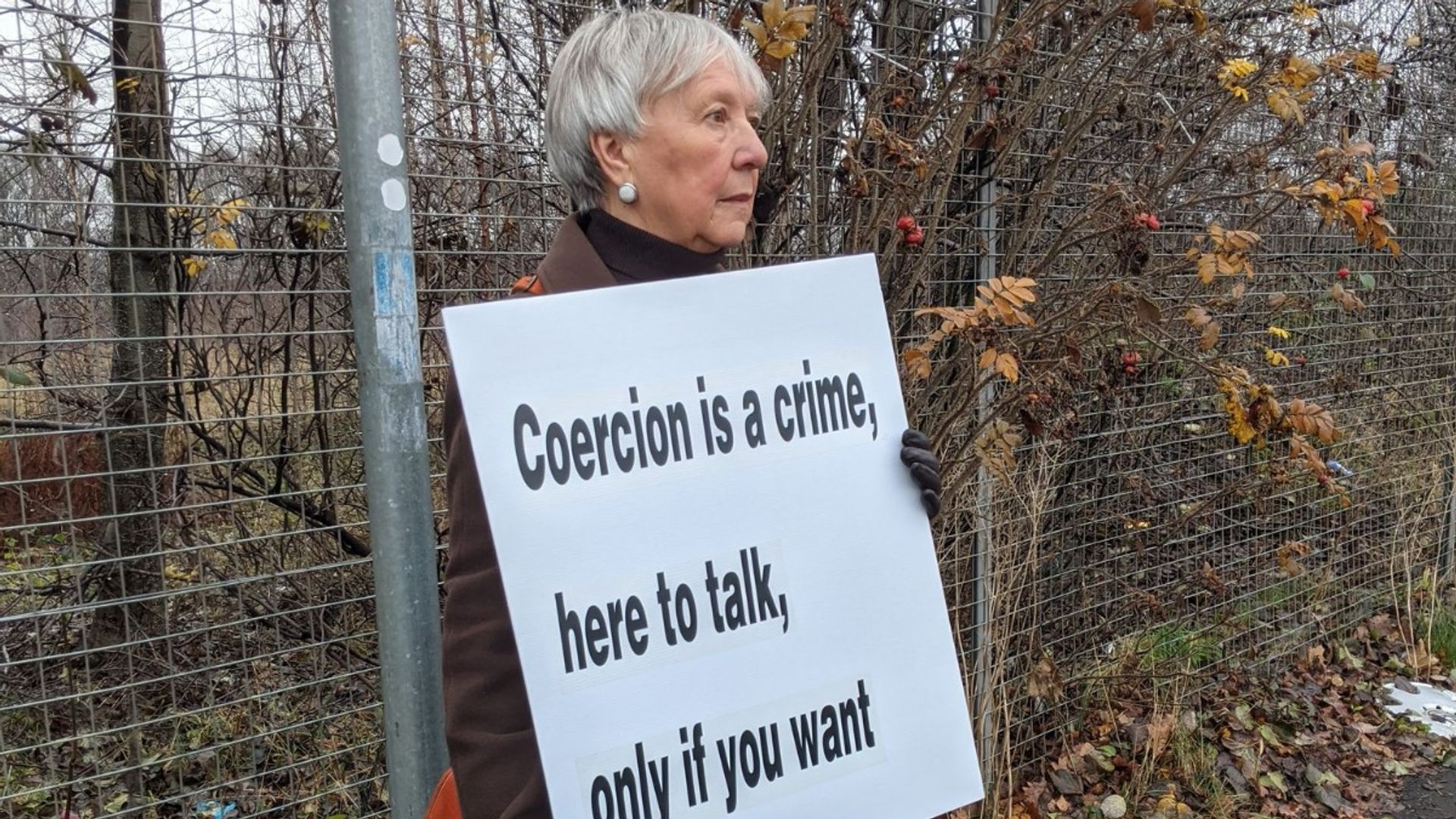
She wasn't shouting. She wasn't carrying a neon-bright sign with jagged lettering or blocking the path of those walking by with hurried, averted eyes. She was simply there. A grandmother in a sensible coat, occupying a sliver of public space near an abortion clinic. But in the eyes of the law on that specific afternoon, her silence was loud enough to be a crime.
The police officers approached her with the practiced detachment of people doing a job they didn’t ask for but were bound to complete. They asked what she was doing. She told them she was walking and praying. In that moment, the mundane act of locomotion coupled with the private act of devotion became a legal flashpoint. She was arrested, charged, and ushered into a machine that cares more for the letter of a local Public Spaces Protection Order (PSPO) than the quiet intentions of a solitary citizen.
The Invisible Fence
Local councils across the United Kingdom have been quietly erecting invisible fences. These are "buffer zones," legally designated areas where certain behaviors—even peaceful ones—are strictly prohibited to ensure that those accessing medical facilities feel safe and unburdened. On paper, it sounds like a straightforward balancing act of rights. But when the weight of the law falls on a woman standing still in the cold, the balance starts to feel skewed.
Rosa’s arrest wasn’t just about her. It became a proxy battle for something much larger: the sanctity of the space inside a human skull. If the state can dictate what you do in a public square, that is one thing. If the state can penalize you for what you are thinking while you stand in that square, we have crossed a threshold into a different kind of society altogether.
The Crown Prosecution Service eventually took a hard look at the evidence against her. They looked at the footage. They looked at the statements. And then, without much fanfare, they dropped the charges. They conceded that Rosa Lalor had a "reasonable excuse" for being where she was. The case evaporated, but the chill remained.
A Walk with Weight
Imagine for a second that you are Rosa. You are not a professional activist. You do not have a megaphone or a legal team on speed dial. You are a woman who believes, with every fiber of your being, that life is sacred and that prayer is a tangible force for good. You go to a place where you feel that prayer is needed most.
You aren't there to harass. You aren't there to judge. You are there to be a silent witness.
Then comes the tap on the shoulder. The questions. The realization that your presence is considered a nuisance, an interference, a breach of the peace. The legal process is often the punishment itself. Months of uncertainty. The stain of a criminal charge hanging over a life spent in service to family and faith. The cost of defending that "reasonable excuse" is paid in stress, in sleepless nights, and in the quiet erosion of one’s sense of belonging in their own city.
The Friction of Liberty
The debate often gets flattened into two shouting camps. On one side, the absolute necessity of access to healthcare without intimidation. On the other, the fundamental right to free speech and religious expression. We tend to treat these as two trains on a collision course, but they are actually the rails that keep a free society moving. When one rail is ripped up, the whole thing derails.
In Rosa’s case, the "intimidation" was internal. She was praying. To the observer, she was a woman standing on a sidewalk. To the law, she was a potential violator of a "safe zone." This is where the logic of buffer zones starts to fray at the edges. When we start policing the "vibe" of a person or the suspected content of their silent thoughts, we are no longer protecting people; we are sanitizing the public square of any dissenting presence.
Liberty is naturally high-friction. It requires us to encounter people we disagree with, to see things that make us uncomfortable, and to navigate a world that isn't perfectly curated to our preferences. When we use the law to smooth over every possible point of friction, we don't just remove the discomfort. We remove the liberty.
The Victory That Felt Like a Warning
The dropping of the charges was a victory, certainly. Rosa expressed her relief, noting that she never should have been arrested in the first place for doing something as basic as praying in a public space. But the fact that it went as far as it did serves as a grim marker.
It suggests that the default setting for authority has shifted. Instead of assuming the innocence of a peaceful bystander, the system now scans for "non-compliance" with social mandates that are increasingly vague. If a grandmother can be processed through a criminal justice system for a silent prayer, what happens to the person with a louder message? What happens to the protester with a more controversial cause?
The law is a blunt instrument. It is designed to stop violence, to prevent theft, to keep the gears of civilization turning. When it is used to prune the thoughts of individuals standing on a street corner, it becomes something else. It becomes a tool of conformity.
The Echo in the Square
Rosa Lalor is back to being a grandmother now, no longer a headline or a case file. But the streets of Birmingham, and London, and Bournemouth, are different now. They are mapped with zones of silence and areas of permitted thought.
The struggle isn't over just because one case was dropped. There are others facing similar charges. There are new laws being debated in Parliament that would make these buffer zones a national standard, effectively nationalizing the "invisible fence."
The real stakes aren't found in the courtroom or the halls of government. They are found on the sidewalk. They are found in the gap between a person's conscience and the state's reach. We have to ask ourselves if we are willing to live in a country where a woman’s quietest moment is treated as a threat to the public order.
The police eventually moved on. The lawyers closed their files. The news cycle turned its hungry eyes elsewhere. But if you walk past that stretch of pavement today, the air feels just as cold, and the silence feels a lot heavier than it used to.
Freedom isn't just the right to speak; it's the right to exist in a space without having to justify your soul to a man with a badge.