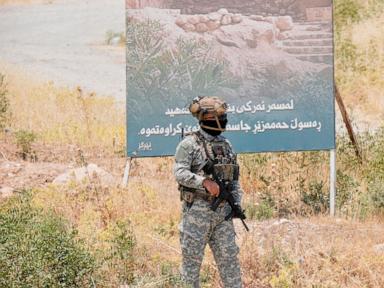
The tea in the mountains is always bitter, brewed over wood fires that leave the scent of smoke clinging to every fiber of a wool jacket. In these high altitudes, where the border between Turkey and Iraq dissolves into jagged limestone peaks, silence is rarely just the absence of sound. It is a heavy, physical presence. It is the breath held before a storm. For decades, that silence has been the only thing keeping the peace, a fragile truce that everyone knew was fraying at the edges.
Cemil Bayik, a man whose name carries the weight of forty years of insurgency, recently stood before this backdrop to deliver a message that felt like the snapping of a rusted wire. He didn't speak of war in the abstract. He spoke of a stall. A freeze. He described a peace process that has become a hollow shell, not because of a lack of will on the mountain, but because of a lack of courage in the marble halls of Ankara.
Politics is often viewed as a series of chess moves played out on maps. But for the people living in the shadow of the Taurus Mountains, politics is the difference between a child walking to school or a drone circling overhead. The peace talks were supposed to be the bridge. Instead, they have become a dead end.
The Weight of a Broken Promise
Imagine a man named Adar. He is a hypothetical composite of the thousands who live in the border villages. Adar remembers the 1990s, when the nights were lit by the orange glow of burning settlements and the days were defined by the metallic click of checkpoints. When the peace talks began years ago, Adar dared to buy new seeds for his field. He dared to think of a future where his son wouldn't have to choose between the mountain and the prison cell.
That hope wasn't based on a whim. It was based on a promise of reform. The Kurdish movement, represented by the PKK and its leadership, demanded something fundamental: the right to exist without apology. This meant constitutional changes that recognized Kurdish identity, the right to education in their mother tongue, and a decentralized system that allowed local communities to breathe.
But the reforms never came.
Bayik’s recent declaration isn't just a grievance; it’s an autopsy of a failed negotiation. He points to a government that used the language of peace to buy time, while simultaneously tightening the screws of security. It is a classic stall tactic. By refusing to codify rights into law, the state keeps the Kurds in a state of perpetual legal limbo.
Consider the mathematics of power. If a government promises to change a law but never puts pen to paper, the law remains a weapon. The Turkish state has maintained its anti-terror laws with such broad strokes that a journalist, a teacher, or a mayor can find themselves behind bars for a poem or a protest. This isn't just a legal quirk. It is a structural barrier to peace.
The Architecture of the Stall
The stall is a sophisticated piece of political machinery. It works by creating a cycle of "waiting for the right moment." In Ankara, the right moment is always just beyond the next election, the next regional crisis, or the next shift in the global economy.
But the mountains don't have the luxury of the "right moment."
While the talks remained frozen, the landscape changed. Turkey shifted its focus, launching cross-border operations into northern Iraq and Syria, targeting the very groups it was supposed to be negotiating with. This isn't a metaphor; it is a physical reality. Steel meeting stone. The official stance from the Kurdish side is that you cannot talk peace while the drones are hunting your negotiators.
The invisible stakes here are the lives of a generation. Every year that the peace process stalls, another group of young people grows up seeing the state only through the lens of a riot shield. When Bayik says the government is responsible for the deadlock, he isn't just blaming a political party. He is describing a betrayal of a historical opportunity.
Turkey had a chance to become a truly inclusive democracy. It had a chance to lead the Middle East by showing that ethnic grievances can be solved through the ballot box rather than the bullet. Instead, the government retreated into the comfort of nationalism. It is easier to win an election by stoking fear of an internal enemy than it is to do the hard, grueling work of constitutional reform.
The Cost of Cold Tea
Back in the village, Adar watches the sun dip behind the peaks. The tea has gone cold.
The tragedy of the stalled peace talks is that they aren't just a failure of diplomacy; they are a failure of imagination. The leaders in Ankara see the Kurdish issue as a security problem to be managed. The leaders on the mountain see it as an existential struggle for survival. There is no middle ground when one side is waiting for a law and the other side is waiting for a surrender.
Bayik’s words serve as a chilling reminder that peace is not a permanent state. It is a garden that requires constant watering. When the water stops—when the reforms are blocked and the dialogue becomes a monologue—the garden dies.
What remains is the dry brush of resentment, waiting for a spark.
The world often ignores these mountain skirmishes, distracted by larger wars and louder voices. But the silence in the mountains today is different than it was a decade ago. It is louder. It is more aggressive. It is the silence of a man who has realized that the hand extended to him was empty all along.
The stall is over. What comes next isn't a return to the table, but a return to the shadows. The invisible stakes have become visible in the eyes of the young men watching the horizons. They aren't looking for a reform bill anymore. They are looking for a reason to believe that the smoke in the air will ever be from a cooking fire again, and not from the ruins of another broken promise.
The mountain remains. The wind still carries the scent of pine and old grievances. And the peace, once a flickering candle in a dark room, has finally been blown out by the very people who claimed to be guarding the flame.