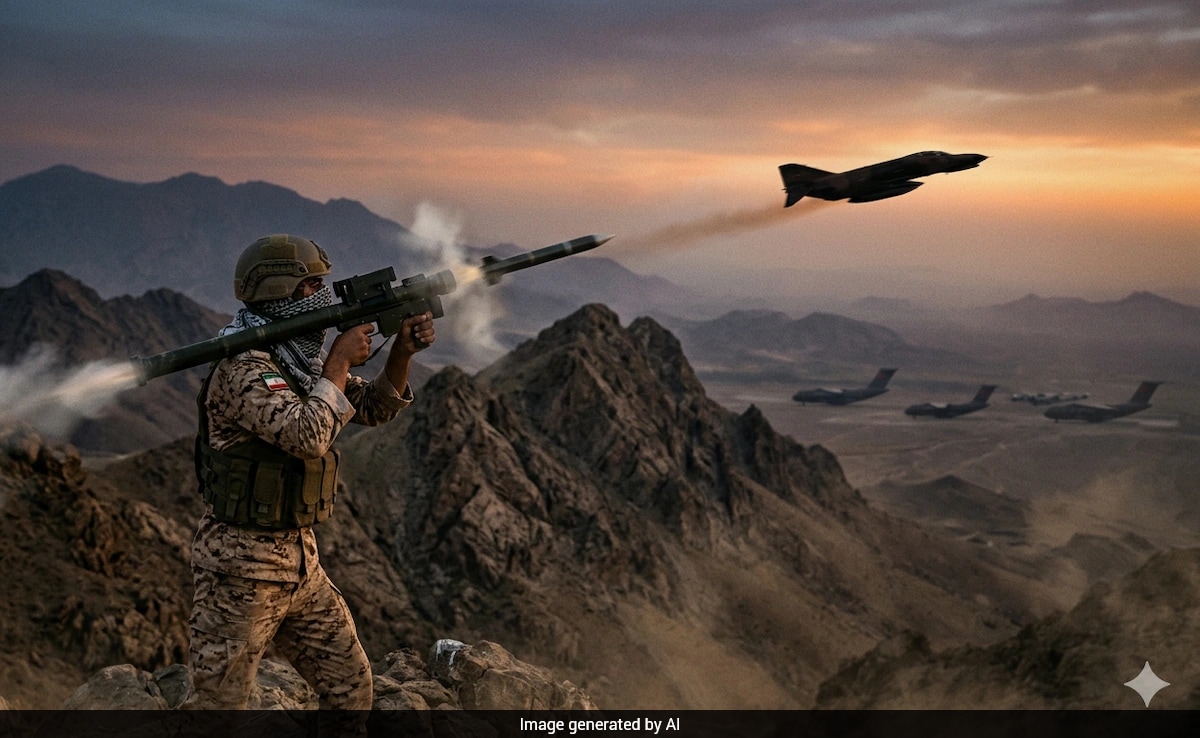
The defense punditry is currently obsessed with a romantic, David-and-Goliath fantasy. They look at the rugged terrain of the Zagros Mountains and imagine a lone insurgent with a $50,000 Misagh-2 MANPADS (Man-Portable Air-Defense System) bringing a $100 million F-35 Lightning II screaming out of the sky. It is a neat narrative. It is also tactically illiterate.
Military commentators love to point to the Soviet-Afghan war or the current attrition in Ukraine as proof that the era of air superiority is over. They argue that the proliferation of shoulder-fired missiles has democratized the sky, making it impossible for a modern air force to operate without sustaining ruinous losses.
They are wrong. They are confusing air denial in a low-intensity regional slog with the systemic dismantling of an integrated air defense network. If you think a soldier on a hillside is the primary threat to a US-led air campaign, you aren't paying attention to how modern physics and electronic warfare actually function.
The Altitude Fallacy
The most basic error in the "Manpads Ground the Air Force" argument is a failure to understand the vertical limits of the engagement zone.
Most modern MANPADS, including the Iranian Misagh series or the Russian Igla-S, have a maximum engagement ceiling of approximately 11,000 to 13,000 feet. That sounds high to a civilian. To a combat pilot, that is the basement.
The US Air Force does not fight in the basement.
Since the 1991 Gulf War, the doctrine has shifted toward medium-altitude operations. Precision-guided munitions (PGMs) like the GBU-39 Small Diameter Bomb or the JDAM family allow strike aircraft to orbit at 25,000 to 35,000 feet. At that height, the plane is literally a ghost to a shoulder-fired missile. The seeker head on a Misagh-2 cannot even see the thermal signature of an engine at that distance, and even if it could, the rocket motor would burn out and gravity would reclaim the missile long before it reached the target.
To argue that MANPADS will ground the air war is to assume that US pilots will be forced to fly low-level "show of force" missions or archaic unguided bombing runs. We don't do that anymore. We haven't done it for thirty years.
Seeker Heads vs. Spectral Reality
The contrarian truth about infrared (IR) seekers is that they are increasingly obsolete against high-end platforms.
The common misconception is that a MANPADS locks onto "heat." In reality, modern seekers look for specific spectral signatures. They are programmed to distinguish between the mid-wave infrared (MWIR) of a jet nozzle and the "clutter" of the sun or a flare.
However, we are now seeing the dominance of Large Aircraft Infrared Countermeasures (LAIRCM) and Directed Infrared Countermeasures (DIRCM).
Instead of just dumping burning magnesium flares and hoping the missile misses, modern systems use a high-intensity modulated laser beam. When the system detects an incoming missile, it fires a laser directly into the missile’s "eye." This doesn't blow the missile up; it does something worse. It confuses the seeker's guidance logic, making it think the target is miles away from where it actually is.
I have seen the testing data on these systems. When a DIRCM suite is active, the hit probability of a shoulder-fired missile drops from a "dangerous threat" to "expensive fireworks." Against a fifth-generation fighter like the F-35, which possesses an integrated Distributed Aperture System (DAS), the pilot has 360-degree spherical awareness. The plane sees the launch before the soldier even feels the recoil.
The Logistics of the "Lucky Shot"
Even if we concede the possibility of a "lucky shot" during take-off or landing—the only time these aircraft are truly vulnerable to MANPADS—the math doesn't favor the defender.
The Iranian landscape is vast. To effectively "ground" an air war using shoulder-fired missiles, you need more than just weapons; you need a density of operators that is physically impossible to maintain. You need thousands of trained teams stationed at every possible flight path, 24 hours a day, in high-altitude environments where oxygen is thin and logistics are a nightmare.
Furthermore, a MANPADS is a "use it and lose it" weapon in more ways than one. The moment a missile is fired, it creates a massive thermal and visual signature. In an environment saturated with high-altitude long-endurance (HALE) drones like the RQ-4 Global Hawk, a launch plume is a death sentence. The "missile on a shoulder" might get one shot off, but the operator will be erased by a loitering munition or a kinetic strike within minutes.
We aren't talking about a fair fight. We are talking about an asymmetric slaughter where the asymmetry favors the side with the satellites.
The Real Threat is Not the Shoulder, but the Socket
The people obsessing over the Misagh-2 are ignoring the real danger: the S-300PMU2 and the indigenous Bavar-373.
These are not shoulder-fired toys. These are long-range, truck-mounted strategic SAM (Surface-to-Air Missile) systems. They can reach out 200 kilometers and hit targets at 90,000 feet. They use sophisticated phased-array radars that can, theoretically, track multiple stealth targets.
The focus on MANPADS is a distraction. It's a "tacticool" obsession for people who watch too many movies. If a US air campaign is stalled, it won't be because a guy in a cave had a Stinger equivalent. It will be because the Integrated Air Defense System (IADS) was too dense to penetrate without unacceptable losses to the "Wild Weasel" SEAD (Suppression of Enemy Air Defenses) aircraft.
But even then, the US solution isn't to fly lower into the range of MANPADS. The solution is to stand off.
The Stand-Off Revolution
The argument that a shoulder-fired missile can ground an air war ignores the shift toward "stand-off" weaponry.
Imagine a scenario where a B-21 Raider or a flight of F-15EXs approaches Iranian airspace. They don't need to cross the border to be effective. They can release dozens of AGM-158 JASSM (Joint Air-to-Surface Standoff Missiles) from hundreds of miles away.
What is the man with the shoulder-fired missile going to do against a cruise missile flying at Mach 0.8 that he can't see on radar and that doesn't have a human pilot to scare?
He is going to sit on his hillside and watch the horizon glow while his infrastructure disappears.
The era of "Over the Top" bombing is dead. We are in the era of "From Over the Horizon" destruction. In this reality, the MANPADS is a relic of a previous century's tactical playbook. It is effective for shooting down a stray helicopter or a low-flying cargo plane in a porous civil war. It is utterly useless against a high-tier kinetic strike package designed to operate in "contested" environments.
The Cost-Exchange Ratio Fallacy
The final pillar of the "MANPADS will win" argument is the cost-exchange ratio. "A $50,000 missile kills a $100 million jet! The economics favor the insurgent!"
This is an accountant's way of losing a war.
The US military does not care about the cost-exchange ratio of a single engagement. It cares about mission accomplishment. If losing three jets means the entire nuclear enrichment capability of an adversary is neutralized, that is a "win" in the cold logic of statecraft.
Moreover, the "low cost" of MANPADS is offset by their limited shelf life and high failure rate. Iranian-produced batteries for these systems are notoriously unreliable. The cooling units for the IR seekers have a limited duration. You cannot just leave a Misagh-2 in a crate for five years and expect it to work perfectly when you pull the trigger.
The US, meanwhile, spends billions on Electronic Attack (EA) platforms like the EA-18G Growler. These planes don't just jam radars; they jam the very frequencies used for communication between decentralized MANPADS teams. If the guy on the hill can't get the "heads up" from the early warning radar because his radio is screaming white noise, he won't even know the jets are there until the bombs have already hit their targets.
The Wrong Question
People ask: "Can a MANPADS shoot down a US jet?"
The answer is: "Technically, yes."
But that is the wrong question.
The right question is: "Can MANPADS provide a persistent, credible defense that alters the strategic outcome of a coordinated air campaign?"
The answer is a resounding "No."
To suggest otherwise is to ignore the reality of modern multi-domain operations. We are looking at a future of swarming drones, collaborative combat aircraft (CCA), and cognitive electronic warfare. In that world, a man with a tube on his shoulder is not a "game-changer." He is an anomaly. He is a statistical outlier in a data set defined by total sensor dominance.
The romantic image of the lone rebel defeating the high-tech empire makes for great cinema. It makes for terrible military analysis. The US air war in Iran, should it ever happen, will be won or lost in the electromagnetic spectrum and at altitudes where the air is too thin for a MANPADS to breathe.
Stop looking at the shoulder. Start looking at the stars. That is where the missiles are actually coming from.
The "missile on a shoulder" isn't a threat to the US Air Force. It's a security blanket for an adversary that has already lost the sky.