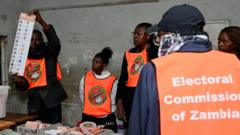
The air in Lusaka thickens with a heavy, unspoken dread long after the polling stations shutter their metal doors. Ink-stained fingers, once held up as badges of democratic pride, now feel like targets. Outside, the dust settles on the streets, kicked up by the heavy boots of security forces moving with calculated precision through the humid night.
Democracy rarely dies in a sudden flash of theatrical violence. Instead, it fades away in the quiet hours of the morning, marked by the sharp rap of knuckles on a heavy wooden door and the sudden flashing of red and blue lights against cracked plaster walls.
Consider what happens next in a fragile political ecosystem. When the votes are cast and the ballot boxes are sealed, the real test of a nation begins. But for top opposition figures in Zambia, that test arrived not with the verification of talllets, but with handcuffs and sirens. Days after a contentious presidential vote, the political landscape shifted overnight from a contest of ideas to a struggle for personal liberty.
To understand the weight of this moment, you have to look past the cold statistics of voter turnout and electoral math. You have to look at the kitchen tables where families sit in nervous silence, radios hissing with static as they wait for news that may never come.
Let us walk through a hypothetical scenario grounded entirely in the verified patterns of post-election crackdowns, keeping in mind that this is a metaphor for the broader silencing of dissent. Imagine a veteran politician, someone who spent decades organizing rallies under the scorching sun, sitting in a dimly lit room. The phone rings. It is an aide warning that security vehicles are turning onto the street. There is no time to pack a bag. There is only time to swallow the bitter realization that opposing the ruling party carries a price far heavier than a lost election.
When leaders of opposition parties are detained in the delicate window following an election, the shockwaves travel far beyond the individuals themselves. Every voter who cast a ballot for change suddenly feels their own voice intercepted, folded up, and locked away in a cell.
The official statements from authorities often speak of maintaining public order and upholding the rule of law. They use calm, bureaucratic language to describe actions that send shockwaves of fear through civil society. But the timing speaks a louder language. Arrests executed in the immediate aftermath of a vote create a chilling effect. They signal to the populace that dissent has an expiration date, and that date arrives the moment the polls close.
History offers a stern teacher on these matters. Across developing democracies, the transition of power is rarely a smooth highway; it is an unpaved road full of hidden sinkholes. When the ruling apparatus utilizes state security to neutralize political rivals, trust in the entire electoral architecture collapses. People stop believing in the ballot. And when people lose faith in the ballot, the alternatives grow dark and unpredictable.
We must confront the human element here. Behind every headline about detained politicians are aging parents, anxious spouses, and children who do not understand why father or mother cannot come home for dinner. The personal cost of political ambition in a polarized state is devastatingly high. It is measured in lost sleep, raided offices, and the constant, gnawing anxiety of surveillance.
Yet, despite the intimidation, a stubborn resilience often persists on the streets of Lusaka. Markets buzz with whispered conversations. Neighbors exchange cautious glances, refusing to let fear entirely extinguish the debate. The desire for accountability runs deep, anchored in the belief that a nation belongs to all its citizens, not just those currently holding the keys to government offices.
The road ahead for Zambia remains uncertain. The arrests of these opposition figures have not quieted the underlying questions about governance, economic hardship, and the distribution of power; they have only amplified them in a different frequency.
Silence is not peace. It is merely the space between thunderclaps.
As the legal battles begin to wind their way through courts shadowed by executive influence, the eyes of the region remain fixed on this southern African nation. Every summons, every bail hearing, and every suppressed protest writes another line in a developing chapter of political survival.
The sun rises over Lusaka each morning with the same indifferent brilliance, casting long shadows across government corridors and crowded townships alike. Those shadows stretch far, touching every citizen who dared to hope that their vote could change the course of history, leaving them to wonder if the dawn will ever truly break.


