The wind off the Potomac doesn't care about politics. It carries the same bite, the same smell of damp earth and river salt, whether it’s blowing past the Lincoln Memorial or across the empty, contested grass of the National Mall. On a Tuesday afternoon, a middle-aged man named David—let’s call him that, though his face is one of a thousand tourists—stands near the site where a new monument is proposed to rise. He’s holding a crumpled map and looking toward the Capitol. He isn't thinking about architectural blueprints or the legislative gridlock in the buildings nearby. He’s wondering if his grandchildren will look at this skyline and see a story of unity or a permanent marker of a fractured era.
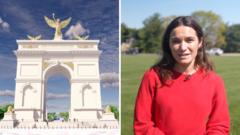
This isn’t just about stone and mortar. It’s about the soul of the "front yard" of America. Donald Trump’s vision for a "triumphal arch" to be built in Washington D.C. has moved from a campaign trail flourish to a point of physical contention. To some, it is a necessary symbol of national strength, a callback to the grandeur of Rome or the Arc de Triomphe. To others, it is a scar. An ego in marble.
The National Mall is already a crowded conversation. You have the somber, sunken V of the Vietnam Veterans Memorial, a place that pulls you downward into grief. You have the soaring obelisk of the Washington Monument, which demands you look up. Every inch of this dirt is curated to tell a specific version of the American story. When you propose a new structure here, you aren't just adding a building; you are editing the biography of a nation.
The Weight of Marble
History is heavy. A triumphal arch, by its very definition, celebrates victory. But in a country where half the population feels defeated every four years, whose victory does the arch belong to?
Consider the physical reality of the proposal. We aren't talking about a small plaque. We are talking about a massive, multi-story gateway. In the renderings, it gleams. It promises a return to classical aesthetics, a rejection of the brutalist concrete that dominates much of the capital’s federal architecture. There is an undeniable pull to that kind of beauty. People like David, standing in the cold, often feel that modern architecture has failed them—that it is cold, sterile, and tells no story at all.
But a triumphal arch carries baggage that no amount of white marble can scrub clean. Historically, these structures were built to welcome home conquering heroes, often dragging the spoils of war and enslaved captives behind them. They are monuments to "The End." They signal that a struggle is over and a winner has been crowned. In the current American climate, nothing feels over.
The logistics of such a project are a nightmare of red tape and ego. The Commission of Fine Arts and the National Capital Planning Commission act as the gatekeepers of this sacred space. They are the librarians of the Mall’s aesthetic. For them, the introduction of a massive new arch isn't just a matter of taste; it’s a matter of "sightlines."
If you stand at the base of the Grant Memorial and look toward the Lincoln Memorial, you are witnessing a carefully calibrated visual narrative. It is a straight line of sight that suggests a clear, unobstructed path for the Republic. Dropping a massive arch in the middle of that path is the architectural equivalent of shouting in a library. It breaks the silence. It demands that the eye stop at the arch rather than continuing to the horizon.
The Invisible Stakes
Why does this matter to someone who lives three thousand miles away? Because the Mall is the only place where the abstract idea of "The United States" becomes a physical reality you can touch.
When a family from Iowa saves for three years to bring their kids to the capital, they are looking for a sense of permanence. They want to feel that they belong to something that started long before them and will last long after they are gone. When that space becomes a playground for the specific aesthetic whims of a single leader—any leader—that sense of permanence begins to feel like a temporary lease.
There is a psychological cost to monument-building. We build things in stone because we are afraid of being forgotten. We carve names into granite because we know our voices will eventually fail. The rush to build an arch is a rush to claim the future’s memory. It’s an attempt to ensure that, a hundred years from now, the conversation must start with this specific person, this specific era.
Imagine a young woman walking through this arch fifty years from now. She didn't live through the rallies. She doesn't remember the headlines. She only sees the stone. Does the arch tell her that her country is a place of triumph? Or does it tell her that, at one point, the country was so obsessed with its own image that it forgot how to move forward without looking in a mirror?
The Architecture of Division
The debate over the arch isn't really about the arch. It’s about whether we still have a "common" space.
If you walk through the streets of D.C. today, the tension is a physical weight. Metal barriers. Security checkpoints. The "City of Magnificent Distances" has become a city of magnificent fences. The proposed arch sits at the center of this tension. It is a structure designed to be walked through, yet it represents a barrier to many.
There is a deep irony in using the word "triumphal." True triumph in a democracy is usually quiet. It’s the sound of a ballot hitting a box. It’s the murmur of a peaceful transfer of power. It’s the slow, agonizingly boring work of a subcommittee meeting. An arch is loud. It is the architectural equivalent of a victory lap taken before the race has actually been won.
Think about the materials. Granite. Marble. Bronze. These things are extracted from the earth with violence and shaped with fire. They are meant to endure. But the most enduring things in Washington aren't the buildings; they’re the ideas. The Lincoln Memorial is powerful not because of the seated man’s height, but because of the words carved into the walls beside him—words about malice toward none and charity for all. Those words are the true "triumphal" monuments. They are the things that survived the fire.
An arch, by contrast, is empty in the middle. It is a hole surrounded by stone.
The Cost of Cold Facts
The BBC’s reporting on the site focuses on the "where" and the "how much." It looks at the maps and the budget estimates. But those facts are bloodless. They don't capture the way the air changes when you talk about this project with the people who live in the District. For them, this isn't a news story; it’s a neighborhood dispute with global consequences.
They see the trucks. They hear the politicians. They know that once a foundation is poured, it is almost impossible to un-pour. Decisions made in a single four-year window can dictate the visual language of a city for centuries. This is the ultimate exercise of power: the ability to force the future to look at what you want them to see.
We are a nation currently obsessed with our own reflection. We argue over statues, over names of schools, over which flags get to fly. The arch is the ultimate expression of this obsession. It is a literal frame. It tells you exactly where to stand and exactly what to look at.
But the beauty of the National Mall has always been its openness. It is a space that allows for protest, for celebration, and for the quiet, solitary reflection of people like David. It is a space that belongs to everyone precisely because it doesn't belong to any one person’s ego.
The Final Stone
As the sun begins to set over the Potomac, the shadows of the existing monuments stretch across the grass. They are long, thin fingers of darkness that reach toward each other. The Washington Monument’s shadow is a needle, stitching the earth.
If the arch is built, it too will cast a shadow. It will be a heavy, rectangular block of dark, cold air. It will fall over the tourists, the joggers, and the protestors alike.
We often think of monuments as gifts to the future. We assume that the people who come after us will be grateful for the stone we left behind. But perhaps the greatest gift we can give the future is a bit of empty space. The room to breathe. The room to build their own stories without having to walk through the heavy, shadowed gate of ours.
The river continues to flow. The wind continues to bite. And on the Mall, the grass waits, holding its breath, wondering if it is about to be buried under the weight of a triumph that half the world doesn't recognize as a victory at all.
Power is fleeting. Stone is patient. But memory is the most fickle of all. We can build arches to the sky, but we cannot force the heart to feel a glory that isn't there.