Walk into any diner in Des Moines or grab a stool at a crowded counter in Manchester on a Tuesday morning, and you can smell it in the cold filter coffee. Power does not wait for a cycle to finish. It breathes in the vacuum of the previous day's ballots. While political reporters were still cleaning the confetti of the midterm elections off their shoes, the machinery for the next great coronation had already been oiled, plugged in, and set to hum.
We treat elections like seasonal storms. They arrive with wind and sirens, flood the airwaves for a few months, and then supposedly recede, leaving behind a quiet coastline where politicians govern and citizens catch their breath. That is a comforting fiction. In reality, the American presidency is a continuous, subterranean war that pauses only long enough for the dead to be buried and the victors to take their oaths.
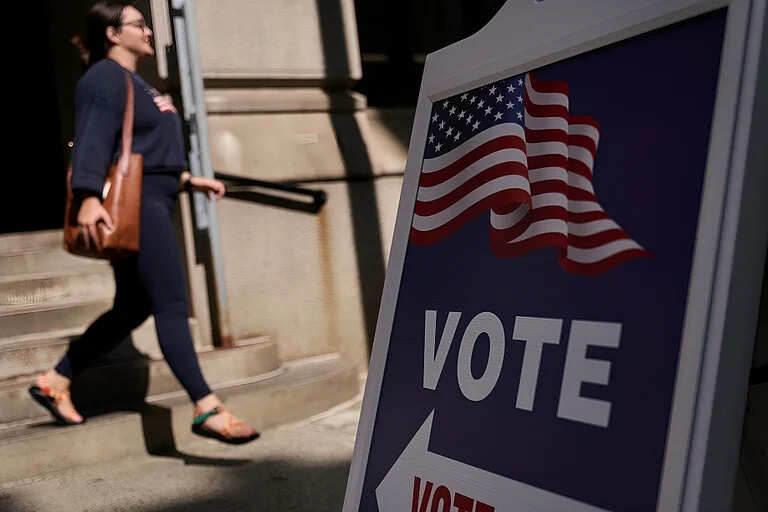
Consider the arithmetic of the midterms that just passed. Every congressional district flipped by a razor-thin margin, every Senate seat defended by inches, served as a raw nerve test for the national mood. Voters did not just send representatives to Washington; they drew battle lines across the map for 2028. Governors who survived tough re-election fights and senators who managed to nationalize local races suddenly found themselves holding a very specific kind of map. It is a map marked with invisible ink, pointing directly toward the Oval Office.
Right now, in quiet conference rooms in northern Virginia and high-ceilinged offices overlooking San Francisco Bay, strategists are looking at those midterm results not as history, but as a blueprint.
Let us trace the outlines of this quiet succession struggle by looking at the two archetypes currently defining the future of American statecraft: Gavin Newsom and JD Vance.
On one side stands Newsom, a creature of the West Coast megastate, whose political identity is forged in the high-stakes crucible of California policy battles. To watch him operate is to watch a masterclass in modern political branding. He treats the governorship of his state not merely as an administrative post, but as a national counter-weight. When conservative states pass restrictive social legislation, Newsom responds with targeted billboard campaigns and legislative countermeasures, effectively running a shadow national campaign from Sacramento. He represents the muscular, unapologetic defense of coastal progressivism, an executive who leans directly into cultural combat rather than dodging it.
Yet, that very profile carries its own gravity. To middle America, Newsom can easily be framed through a specific, carefully curated lens by his opponents—a symbol of elite coastal governance, high taxes, and progressive cultural orthodoxy. His challenge between now and the next convention is not convincing Democrats in Los Angeles or New York. They are already in the fold. His challenge is bridging the psychological chasm that separates the San Francisco bay from the industrial Midwest or the rural South. Can a leader so thoroughly identified with the most progressive state in the union translate his appeal to a factory worker in Michigan whose primary concern is the cost of heating oil? That is the billion-dollar question keeping his speechwriters awake at night.
Flip the coin, and you find JD Vance operating from a wholly different ideological coordinate. Vance represents the populist realignment that reshaped the conservative coalition over the last decade. His appeal is rooted in a narrative of economic dislocation, blue-collar grievance, and a sharp skepticism toward traditional corporate orthodoxy and foreign intervention. When he speaks, he does not lean into the polished platitudes of the late-twentieth-century establishment. He speaks the language of the Rust Belt, of towns where the factories rusted over decades ago and the opioid crisis left empty chairs at Thanksgiving tables.
For Vance, the midterm results were a referendum on whether the populist wing of his party could maintain its momentum without Donald Trump at the very top of the ticket. Every local candidate who ran on that economic nationalism playbook became a data point in a much larger experiment. Can the movement survive its creator? Can a philosophy built on grievance transition into a governing agenda that actually lowers inflation, restores manufacturing jobs, and heals fractured communities? Vance and his allies must prove that their brand of politics is not just a passing populist fury, but a durable, permanent architecture for the American right.
Between these two figures lies a vast, anxious electorate that is profoundly tired of the shouting.
Talk to independent voters in suburban Philadelphia or outside of Phoenix, and you hear a recurring theme. They are exhausted. They do not want another four years of performative outrage broadcast across their phones at midnight. They want potholes fixed, grocery prices stabilized, and a sense that someone—anyone—is paying attention to the mechanics of daily survival rather than the next viral social media clip.
This exhaustion creates a massive opening for dark horse contenders, governors of midwestern or mountain states who have managed to keep their heads down while delivering basic competence. While the media fixates on the high-profile ideological heavyweights trading barbs on national television, quiet executives in state capitals are studying the playbook of successful governance. They know that when the electorate grows weary of the ideological extremes, the pendulum has a habit of swinging violently toward the center, rewarding the politician who looks less like a cable news combatant and more like a capable mayor.
The machinery behind these ambitions is staggering. Super PACs do not hibernate. Fundraising networks do not take sabbaticals. While ordinary citizens are trying to figure out how to pay their car insurance and manage their mortgages, donor class meetings are already underway in Martha's Vineyard and Palm Beach, vetting candidates, testing message frames in focus groups, and measuring the emotional resonance of potential campaign themes.
This is where the invisible stakes of the midterms become brutally clear. The congressional margins established in those elections dictate which investigations can be launched, which judicial nominees can be blocked, and which economic narratives can be amplified on the national stage. Every single committee hearing is a commercial audition for 2028. Every floor speech is a trial balloon designed to test how a prospective nominee handles pressure, controversy, and the unsparing eye of the 24-hour news cycle.
We often misread politics because we look for dramatic plot twists where there are only slow, tectonic shifts. No single debate performance or primary endorsement will decide who sits behind the Resolute Desk when the decade turns. It will be decided by a thousand invisible choices made in hotel lobbies, union halls, and suburban kitchens over the next several years.
The question is not merely which man or woman will emerge victorious from the grueling gauntlet of the primary system. The deeper, more unsettling question is what kind of country will be left standing when the dust clears. Will we be a nation more deeply fractured into warring cultural tribes, or will we find a way to rebuild a common vocabulary of civic life?
The campaign has already started. The speeches are being written. The money is moving through the banking system in quiet, heavy currents. The only real question left is whether we will continue to watch the spectacle as passive spectators, or whether we will finally demand something better from the people asking for our trust.
The diner lights in Des Moines flicker. The coffee cools in the cup. Somewhere nearby, a staffer is checking a spreadsheet of precinct data, looking for an edge that hasn't been found yet.