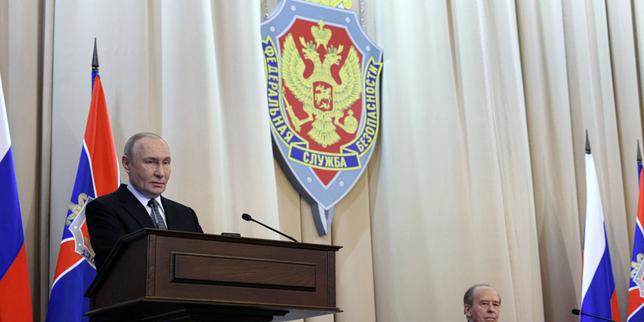
The Lubyanka has won its longest internal war. As Russia’s invasion of Ukraine drags into its fifth year, the Federal Security Service (FSB) has successfully cannibalized the traditional military hierarchy, transforming itself from a domestic intelligence apparatus into the primary architect of the Kremlin’s war economy and geopolitical strategy. This is not merely a bureaucratic shift. Vladimir Putin’s reliance on his alma mater has fundamentally altered the trajectory of the conflict, replacing conventional military logic with a paranoid security doctrine that prioritizes regime survival over battlefield efficiency.
Western analysts long assumed that military failures in Ukraine would diminish the FSB’s influence. The opposite happened. By leveraging its proximity to Putin and exploiting the failures of the regular armed forces, the FSB has secured absolute oversight over defense production, occupied territories, and domestic dissent.
The Secret Redirection of Russian Power
For decades, a delicate balance of power existed within the Kremlin walls. The Ministry of Defense, the foreign intelligence service (SVR), and the FSB competed for resources and the President’s ear. That balance is dead.
When the initial February 2022 blitzkrieg failed, blame fell squarely on the FSB’s Fifth Service, the operational arm tasked with preparing Ukraine for a swift capitulation. Analysts predicted a purge. Instead, the agency executed a classic bureaucratic counter-offensive. It deflected blame toward the military command, specifically targeting former Defense Minister Sergei Shoigu and his entourage, culminating in a sweeping corruption purge that cleared the path for technocrats answerable to the security services.
This cannibalization relies on a specific structural evolution. The FSB is no longer just a spy agency. It operates as a parallel government.
The mechanism of this control is the system of kurators—embedded security officers who sit within every major Russian state enterprise, university, and ministry. In the defense sector, these officers oversee the distribution of state funds, ensuring that factories run twenty-four hours a day. Factories that fail to meet quotas face immediate criminal sabotage investigations handled by the FSB’s Economic Security Service.
This total control introduces a fatal flaw into Russia's war machine. Military strategy is now dictated by intelligence officers who view the world through a lens of subversion and covert operations rather than combined-arms tactics. The result is a rigid operational environment where local commanders fear reporting negative news up the chain of command, knowing an FSB report can classify a tactical retreat as treason.
The Conquest of the Occupied Territories
Nowhere is the agency's absolute authority more visible than in the occupied regions of Donetsk, Luhansk, Zaporizhzhia, and Kherson. These zones do not operate under standard military occupation law. They are governed as intelligence fiefdoms.
While the regular army holds the trenches, the FSB manages the rear. The process follows a brutal, industrialized template.
- Filtration and Databases: Every resident in occupied territory passes through filtration camps managed by the FSB's Special Operations Center. Biometric data, phone contacts, and social media histories are scraped into a central database called Vedomost, designed to identify any individual with potential ties to Ukrainian security or civil society.
- Economic Russification: Business owners face a simple choice: register their property under Russian law and pay protection fees to local FSB handlers, or watch their assets be seized and handed to loyalists from Moscow.
- The Child Deportation Pipeline: Documenting the movement of Ukrainian children into Russia reveals a highly organized logistical network overseen by security personnel, used as both a demographic tool and a psychological weapon against occupied populations.
This system creates a false impression of stability. Security reports sent to Moscow claim total pacification of the population. Beneath the surface, however, this heavy-handed repression fuels a resilient partisan movement. The FSB's response to this resistance is invariably more terror, creating a self-reinforcing loop of violence that requires an ever-greater commitment of manpower and money just to keep the occupied territories from exploding.
The Economics of Permanent Confrontation
A common misconception among Western policymakers is that sanctions will eventually force the Kremlin to negotiate because the economic pain will become unbearable. This view misjudges the economic philosophy of the Lubyanka.
The security apparatus does not view economic growth or consumer welfare as metrics of success. To the FSB leadership, the economy exists solely to sustain the state's geopolitical ambitions and secure the regime's survival.
Under the influence of Nikolai Patrushev, the former head of the Security Council and a key FSB ideological godfather, Russia has transitioned to what can be termed "security capitalism." In this model, the state permits private wealth accumulation only if that wealth can be requisitioned for state purposes at a moment's notice.
[State Budget Allocation]
       │
       ├──► Conventional Military (Frontline Operations)
       │
       └──► FSB Control Networks
               ├──► Defense Factory Oversight (Economic Security Service)
               ├──► Occupied Territory Infrastructure (Fifth Service)
               └──► Digital Surveillance & Cyber Operations (Sixteenth Center)
The agency has actively benefited from Western sanctions. The departure of Western corporations created a massive vacuum. The assets of companies like Danone, Carlsberg, and various energy giants were not simply nationalized; they were redistributed to oligarchs closely aligned with the security services. The FSB’s Economic Security Service acts as the ultimate arbiter of this spoils system.
War is profitable for the gray cardinals of Moscow. The longer the conflict persists, the more assets they can reallocate, solidifying their control over the domestic market. They have no financial incentive to seek peace.
The Information Panopticon
Domestically, the agency has used the war to realize its long-held dream of a completely controlled information ecosystem. The methods used are sophisticated, systemic, and digital.
The centerpiece of this domestic control is the expansion of SORM (System for Operational-Investigative Activities), Russia's lawful interception hardware. Since 2022, the FSB has forced internet service providers to install updated SORM-3 hardware, which allows for deep packet inspection and the automated tracking of specific keywords across social media platforms, including encrypted messengers like Telegram.
The Digital Enforcement Mechanism
| Agency Component | Primary Target | Operational Method |
|---|---|---|
| Information Security Center (18th Center) | Tech dissidents and VPN networks | Deep packet inspection, targeted hacking, forced localization of data servers. |
| Protection of the Constitutional Order (2nd Service) | Political opposition and anti-war groups | Infiltration of local organizations, targeted arrests under "discreditation of the military" laws. |
| Operational-Technical Directorate | General civilian population | Automated monitoring of geolocation data and facial recognition integration in major cities. |
The fear generated by this surveillance is as effective as the surveillance itself. By conducting highly publicized arrests of ordinary citizens for minor online infractions—such as liking an anti-war post—the agency has successfully re-engineered Soviet-era self-censorship. People shut up. They stop talking to journalists, they stop organizing, and they stop questioning the cost of the war.
The Limits of the Shadow State
This expansion of power contains the seeds of its own instability. By absorbing so many state functions, the FSB has taken on liabilities it is structurally unsuited to handle.
The agency is designed for subversion, surveillance, and short-term tactical operations. It is not an administrative body. As it takes over the management of heavy industry, regional governance, and complex supply chains to bypass sanctions, its lack of technical expertise becomes glaring. Stories of critical infrastructure failures, from collapsing regional heating systems to systemic delays in high-tech military production, point to a governance model that prioritizes political loyalty over basic competence.
Furthermore, the concentration of wealth and power within a single agency is generating quiet but intense resentment among other factions of the elite. The regular military, though currently cowed by purges, harbors deep anger over being used as scapegoats for failures initiated by intelligence miscalculations. The remaining civilian technocrats within the central bank and economic ministries watch helplessly as the country's long-term fiscal stability is sacrificed to fund the security apparatus.
The FSB has built a fortress around Vladimir Putin, but it is a fortress constructed on a foundation of managed information and forced compliance. When an intelligence service becomes the state, the state inherits the structural paranoia of the intelligence service. Every economic setback is viewed as sabotage; every policy disagreement is treated as treason. This mindset makes strategic pivots impossible, locking Russia into a cycle of permanent escalation abroad and intensifying repression at home, with no viable exit ramp.