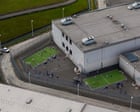
The fluorescent tubes hum a low, constant frequency. It is a sound that does not belong to the natural world. It belongs to waiting rooms, to cold corridors, to places where time is measured not by the rising of the sun or the changing of leaves, but by the heavy, rhythmic clicking of a metal door locking from the outside.
Inside one of these rooms, behind glass that has been smudged by countless palms, a man sits upright on a vinyl-covered mattress. His name is an administrative file, a sequence of numbers printed on a wristband, but in the life he built over decades, it belonged to a neighbor, a father, a person who knew the precise weight of a grandchild falling asleep against a shoulder. Now, that same shoulder presses against a wall stripped of color. Stage four cancer does not care about immigration status. Tumors do not pause their violent, chaotic expansion while a bureaucratic tribunal debates the legal definition of a permanent resident. Yet the system holding him treats his body as a secondary detail, a footnote to a docket number. Recently making waves recently: Why Europe Lost Its Cool Over Russia at the G20.
We have built systems so large, so thoroughly automated by procedure and precedent, that they have completely forgotten how to recognize a human being.
Consider the machinery of detention. It operates on a cold logic. An infraction occurs, or paperwork lapses, or a flag is raised in a database, and the machinery responds with an inevitable momentum. Arrest. Process. Detain. It does not pause to check a pulse. It does not ask whether a liver is failing or whether a spine is fractured by malignant cells multiplying in the dark. The file moves from one desk to another, shuffled through fluorescent corridors by people who will never look into the eyes of the person the file represents. Additional insights into this topic are explored by TIME.
When you strip away the legal briefs, the statutory references, and the dry press releases issued by agencies speaking in passive voice, the reality is stark. A human being with a terminal diagnosis is sleeping on a thin mattress beneath a security camera, waiting for an administrative board to decide whether he is allowed to die surrounded by his family or behind a chain-link fence.
Logic fails here. Not legal logic—that has its own twisted internal consistency, its own self-referential web of codes and sub-clauses. Human logic fails. How does a society that prides itself on constitutional protections, on due process, on the fundamental dignity of the individual, arrive at a place where holding a dying man in a cell is viewed as a routine administrative action?
The answer lies in the architecture of distance.
When you never have to look someone in the eye, cruelty becomes remarkably easy to disguise as compliance. It looks like a signed form. It looks like a compliance officer following protocol. It looks like an institutional policy enacted to ensure uniformity. But uniformity applied blindly to a crisis of mortality is not justice. It is administrative cruelty wearing a suit.
Walk down the imaginary hallway of a detention facility holding ward. Smell the institutional floor wax mixed with the sharp, metallic tang of fear. Listen to the coughing. It is not just one man; it is the collective rasp of bodies pushed past their limits by stress, poor nutrition, and the absolute absence of hope. When cancer enters that environment, it accelerates. The body, already fighting a civil war within its own cells, finds itself expending precious energy simply to endure the psychological terror of confinement.
Permanent residency was supposed to mean something. It was supposed to be a bridge across oceans, a legal acknowledgment that a person had planted roots so deep into the soil of a community that they could no longer be easily uprooted without tearing the fabric of the neighborhood itself. A green card is an anchor. But an anchor is useless if the ship has already been dragged onto the rocks by a storm of red tape.
We tell ourselves stories about the rule of law as if it were a monument carved in stone, unchanging and absolute. But the law is made by people, interpreted by people, and enforced by people. Every single step of the process involves a human choice. A human chooses to issue the warrant. A human chooses to deny the medical furlough. A human chooses to look at a medical chart showing advanced metastasis and stamp detain anyway.
The defense offered by the apparatus is always the same. Security. Precedent. The integrity of the border. These are heavy words, designed to end arguments before they begin. But invoke them long enough, and they become a shield against empathy. They allow officials to wash their hands of the outcome, pointing to the manual as the ultimate moral authority.
But a manual has never held a dying hand. A statute has never wept in a waiting room.
The man in the cell does not want a political revolution. He wants to breathe air that does not smell of industrial disinfectant. He wants to see his children without a sheet of scratched plexiglass separating their fingertips. He wants the remaining weeks or months of his life to belong to the people who love him, rather than the state that holds his administrative custody.
We have normalized this. That is the true tragedy. We read headlines about administrative overreach, medical neglect in holding facilities, and the absurd rigidity of immigration enforcement, and we scroll past them. We treat them as distant weather patterns, storms happening in a different zip code.
Until it is your father. Until it is your sister whose chemotherapy schedule is interrupted because an ICE transport van arrived at dawn.
The distance between the bureaucrat at a mahogany desk and the man on the vinyl mattress is measured in empathy. It is an immense, unbridled chasm. Closing that distance requires something radical. It requires us to abandon the comforting fiction that rules can entirely replace moral judgment. It requires officials to possess the courage to look past the file and see the person.
Until we demand that recognition, the fluorescent lights will keep humming in those empty corridors. The doors will lock. And somewhere in the dark, a life measured in terminal months will quietly slip away, not from the cancer alone, but from the crushing weight of a system that forgot how to see.


