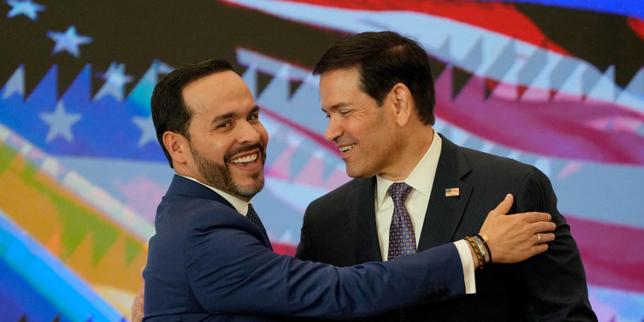
The afternoon heat in Bogota presses down through the high-altitude air, thin and sharp. In the narrow corridors of the presidential palace, every footstep echoes with a heavy history of bargains struck, broken, and rewritten. For decades, the partnership between Washington and Colombia has been measured in the cold currency of security aid, eradicated coca hectares, and diplomatic handshakes staged beneath blinding camera lights. It has been a relationship of convenience written on parchment, signed in the quiet corners of embassies, and felt only distantly by the coffee farmer working the steep volcanic slopes of Huila or the family navigating the tense street corners of Medellin.
Then comes the arrival.
Marco Rubio steps off the aircraft, cutting a familiar figure under the South American sun. This is not a routine diplomatic stopover to check boxes on a bureaucratic checklist. The tour across Latin America carries an underlying frequency, a quiet hum of urgency that transcends partisan politics. In a world where old alliances fracture under the weight of rising global competition, the chessboard is shifting. Beijing is moving quietly through the region, stringing together infrastructure projects, port agreements, and digital networks with a patient, calculated rhythm. Washington realizes it has been speaking a language of conditions while others are speaking a language of immediate commerce.
To understand what happened next, you have to look past the velvet ropes of the state dining rooms.
Imagine a small-scale textile manufacturer in Pereira. Let us call him Mateo. For twenty years, Mateo has fought a daily war against fluctuating currencies, high tariffs, and the suffocating shadow of regional instability. When politicians talk about cooperation, Mateo does not hear abstract policy. He hears whether his sons will have jobs next year, or if they will join the endless, desperate exodus heading north toward the Darien Gap. When a high-ranking American official arrives promising a completely new architecture of partnership—a cooperation without precedent—Mateo does not care about the rhetoric. He cares about whether the credit lines open, whether the shipping lanes clear, and whether the ground beneath his feet stops shaking.
Rubio’s message in Colombia was explicit, though wrapped in the polished vocabulary of international relations: the old script is finished.
We are living through a generational realignment. For years, U.S. foreign policy toward its southern neighbors suffered from an acute myopia. It woke up only when a crisis erupted—a sudden spike in migration, a drug cartel expanding its footprint, or an ideological shift in a neighboring capital. Between crises, Latin America was treated as a backyard rather than a boardroom. It was a region expected to fall in line with Washington's priorities without receiving an equal seat at the table.
That dynamic is breaking down.
When Marco Rubio uses the phrase cooperation without precedent, he is acknowledging a hard, unvarnished truth. The United States cannot afford to treat Colombia—its most steadfast anchor in the Andes—as an afterthought or a transactional pawn. Too much is at stake. The democratic fiber of the region is fraying at the edges. Disillusioned populations, exhausted by economic stagnation and institutional corruption, are listening to demagogues who offer simple answers to complex miseries.
Consider what happens when a democracy stalls. The public square fills with anger. Trust evaporates. Institutions that took generations to build hollow out in months.
This is where the new diplomatic blueprint attempts to intervene. It shifts the weight from purely punitive or counter-narcotic measures toward economic integration, technological resilience, and strategic infrastructure. It is an acknowledgment that the best defense against authoritarian creeping influence or cartel dominance is a thriving, middle-class society that has a stake in its own governance.
Yet, skepticism is the default setting in Latin America, and for good reason.
Generations of Colombians have watched American delegations arrive with grand visions, only to see those promises diluted by congressional gridlock or shifting white house priorities four years later. They have seen the war on drugs waged in their valleys while the demand north of the border remained insatiable, leaving local communities to shoulder the human toll of violence and displacement. Trust cannot be rebuilt with a single speech or a signed memorandum of understanding. Trust is earned in the quiet, unglamorous execution of details over decades.
What makes this particular tour different is the terrifying clarity of the alternative.
Look across the continent. Look at the ports financed by foreign state-backed capital, ports that double as strategic choke points. Look at the digital backbones being laid by entities whose values run counter to open societies. Washington is waking up to the reality that if it does not offer a compelling, deeply integrated economic partnership, someone else will. And that someone else will not ask questions about human rights, transparency, or democratic governance.
During his meetings in Bogota, Rubio walked a tightrope. He had to reinforce security partnerships while pivoting heavily toward economic destiny. Security without prosperity is a cage. Prosperity without security is a mirage. The two must walk in tandem, locked together, or the entire enterprise collapses under its own weight.
For the average citizen waking up to the news of this unprecedented cooperation, the immediate reality does not change overnight. The buses still run late. The inflation rates still pinch. The narco-traffickers still lurk in the remote jungle departments where the state’s writ is thin.
Change, real structural change, is excruciatingly slow.
It happens in the quiet negotiation of supply chains that bypass vulnerable maritime routes. It happens when university labs in Medellin partner with Silicon Valley engineers to build local tech ecosystems. It happens when supply lines are shortened and manufacturing is brought closer to home—a concept dryly termed nearshoring, but which on the ground looks like a thousand new jobs in a town that had almost given up hope.
The tour continues southward, but the anchor dropped in Colombia holds a special weight. It serves as a test case for whether a superpower can reinvent its relationships before they snap.
As the sun sets over the Monserrate sanctuary, casting a long, amber shadow across the sprawling lights of Bogota, the air grows cold again. The politicians have flown out. The motorcades have cleared the tarmac. Back in his workshop in Pereira, Mateo turns off the lights, locks the heavy steel door, and wonders what tomorrow brings. The grand promises made in the presidential palace are far away, reduced to ink on paper. But somewhere in that ink, if the words hold true, is the faint outline of a future that finally looks forward instead of glancing nervously over its shoulder.


