The air in Seoul smells of roasted chestnuts, diesel exhaust, and the quiet, unending hum of twenty-six million lives moving forward. On any given evening, the banks of the Han River fill with office workers shedding their jackets, neon signs bleed pink and electric blue into the dusk, and the subway lines pulse like arteries carrying the heartbeat of a hyper-modern metropolis.
Look across the border, just thirty-five miles to the north, and another world exists.
It is a world carved out of granite mountains and fortified tunnels, where the soil has been turned over for decades to hide teeth of steel and fire. When Pyongyang announces a new test of weapons capable of striking the South with immense destructive power, the television screens in Seoul flicker in noodle shops and subway stations. People glance up. They watch for three seconds. Then they turn back to their bowls.
That normalization of dread is the most dangerous thing on the peninsula.
To understand what a weapons test actually means when state media boasts of huge destructive power, you have to strip away the dry military nomenclature. You have to look past the missile designations and the range circles drawn on Pentagon maps. You have to imagine what happens when the geography of peace is compressed by the speed of solid-fuel engines.
Consider a hypothetical citizen named Min-ho. He is thirty-four, an engineer who designs ventilation systems for underground parking structures. He worries about housing prices, his mother’s blood pressure, and whether his daughter will get into a good kindergarten. He does not spend his days trembling at the thought of war. History has taught him that panic pays no bills. But history also has a cruel habit of accelerating when people are looking the other way.
When North Korea fires a salvo of tactical ballistic missiles or tests new long-range artillery systems designed to saturate the Seoul metropolitan area, Western headlines treat it as a routine diplomatic spasm. Another provocation. Another cycle of tension, UN statements, and quiet sighs in Washington and Tokyo.
Each test refines the geometry of death.
For decades, the deterrent against a northern invasion was distance and time. Seoul was famously described as being within range of conventional artillery massed in the demilitarized zone—a city held hostage by thousands of heavy gun tubes dug into granite caverns. It was a terrifying calculus, but it was predictable. It relied on massive iron and friction.
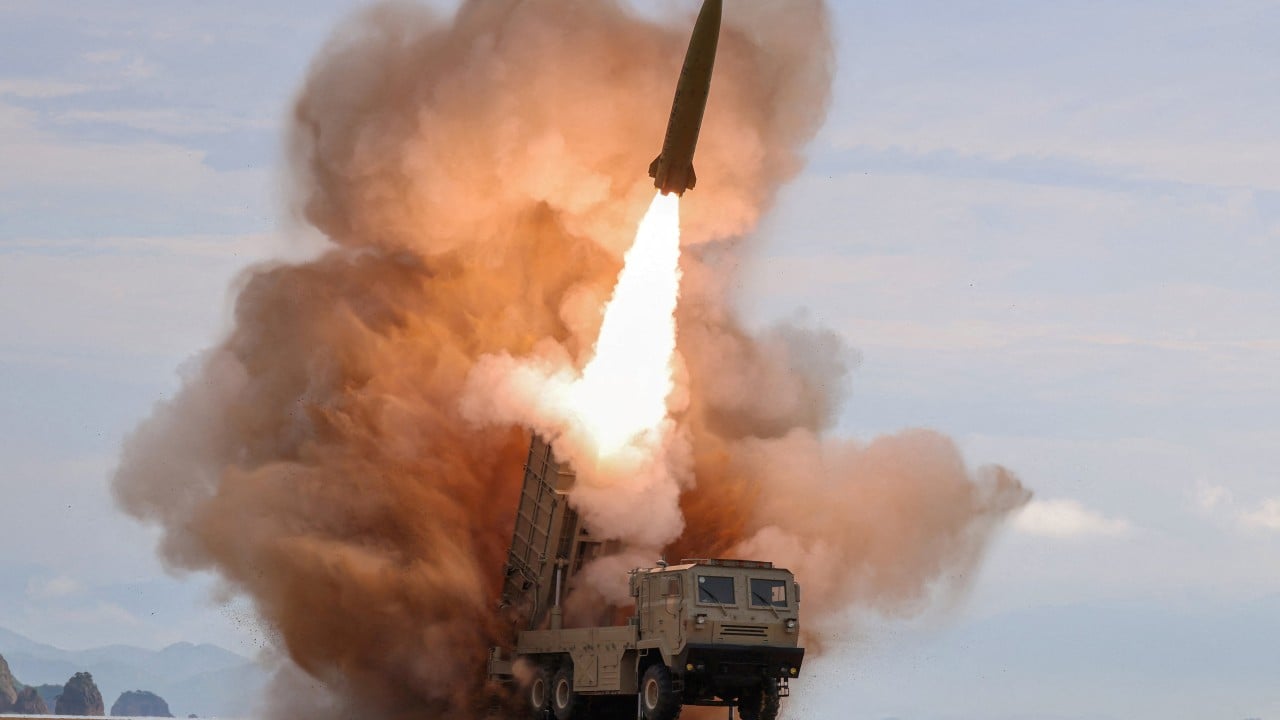
Today, the calculus has mutated. The shift toward solid-fuel propellants means missiles no longer require hours of cumbersome fueling procedures before launch. They can be rolled out of underground bunkers on heavy transporter-erector-launchers, raised, and fired within minutes. Liquid-fueled rockets were vulnerable sitting ducks during the hours it took to pump volatile propellants into their tanks. Solid-fuel rockets are coiled springs, ready to snap the moment the order is given.
And then there is the matter of maneuverability. Modern short-range systems tested by Pyongyang are designed to pull erratic, pull-up maneuvers during their descent, skipping across the upper atmosphere like a flat stone thrown across a pond. This makes them notoriously difficult for traditional missile defense batteries like Patriot or THAAD to intercept cleanly. They are built to bypass the net.
When state media proudly proclaims that these systems possess huge destructive power, they are not merely engaging in domestic propaganda meant to feed a starving population with spectacles of technological might. They are sending a very specific, chilling message to military planners in Seoul and Washington: We can compress your reaction time from twenty minutes to two.
Two minutes.
That is not enough time to make a phone call to a loved one, let alone evacuate twenty-six million souls. It is barely enough time for automated defense systems to calculate an intercept trajectory before the horizon lights up.
Walking through the streets of Seoul, you can feel the fragile brilliance of what has been built here. South Korea clawed its way out of the ashes of a devastating war in the 1950s to construct one of the most vibrant, creative, and technologically advanced societies on earth. Every glass skyscraper, every sprawling university campus, every quiet alleyway lined with centuries-old traditions living side-by-side with futuristic cafes—it is all built on a fault line.
The people know this. They carry it in their bones. It is an unvoiced national contract: live intensely, build fiercely, love deeply, because tomorrow is an open question.
Yet, living under a shadow requires a peculiar kind of psychological architecture. You cannot walk around terrified every second of every day. If you do, the system collapses from the inside out without a single shot being fired. So, collective denial becomes a survival mechanism. The sirens that test the air-raid shelters on the fifteenth of every month become background noise, ignored just as easily as passing ambulance wails.
This psychological resilience is both a shield and a vulnerability. It protects the social fabric from fraying under the constant weight of external threats, but it can also dull the senses to the gradual, ratcheting escalation happening just across the wire.
Every successful test of a low-flying, nuclear-capable missile system shifts the baseline of reality. What was unacceptable yesterday becomes the baseline of today. A new missile variant with greater accuracy, a shorter preparation window, or a larger payload capacity is unveiled, analyzed by think tanks in Washington, condemned in Geneva, and then absorbed into the background hum of daily life.
The danger is not always a sudden, cinematic apocalypse. Sometimes, the danger is the slow erosion of safety margins until a single miscalculation—a misinterpreted radar blip, a nervous lieutenant, a weather balloon crossing the demarcation line—triggers an avalanche that no diplomat can stop.
When we talk about weapons capable of striking with devastating force, we are talking about the fragility of human achievement. We are talking about centuries of culture, art, families, and futures hanging by the thread of a guidance system’s microchip.
Min-ho finishes his coffee on a bench overlooking the Han River. The water reflects the neon of the bridges, shimmering in long, distorted streaks of red and gold. A cool autumn wind rustles the dry leaves in the park. Down below, a group of teenagers laugh loudly, their voices carrying over the muted roar of evening traffic.
He checks his watch. It is time to head home for dinner. He stands up, brushes a stray leaf from his coat, and joins the river of people flowing back into the subterranean warmth of the subway. Above them, invisible in the dark northern sky, the stars shine down indifferently across a jagged mountain range that divides a single people into two irreconcilable realities, waiting to see what the morning brings.