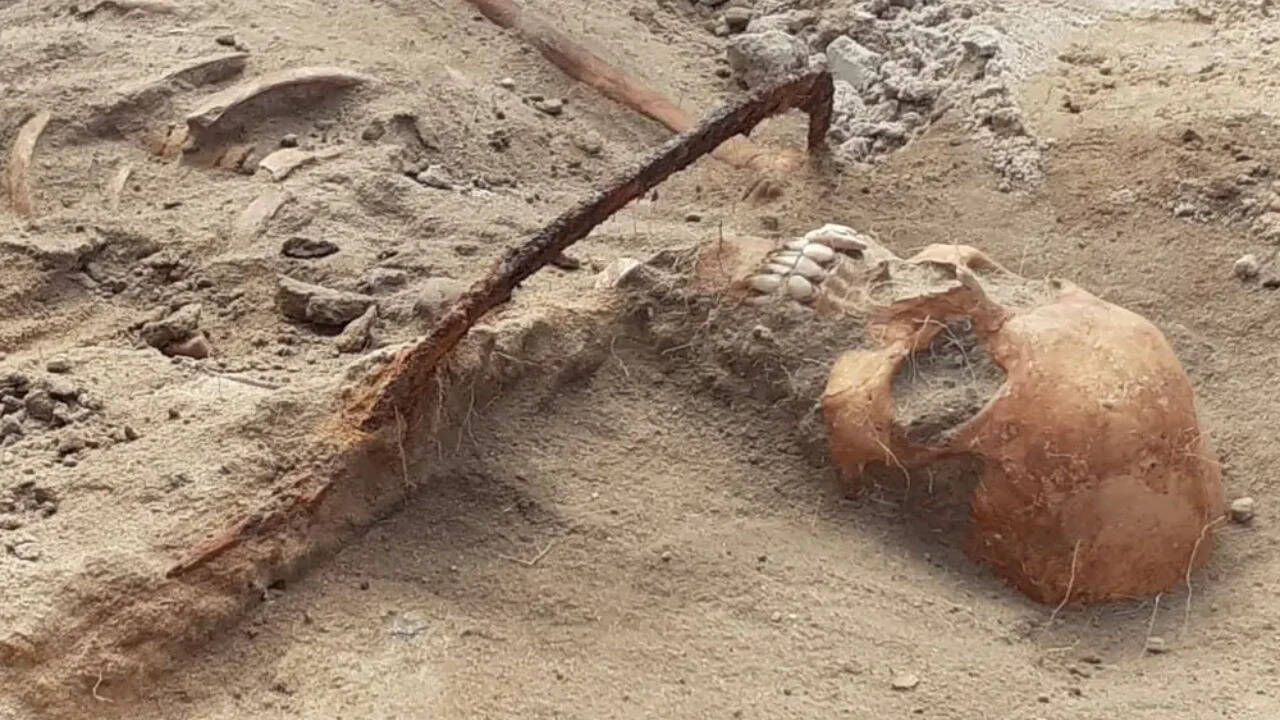
In August 2022, archaeologists excavating a seventeenth-century cemetery in the village of Pień, northern Poland, uncovered the skeletal remains of a young woman buried with an iron sickle placed directly across her throat and a triangular padlock clamped onto her big toe. Led by Professor Dariusz Poliński of Nicolaus Copernicus University in Toruń, the excavation team immediately recognized the grave as an anti-vampire burial—a deliberate ritual engineered by terrified neighbors to prevent the deceased from rising to prey on the living. Far from a scene out of Victorian gothic fiction, this burial represents a grim, pragmatic survival mechanism practiced by rural communities grappling with unexplained disease, sudden death, and social nonconformity.
The blade was not laid there by accident. Positioned horizontally over the neck, the sharp edge of the iron sickle rested against her cervical vertebrae so that if the corpse attempted to sit up, the steel would sever or severely lacerate her throat. The padlock secured to her left hallux served as a secondary spiritual tether, symbolizing the permanent closing of a chapter and the physical locking of the body to the earth. If you enjoyed this post, you might want to read: this related article.
The Anatomy of a Seventeenth-Century Deviant Burial
Most mainstream coverage of the Pień discovery stops at the sensational visual of the sickle. That misses the deeper archaeological truth. In bioarchaeology, graves like this are classified as deviant burials—interments that diverge sharply from the normative funerary customs of a given time and place. When a seventeenth-century Polish villager died an ordinary death, they were wrapped in a simple shroud, laid supine with hands folded over the chest or pelvis, and buried in consecrated ground without metal tools pinned to their anatomy.
The woman in Pień received no such peace, yet her grave contains a striking contradiction that complicates the simple "outcast" narrative. For another angle on this event, see the recent coverage from TIME.
While the sickle and padlock scream fear and rejection, archaeologists found traces of a silk cap woven with gold or silver thread resting on her skull. In seventeenth-century Poland, silk was an exorbitant luxury restricted almost exclusively to the nobility or wealthy merchant class. She was not an impoverished vagrant dragged to the edge of town in rags. She was a woman of high social standing whose wealth could not insulate her from the paranoia of her peers.
Bioarchaeological analysis conducted following the excavation revealed more clues about her physical life. She died young, likely between eighteen and twenty years old. Her skull displayed a distinct protruding front tooth, a minor cranial anomaly that, in an era obsessed with physical omens, could have marked her as suspicious or uncanny while she was still alive. To a superstitious populace lacking modern medical literacy, a visible physical quirk combined with high status—perhaps making her an outsider to the local peasantry—was enough to plant the seeds of dread.
How Folk Belief Turned Neighbors Into Monsters
To understand why sane, hardworking villagers spent valuable iron on a corpse, you have to strip away Bram Stoker, Bela Lugosi, and modern pop culture. The Slavic upiór or strzyga—the historical precursors to the modern vampire—had almost nothing in common with aristocratic seducers in velvet capes.
In seventeenth-century Eastern and Central Europe, a revenant was a bloated, ruddy-faced corpse that crept out of the soil at night to suffocate sleeping relatives, drain the vitality from livestock, and spread wasting sickness through a village. Folk belief held that humans possessed two souls, or that a soul tainted by sin, trauma, or improper death remained trapped inside the flesh after the heart stopped.
Fear dictated the burial rules. Communities relied on strict apotropaic practices—rituals designed to ward off evil—whenever a death deviated from the expected script.
Triggers for an Anti-Vampire Burial
Villagers did not pin down every corpse with farm tools. They reserved these measures for specific red flags that signaled a high risk of post-mortem return:
- The First Victim of an Epidemic: When cholera, typhus, or tuberculosis struck a settlement, people had no concept of germ theory. Seeing family members waste away one after another looked exactly like an invisible predator feeding on the living. The first person to die in an outbreak was routinely blamed for pulling the rest of the village into the grave.
- Unbaptized or Liminal Status: Infants who died before baptism, women who died in childbirth, and people who died by suicide existed outside the protective umbrella of Church sacraments. Folk tradition viewed their souls as restless and dangerous.
- Physical Differences and Strange Behavior: People with congenital deformities, severe mental illness, sleepwalking habits, or even rare traits like being born with a caul (a piece of amniotic membrane covering the head) or extra teeth were flagged early in life.
- Sudden or Violent Death: Anyone killed by lightning, drowning, or murder died without last rites, leaving unresolved spiritual energy behind.
Once a community decided a corpse posed a threat, they deployed escalating tiers of physical containment. A sickle across the neck or abdomen was common because agricultural iron was readily available and carried deep symbolic weight as a protective metal. If the blade failed, other graves from the same era show villagers resorting to heavier tactics: pinning bodies down with massive boulders, burying corpses face-down so they would dig deeper into the earth instead of upward, severing the head and placing it between the feet, or driving wooden stakes through the chest and legs.
The Forensic Reality Behind the Panic
Look closely at what happens to a human body underground, and the "vampire" myth suddenly makes disturbingly logical sense. Seventeenth-century villagers were not hallucinating; they were misinterpreting basic taphonomy—the biological processes of decomposition.
When an epidemic struck or a suspected revenant was blamed for local misfortunes, villagers frequently dug up the grave weeks after burial to inspect the body. What they saw terrified them.
Instead of a dry skeleton, they found a corpse swollen with putrefaction gases, looking plumper and healthier than it had during its final days of illness. Blood-tinged purge fluid often leaked from the mouth and nostrils, giving the unmistakable impression that the deceased had recently gorged on fresh blood. As skin shrank and dehydrated around the fingers and jaw, fingernails and teeth appeared to grow longer. When a desperate villager drove a stake into the bloated abdomen, trapped gases escaped through the vocal cords, producing a wet, rattling groan.
To an eyewitness in 1650, every single piece of physical evidence confirmed their worst nightmare. The corpse looked fed, had grown new fangs, and screamed when stabbed.
Pień Was Not an Isolated Incident
The woman with the sickle made international headlines, yet she was not even the only deviant burial in that specific cemetery. Further excavations at the Pień site uncovered an even more chilling grave just meters away: the remains of a child, estimated to be between five and seven years old, buried face-down with a triangular padlock secured beneath the foot.
Archaeologists noted that the child's grave had been reopened sometime after the initial burial, with the upper torso removed while the lower legs and padlock remained undisturbed. Whether the community feared the child had already risen or sought to neutralize a lingering curse, the pattern is unmistakable. Pień served as an informal burial ground for individuals excluded from standard parish cemeteries—a liminal zone reserved for the feared and the marginalized.
Across Poland, similar discoveries keep surfacing as infrastructure projects and academic digs cut into old rural soils.
In 2013, construction workers building a road near Gliwice uncovered multiple skeletons with their severed heads placed carefully between their legs. A year later, researchers examining graves in Drawsko, northwestern Poland, found six skeletons buried with sickles pressed against their throats and hips, alongside heavy stones placed beneath their chins to prevent the jaw from opening to bite.
Bioarchaeological testing on the Drawsko skeletons shattered an earlier assumption held by many historians. For years, scholars assumed anti-vampire burials were mostly reserved for foreign travelers or wandering outsiders whom locals did not trust. Strontium isotope analysis—a forensic technique that measures chemical signatures in tooth enamel to determine where a person grew up—proved that the individuals buried with sickles in Drawsko were actually native locals.
They were neighbors, cousins, and fellow parishioners. When panic took hold, familiarity offered zero protection.
The Clash Between Church Doctrine and Folk Survival
One of the sharpest misconceptions about these burials is that the Catholic Church orchestrated them. In reality, ecclesiastical authorities spent centuries trying to stamp them out.
Official Christian theology maintained that only God held power over resurrection and that the dead could not wander the earth in physical bodies to drink blood. Parish priests condemned grave desecration, corpse mutilation, and pagan iron rituals as sinful superstitions. Yet on the ground in rural Poland, official doctrine routinely lost to immediate existential terror.
When crops failed, cattle died, and children woke up gasping for air, a sermon on theological orthodoxy offered little comfort. Villagers hedged their bets. They buried their dead with Christian prayers, dressed them in fine silk caps, and still slipped an iron sickle over the windpipe just in case the priest was wrong.
Why Modern Narratives Keep Getting It Wrong
Every time an archaeologist pulls a sickle or a stake out of European soil, modern media frames the story as a quirky Halloween curiosity or proof that people in the past were hopelessly gullible. Both angles miss the point.
Labeling these graves "vampire burials" is a convenient shorthand for journalists, but it flattens a complex web of grief, trauma, and primitive public health management into a monster movie trope. The people who buried the young woman in Pień were not hunting Count Dracula. They were trying to stop invisible diseases they had no words to name, using the only tools their culture gave them to assert control over death.
The woman in the silk cap was likely a victim twice over—first of whatever sudden illness cut her life short at twenty, and second of a community so terrified of losing its survivors that it pinned her body to the dirt with cold iron. When archaeologists brush the soil off that rusted sickle three hundred years later, they are not uncovering proof of the supernatural. They are uncovering the exact physical shape of human panic when science has no answers left to give.