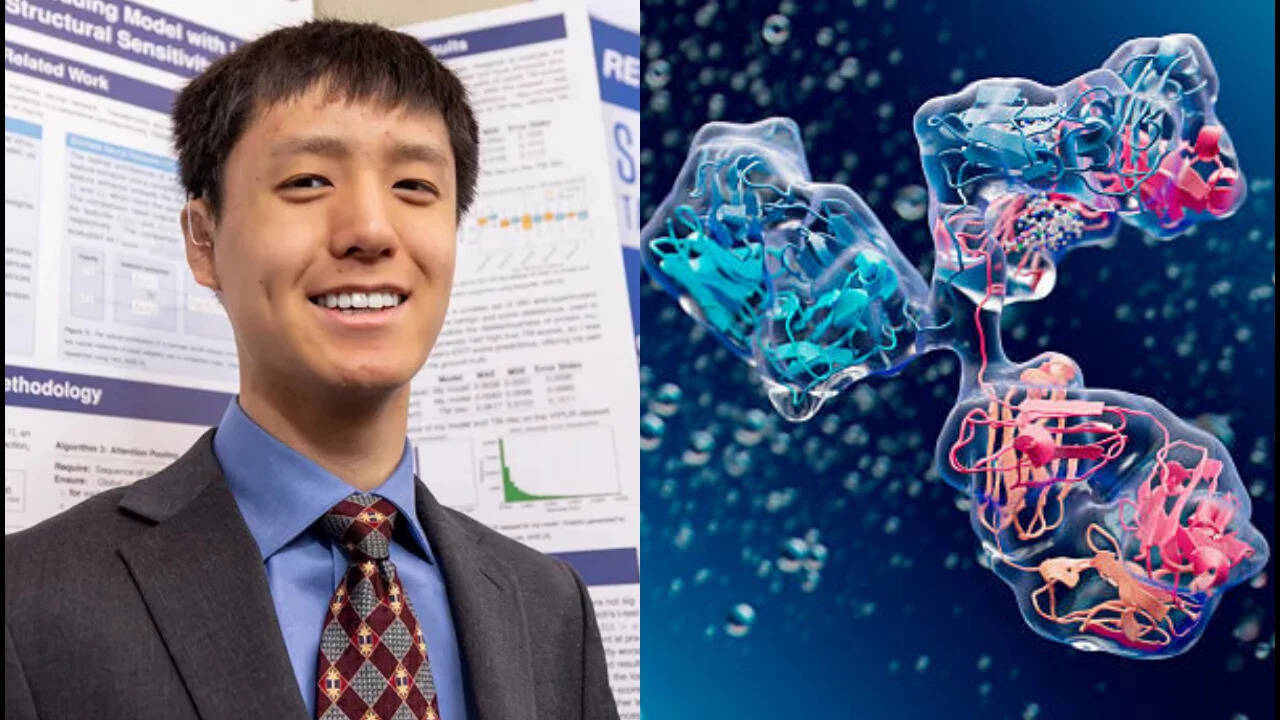
Big tech companies spend billions trying to figure out protein folding. They build massive data centers. They hire hundreds of PhDs. Then a teenager walks in with a laptop and wins a ninety-thousand-dollar prize for doing it better, faster, and cheaper.
It sounds like a movie script. It is actually happening right now in biotechnology.
Most people think cutting-edge science requires a white coat, a tenured professor breathing down your neck, and grant funding that takes six months to clear. That system is broken. When a high schooler builds an artificial intelligence model that decodes complex molecular shapes from a bedroom desk, the entire academic gatekeeping model starts to wobble.
We need to talk about why this happens, how these young builders pull it off, and what it means for the future of medicine.
The Protein Decoding Bottleneck Nobody Talks About
Proteins run your body. They digest food, pump oxygen through your blood, and fight off viruses. Every single protein starts as a long string of amino acids. Then it folds into a complex three-dimensional shape.
Shape dictates function. If a protein folds wrong, you get sick. Diseases like Alzheimer's, Parkinson's, and cystic fibrosis trace back to misfolded proteins.
For decades, figuring out these structures meant doing painstaking lab work. Scientists used X-ray crystallography and cryo-electron microscopy. These methods take years and cost fortunes per protein. Scientists knew the amino acid sequences for millions of proteins, but we only knew the actual 3D shapes of a tiny fraction of them.
Then machine learning entered the chat.
Instead of waiting years for lab results, smart programmers realized algorithms could predict the folds based on patterns in the sequence data. Big labs made headlines with AlphaFold. People assumed you needed massive computing clusters to play this game.
That assumption stopped being true.
How a Teenager Built a Better Bioinformatics Tool
When you remove institutional bureaucracy from science, speed skyrockets. Young developers aren't burdened by the way things have always been done. They do not care about academic hierarchy or traditional peer review timelines until the very end of the process.
Instead of building a supercomputer from scratch, brilliant students tap into open-source repositories and cloud computing credits. They write lean, efficient code that focuses on specific structural gaps rather than trying to solve every biological mystery at once.
When this specific seventeen-year-old developer entered the Regeneron Science Talent Search or similar elite youth science competitions and walked away with a massive cash prize, judges did not award the money for effort. They awarded it because the software worked. The AI model successfully predicted structural interactions that traditional pipelines missed or took too long to compute.
Here is what most casual observers miss about these breakthroughs. The code itself is rarely brand new. The magic lives in how the data is filtered, how the neural network is trained, and how the developer frames the loss function. It takes fresh eyes to spot the inefficiencies everyone else normalized.
Why Traditional Academia is Sweating
Academia moves slowly by design. Grants take quarters to approve. Committees debate wording for months. Journals reject papers because a footnote is out of place.
Meanwhile, kids on Discord share breakthroughs in real time. They train models overnight on rented GPUs.
This creates a massive culture clash. Traditional researchers spend a decade earning credentials just to get access to the right lab equipment. Modern computational biology only requires an internet connection and a brain. When a teenager can outperform legacy research teams, university biology departments have to rethink their value proposition entirely.
You cannot gatekeep a field when the barrier to entry drops to the cost of a used MacBook and an AWS subscription.
Drug discovery is shifting from a wet lab industry to a software industry. Chemistry is becoming code. When code eats biology, age stops mattering. Experience takes a back seat to raw computational intuition.
What This Means for Practical Medicine
Let us translate this out of the tech blogs and into the real world. Why should you care about a teenager winning ninety grand for folding proteins?
Because faster structure prediction means faster drug discovery.
Right now, creating a new medication takes over a decade and billions of dollars. Most of that money vanishes into dead ends where a drug molecule fails to bind correctly to its target protein. If an AI model can accurately predict those binding interactions in seconds instead of years, the pharmaceutical timeline shrinks dramatically.
Rare diseases that big pharma ignores because they lack a profitable market suddenly become solvable by independent research groups or open-source collectives. When tools become this accessible, medical research democratizes.
We are moving away from centralized pharmaceutical monopolies toward distributed, agile problem-solving.
How to Start Building in Computational Biology
If reading about a teenager disrupting structural biology makes you want to dive in, stop waiting for permission. You do not need a biology degree to build models that help scientists.
Start with the basics of Python and machine learning frameworks like PyTorch.
Pull open-source datasets from the Protein Data Bank.
Join open science communities online where researchers collaborate on structural biology challenges without worrying about university affiliations or corporate patents.
The tools are sitting there right now, completely free, waiting for someone to use them better than the person who came before. Pick a problem, open your terminal, and get to work.