The 4.5-magnitude earthquake that struck near Gulgong in New South Wales serves as a high-fidelity case study in the vulnerability of intraplate regions—areas located far from tectonic plate boundaries that nonetheless accumulate significant crustal stress. While a 4.5-magnitude event ranks as "light" on the Moment Magnitude Scale ($M_w$), its impact is disproportionately governed by shallow focal depths and the specific geological composition of the Lachlan Fold Belt. The energy release, equivalent to approximately 500 tons of TNT, creates a localized acceleration of ground motion that challenges the prescriptive assumptions of regional building codes. Understanding the risk requires a deconstruction of the seismic mechanics, the failure points in regional infrastructure, and the economic ripple effects of moderate-intensity events in non-seismic zones.
The Mechanics of Intraplate Seismicity
Standard seismic models often overlook the nuances of intraplate stress accumulation. Unlike the plate boundaries of the "Ring of Fire," where subduction and slip are predictable, the Australian landmass operates under a regime of horizontal compressive stress. This stress is generated by the northward movement of the Indo-Australian plate, which encounters resistance at its northern boundary near Indonesia and the Himalayas.
Crustal Stress Redistribution
The Gulgong event is a manifestation of this compression hitting localized points of weakness—ancient fault lines that have remained dormant for millennia. The seismic process follows a three-stage mechanical cycle:
- Stress Loading: Elastic strain builds within the brittle upper crust. Because the Lachlan Fold Belt consists of complex, folded Paleozoic rocks, this strain does not distribute evenly.
- Nucleation: The stress exceeds the frictional strength of a pre-existing fault or fracture zone.
- Rupture Propagation: The sudden slip releases energy as seismic waves.
In the case of the central west NSW event, the focal depth was recorded at approximately 10 kilometers. Shallow depths are critical variables; seismic waves have less distance to attenuate (lose energy) before reaching the surface. This leads to higher Peak Ground Acceleration (PGA) values, which directly correlate to the structural damage perceived by residents and captured by seismometers.
Quantifying the Human and Structural Perception
The "rattling" described by thousands of residents is a qualitative measure of a quantitative reality: the Modified Mercalli Intensity (MMI) scale. While magnitude measures the energy at the source, intensity measures the effect at a specific location.
The Attenuation Gradient
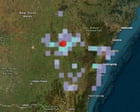
The Gulgong earthquake produced an MMI of V (Strong) near the epicenter and remained felt at an MMI of II-III (Weak to Gentle) as far as Sydney and Dubbo. The ability of these waves to travel long distances is a function of the Australian crust's high "Q-factor" or seismic quality factor. Old, cold, and stable crust transmits energy more efficiently than the young, warm, and fractured crust found in places like California or Japan.
Structural integrity in the region faces a specific "Legacy Bottleneck." Most residential structures in rural NSW were constructed prior to the 1993 adoption of the AS 1170.4 seismic loading standard. These buildings typically feature:
- Unreinforced Masonry (URM): High mass and low ductility make brick chimneys and parapets the first points of failure.
- Non-Ductile Frames: Timber or older steel frames that lack the flexibility to absorb lateral loads.
- Soil Amplification: Buildings situated on river alluvium or soft sediment experience "site effects," where the ground motion is amplified compared to structures built on bedrock.
The Economic Cost Function of Moderate Seismicity
The primary economic fallacy regarding 4.5-magnitude events is that "no visible collapse" equals "no economic impact." The reality is a distributed cost model that affects private equity, public infrastructure, and the insurance markets.
Primary and Secondary Fiscal Impacts
The fiscal impact of the Gulgong earthquake can be categorized into three tiers of loss:
- Direct Capital Loss: Immediate repair costs for cracked plaster, damaged water mains, and compromised telecommunications towers.
- Productivity Friction: The "fright factor" and subsequent safety inspections lead to temporary shutdowns in local industries, including mining operations common in the Mid-Western Regional Council area.
- Insurance Re-rating: Repeated moderate events in a specific zone trigger a reassessment of the Probable Maximum Loss (PML). This leads to a tightening of the insurance market, higher premiums for local businesses, and increased "deductible friction" where homeowners bear the brunt of minor repairs.
Limitations of Current Monitoring Systems
Australia's seismic network, managed by Geoscience Australia, provides rapid data, yet significant gaps remain in "Real-Time Structural Health Monitoring" (SHM).
The density of the sensor network in central west NSW dictates the precision of the location and depth estimates. A lower sensor density leads to higher margins of error in the initial "automated" reports, which often undergo manual revision. This lag creates a vacuum for misinformation and prevents emergency services from deploying resources based on precise "ShakeMap" data in the critical first 30 minutes post-rupture.
Furthermore, the lack of accelerometers inside high-occupancy or critical infrastructure buildings means we have zero data on how specific local building types responded to the Gulgong loads. Without this data, the feedback loop for improving building codes remains broken.
Strategic Framework for Regional Resilience
The Gulgong event is a signal that the "stable" interior of the continent requires a shift from reactive observation to proactive hardening. A rigorous strategy for the region involves three distinct operational shifts.
Structural Retrofitting of High-Risk Assets
The priority must be the identification and reinforcement of URM structures, particularly those serving public functions like schools or hospitals. The application of Carbon Fiber Reinforced Polymer (CFRP) wraps to load-bearing columns is a cost-effective method to increase ductility without requiring total demolition.
Expansion of the Strong-Motion Network
To move beyond "feeling" an earthquake to "measuring" it for engineering purposes, the government must incentivize the installation of low-cost MEMS (Micro-Electro-Mechanical Systems) accelerometers in urban centers across the central west. This would provide the granular data necessary to map site-specific amplification risks.
Insurance and Risk Transfer Innovation
The current insurance model for Australian earthquakes is outdated. We require the development of Parametric Insurance products. Unlike traditional insurance that pays based on assessed damage, parametric insurance triggers an immediate payout based on a pre-agreed parameter—such as an MMI of VI or higher at a specific latitude/longitude coordinate. This eliminates the lengthy claims adjustment process and provides immediate liquidity to affected communities.
The Gulgong earthquake was not an anomaly; it was a reminder of the latent tectonic energy stored within the Australian plate. The failure to treat 4.5-magnitude events as technical warnings leads to catastrophic unpreparedness for the inevitable, though rarer, 6.0-magnitude event. Engineering for the "light" shakes is the only viable path to surviving the "heavy" ones.