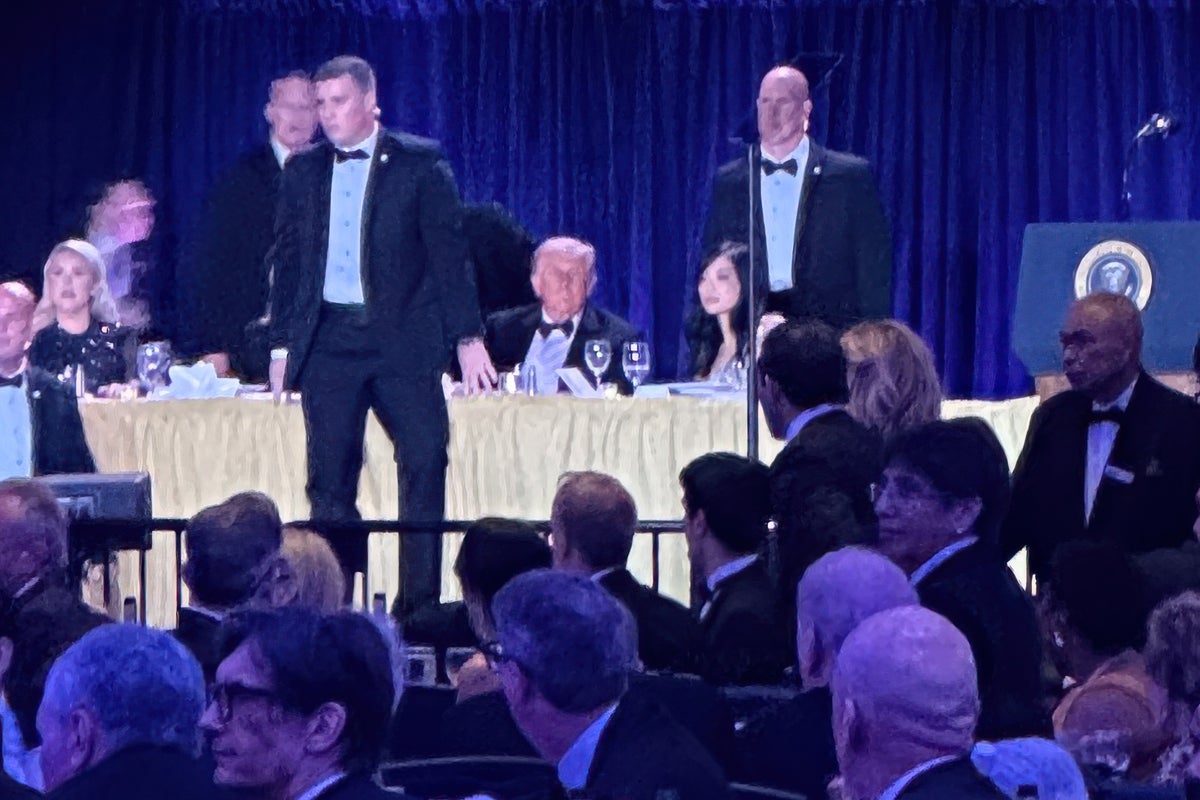
The standard media narrative regarding the attempted breach of a high-profile political event is always the same: a mix of breathless "huddled in fear" testimonials and a heavy-handed focus on the physical mechanics of the door. The press loves a locked-room mystery. They want to tell you about the tension in the ballroom, the click of the latch, and the frantic whispers of the Secret Service. They want you to believe the threat was a single man with a grudge.
They are wrong.
Focusing on the physical perimeter is like obsessing over a screen door while your house is sinking into a sinkhole. In the modern security era, if a physical breach is even possible, the real failure happened months prior, in the digital and psychological layers that the media—and often the organizers—ignore in favor of "security theater."
The Perimeter is a Lie
We treat ballrooms like medieval fortresses. We check bags. We walk through metal detectors. We stand behind velvet ropes. This creates a psychological cocoon that actually makes the room less safe. Security professionals call this "target hardening," but what we saw in the recent attempt to reach Donald Trump was a failure of the "soft" layers that precede the physical wall.
True security isn't a wall. It’s a series of concentric circles starting miles away from the venue. When a person reaches the door of a ballroom with intent to harm or disrupt, the primary security apparatus has already collapsed.
The media focuses on the "bravery" of the agents at the door. I’ve worked in high-threat environments where the most effective agents were the ones you never saw—the ones monitoring signal intelligence and behavioral anomalies three blocks away. If you are wrestling a guy at the entrance, you’ve already lost the tactical advantage. You’re playing catch-up in a game where seconds cost lives.
The Data Vacuum Behind the Door
Why do these breaches keep happening despite "unprecedented" security? Because we are still using 1990s logic in a 2026 threat environment.
The "lazy consensus" suggests that more boots on the ground equals more safety. It doesn’t. It just equals more targets. The real breach wasn't just a physical act; it was a failure of predictive analysis. Modern security relies on the integration of disparate data points—social media sentiment, localized encrypted traffic spikes, and facial recognition cross-referenced with watchlists in real-time.
Most event organizers treat security as a line item on a budget rather than a dynamic tech stack. They hire a firm, they get some guys in suits with earpieces, and they call it a day. But those suits are looking for a guy with a gun. They aren't looking for the digital footprint of a coordinated effort.
The Psychology of the Crowd as a Weapon
The competitor article spent eight paragraphs describing the "panic" inside the room. Panic is exactly what the intruder wants. Panic is a force multiplier for the attacker.
When the press reports on the "harrowing moments," they are effectively rewarding the breach. They turn a security lapse into a cultural moment, which incentivizes the next attempt. We need to stop romanticizing the victimhood of the people inside the room.
In a high-stakes environment, the people inside the room are part of the security ecosystem. Yet, they are never trained on what to do. They are treated like sheep, which creates the very chaos that prevents security from doing their job. A room full of disciplined, informed individuals is a hard target. A room full of terrified socialites and journalists is a playground for a disruptor.
Stop Asking "How Did He Get In?"
People always ask the wrong question. They ask how he got past the first checkpoint. They should be asking why the first checkpoint was the only thing standing between the intruder and the target.
Redundancy is the only thing that works. In technical terms, this is "Defense in Depth."
- The Intelligence Layer: Identifying the threat before they leave their house.
- The Electronic Layer: Jamming or monitoring unauthorized communications in the immediate vicinity.
- The Behavioral Layer: Plainclothes assets identifying "pre-attack indicators" (fidgeting, unnatural gait, checking exits).
- The Physical Layer: The actual door.
If you only have the fourth layer, you don't have security. You have a prayer.
The Myth of the Unpredictable Actor
The media loves the "lone wolf" narrative because it excuses the failure. If someone is "unpredictable," then no one is to blame. But almost nothing is truly unpredictable if you have the right sensors in place.
Breaches are almost always preceded by "dry runs" or "probing." These are subtle tests of the perimeter. A person walks up to a guard, asks a weird question, and walks away. A car circles the block three times too many. In the Trump incident, the "breacher" didn't just fall from the sky. He moved through a physical space that should have been monitored for anomalies long before he touched a door handle.
We rely on human eyes to catch these anomalies. Human eyes get tired. Human eyes get distracted by the VIPs in the room. We should be using AI-driven spatial analysis that flags these patterns instantly. We don't, because people find it "creepy." You know what's creepier? A gunman in your ballroom.
The Cost of Complacency
I’ve seen organizations blow millions on armored cars and tactical gear while their cybersecurity is a joke and their staff doesn't know how to spot a tail. We are obsessed with the optics of security. We want the big dogs and the heavy vests because they make us feel safe.
Feeling safe is the enemy of being safe.
The ballroom breach was a failure of imagination. It was the result of a security team that believed their own press releases. They thought the "Secret Service" brand was enough of a deterrent. It wasn't. It never is.
Actionable Reality
If you are responsible for a high-profile target, stop looking at the door.
Start looking at the data. Hire the "weird" analysts who look at traffic patterns and social sentiment. Fire the security firm that promises "100% safety" based on how many guards they put in the lobby.
The downside to this approach? It’s expensive, it’s invisible, and it doesn't look good in a brochure. You won't have the "hero" story of the guard who tackled the guy at the last second, because the guy will have been picked up three miles away while he was still checking his GPS.
The most successful security operation is the one where nothing happens and the press has nothing to write about. The fact that we are even talking about a "breach" means the system was broken before the event even started.
Stop focusing on the man at the door and start looking at the system that let him walk up to it.