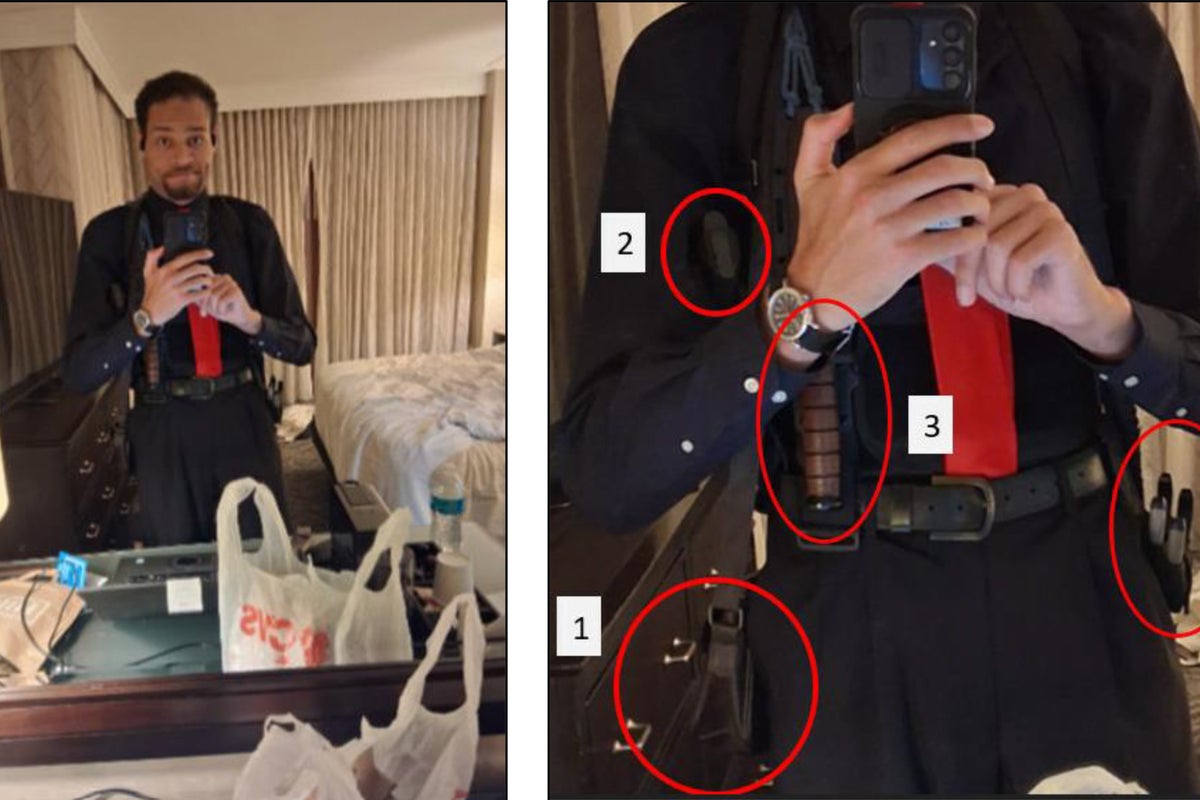
The arrest of Manuel Oliveras in Jupiter, Florida, exposes a systemic breakdown in protective intelligence and physical security perimeter management. While traditional security discourse focuses on the point of impact—the moment an assailant is neutralized—the true failure occurs in the preceding tactical windows: acquisition, staging, and penetration. Oliveras, charged with attempting to assassinate Donald Trump during a private dinner, utilized a "low-signature" infiltration strategy that bypassed standard technical detection by relying on non-ballistic weaponry and proximity-based surveillance.
The Mechanics of Proximity and the Knife Variable
Traditional protection models are heavily weighted toward ballistic threats. Metal detectors, explosive sniffing canines, and line-of-sight clearing are optimized to detect firearms and long-range kinetic projectiles. Oliveras exploited a vulnerability in the security posture by introducing a non-ballistic threat: a fixed-blade knife.
The investigative recovery of a photograph showing Oliveras posing with a knife in his hotel room—taken shortly before the event—functions as a forensic "intent marker." In protective intelligence, an intent marker is a piece of evidence that bridges the gap between a person of interest and a direct threat. By choosing a blade, the assailant reduced his technical signature. Knives do not emit the chemical residues associated with gunpowder and, depending on the material, can be masked more easily against high-traffic physical screening environments.
This creates a Response Time Gap. A firearm creates a "distance-to-target" requirement where the assailant is often visible or detectable before the trigger pull. A bladed weapon requires zero-distance proximity, meaning the security failure occurs the moment the individual enters the "inner circle" of the protectee. If a suspect is within five feet of a target with a concealed blade, the reaction time required for a Secret Service agent to identify, draw, and neutralize the threat often exceeds the physical speed of a lunging strike.
Operational Staging and the Hotel Surveillance Gap
The investigative timeline reveals that Oliveras utilized a local hotel as a tactical staging ground. This is a classic "Short-Term Operational Base" (STOB). Most assassination attempts involve a period of pre-attack surveillance where the actor observes the target's movement patterns.
The photo of the knife serves as more than just evidence of a weapon; it is evidence of a psychological "dry run." High-risk actors frequently engage in ritualistic behavior—taking photos, writing manifestos, or rehearsing movements—in the hours leading up to an engagement. The fact that this staging occurred in a commercial hotel near the venue highlights the failure of "Radius-Based Intelligence."
Security protocols often focus on the venue itself (the dinner) while neglecting the secondary and tertiary zones (local hotels, parking garages, and transit hubs).
- Primary Zone: The immediate 50-foot radius around the protectee.
- Secondary Zone: The venue perimeter and entry/exit points.
- Tertiary Zone: The surrounding 1-mile radius where the assailant lives, eats, and prepares.
Oliveras successfully navigated the Tertiary and Secondary zones. The bottleneck in current protective strategy is the lack of real-time data integration between local law enforcement, hotel security, and federal protective details. A suspicious individual "rehearsing" with a weapon in a room two miles away is outside the current technical reach of a Secret Service perimeter.
The Behavioral Profile of the Lone Actor Infiltrator
Evidence suggests Oliveras fits the profile of a "low-resource, high-intent" actor. Unlike a professional state-sponsored cell, a lone actor relies on the "Invisibility of the Mundane." He does not carry a sniper rifle case or wear tactical gear; he carries a pocket-sized weapon and blends into the demographic of the event attendees or staff.
Investigative findings indicate Oliveras may have been tracking the former President’s schedule via public or semi-public sources. This highlights the Asymmetry of Information. The protectee’s schedule is rigid and often publicized for logistical reasons, whereas the assailant’s schedule is fluid and hidden.
The "Pillar of Pre-incident Indicators" (PINs) for Oliveras likely included:
- Direct Communication: Threats made on social media or to associates (often dismissed as "venting").
- Tactical Acquisition: The purchase or sharpening of the knife.
- Site Proximity: Presence at or near the venue hours before the protectee's arrival.
When these indicators are analyzed in isolation, they appear minor. When mapped as a sequence, they represent a "Launch Chain." The security apparatus failed to break this chain before it reached the kinetic stage.
Technical Failures in Detection and Screening
The presence of a knife in a secure environment where a high-profile protectee is dining indicates a failure of the Magnetometer Protocol. If Oliveras was able to approach the target area while armed, the failure point is either mechanical or human.
- Mechanical Failure: The sensitivity levels on walk-through metal detectors (WTMDs) are often tuned to ignore small metal objects like keys or coins to prevent logistical bottlenecks. A ceramic or high-carbon steel blade can sometimes bypass low-sensitivity settings.
- Human Failure: The "Bypass via Social Engineering." Assailants often watch security guards to identify which guards are distracted, which lines are moving fastest, or which entry points have the least oversight.
The investigative focus on the hotel room photo implies that the knife was a central component of his lethal intent. In a closed-room environment like a dinner, the acoustic and visual chaos of a crowd provides "Signal Noise." This noise masks the movement of an individual moving toward the "High-Value Target" (HVT).
The Cost of Reactive Security
The current protective model is reactive: wait for a threat to manifest, then neutralize. This is an unsustainable cost function. The "Cost of a Miss" is the loss of a former President and national stability. The "Cost of a Prevent" involves massive intelligence sweeping that often treads on civil liberties or logistical feasibility.
The Oliveras case proves that the "Threat Surface" is expanding. It is no longer just about rooftops and long-range ballistics (as seen in Butler, PA); it is about the "Inner Circle" and the concealment of low-tech weaponry.
To mitigate future attempts, the protective strategy must shift toward Contextual Intelligence Overlays. This involves:
- AI-Driven Behavioral Analysis: Using CCTV to identify "anomalous loitering" or "target fixation" in the Tertiary Zone.
- Non-Linear Perimeter Expansion: Moving the "Hard Shield" further away from the protectee to include local staging areas like hotels.
- Weapon-Specific Screening: Implementing Millimeter Wave (mmWave) scanners that detect shapes (like a knife profile) rather than just metal density.
The arrest in Jupiter is not a success story of security—it is a late-stage intervention that occurred at the "threshold of lethality." If the photo of the knife was taken in the hotel room, the assailant had already cleared the hardest psychological barrier: the decision to kill. The physical barrier was all that remained, and it was nearly breached.
The strategic play now is a total audit of "Micro-Threat" detection. Security details must assume that the next assailant will not use a rifle from 150 yards, but a six-inch blade from six inches away. The defense must be as granular as the threat. This requires moving beyond the "Gun Culture" of security and into a "Systemic Anomaly" mindset where every hotel guest within a five-mile radius of a VIP is a data point in a real-time risk assessment. Any individual who documents their weapon in a staging area must be flagged by automated digital intelligence before they ever reach the venue sidewalk.