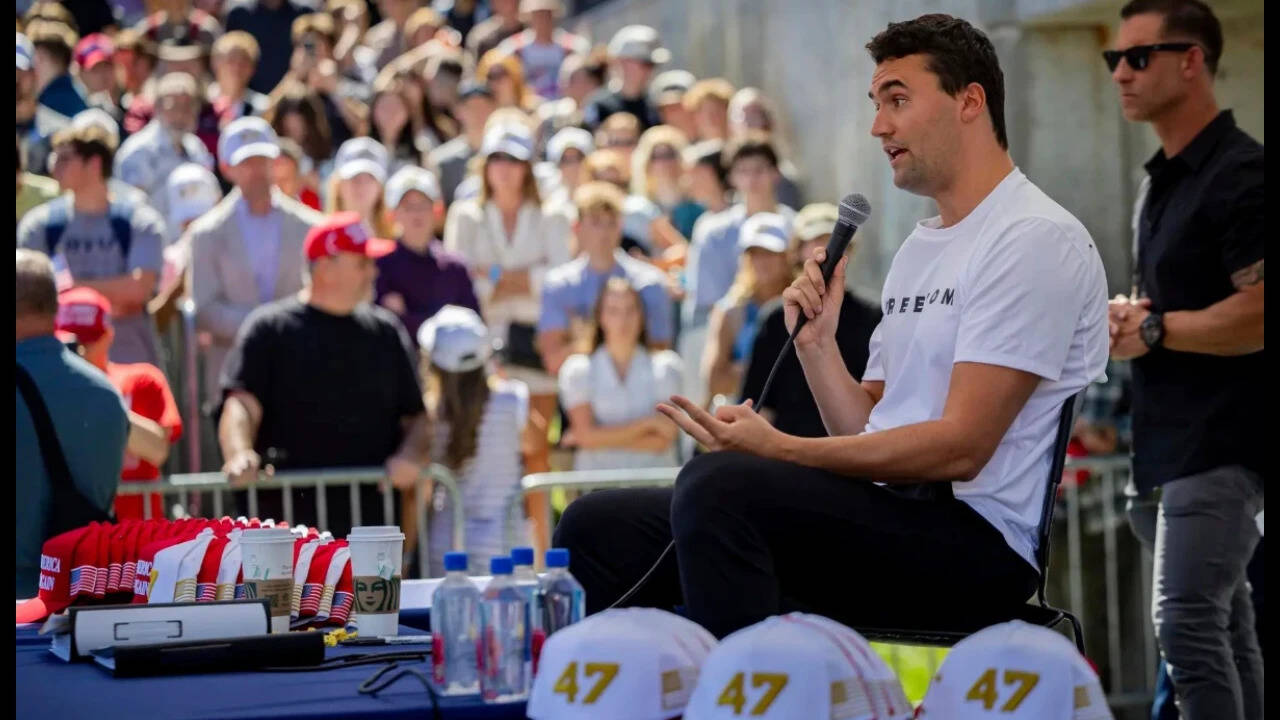
Every single major editorial board, cable news pundit, and institutional apologist has completely missed the actual story coming out of Utah Valley University.
The media wants you to focus on a tired, predictable culture war narrative. They want you to debate whether outdoor venues are inherently unsafe or whether Turning Point USA pushed a reckless logistical envelope. That is the exact trap university risk committees set for the public. It is a calculated diversion designed to obscure a much more dangerous precedent.
Let us strip away the partisan theatre and look at the raw mechanics of institutional cowardice.
When a public university hides behind an inability to provide security, they are not admitting a logistical failure. They are admitting extortion by default. They are establishing a terrifying baseline where any administration can veto constitutionally protected speech simply by quoting an inflated security invoice or pretending the quad is too big to patrol.
I have spent decades watching institutional risk management teams operate. I have seen universities quietly rewrite facility use guidelines overnight to price out controversial speakers, hide behind insurance policy loopholes, and weaponize crowd control estimates to achieve political goals without ever having to issue an outright ban.
Utah Valley University did not fail because the logistics were too complex. They failed because risk aversion has become the default governance model for higher education.
Let us dismantle the core premise pushed by the mainstream consensus. The common narrative argues that insisting on an outdoor address for a high-profile political tour is an unnecessary provocation that strains local law enforcement. This argument assumes that public safety resources are finite commodities that must be rationed based on the political palatability of the speaker.
That logic destroys the First Amendment.
If security costs dictate who gets to speak on a public campus, then free speech is no longer a constitutional right. It is a luxury item sold to the highest bidder or denied to anyone who draws enough outrage to spike the overtime budget. When a university administration claims they cannot secure an outdoor venue, they are abdicating their primary public function. A taxpayer-funded campus is not a private country club that can selectively close its doors when things get messy.
The administrative playbook is painfully predictable. First, inflate the security requirements by demanding dozens of extra officers, metal detectors, and perimeter barricades. Second, present the bill or the logistical hurdle to the hosting student group as an insurmountable barrier. Third, suggest a quiet indoor room down a back hallway at 8:00 AM on a Tuesday. Fourth, when the organizers push back, leak to the press that the speakers were uncooperative and insisted on dangerous venues.
It is a masterclass in bureaucratic deflection.
The real scandal is not that an outdoor event is hard to secure. The real scandal is that university leadership has outsourced its spine to municipal risk assessors. Modern campus presidents act less like academic leaders defending the marketplace of ideas and more like corporate compliance officers terrified of a shareholder lawsuit or a negative social media trend.
Consider the operational reality of securing a campus. Universities host massive football games, packed concert venues, and multi-thousand-person commencement ceremonies every single year. They manage alcohol sales, tailgating traffic, parking logistics, and crowd surges without blinking an eye. Yet the moment a political speaker with a controversial following enters the calendar, the entire campus security apparatus suddenly forgets how to manage a perimeter.
They can handle fifty thousand screaming fans drinking light beer in a stadium, but a couple thousand people standing on a grass quad listening to a speech apparently requires military-grade intervention that the local sheriff cannot possibly manage.
The math does not work because the excuse is fake.
What happens when we accept the university's defense at face value? We hand every hostile administrator a permanent kill switch for speech they dislike. All a dean has to do is whisper to the campus police chief to inflate the threat matrix, and presto, the event is canceled due to safety concerns. The administration looks reasonable, the blame shifts to the organizers, and the constitutional right to assemble is quietly shredded in the name of public safety.
We are watching the death of institutional courage in real time.
The counter-intuitive reality that nobody wants to admit is that outdoor venues are often safer, more transparent, and easier to monitor than confined indoor spaces. In an open-air environment, crowd flow is organic, bottlenecks are minimized, and law enforcement has clear lines of sight from multiple angles. Confining a high-tension crowd inside a stuffy auditorium with a single choke point is a security nightmare. Outdoor setups are chosen precisely because they scale better and prevent the claustrophobic crush that turns minor disturbances into physical stampedes.
Yet the narrative persists that going outside is an act of aggression. That inversion of reality is deliberate.
If you want to fix how public universities handle controversial events, stop treating security estimates as objective truths. Treat them as political negotiations. Demand itemized breakdowns. Force institutions to prove why a political speech requires ten times the security footprint of a crowded campus music festival. When administrators realize their bluff is going to be met with rigorous legal and public scrutiny, their logistical impossibilities tend to evaporate remarkably fast.
The alternative is a slow surrender of public space to whichever faction makes the most noise or threatens the most disruption. Once you let a university cancel an event by crying wolf over security, you have given them the power to silence anyone.
Never mistake a liability shield for a safety protocol.