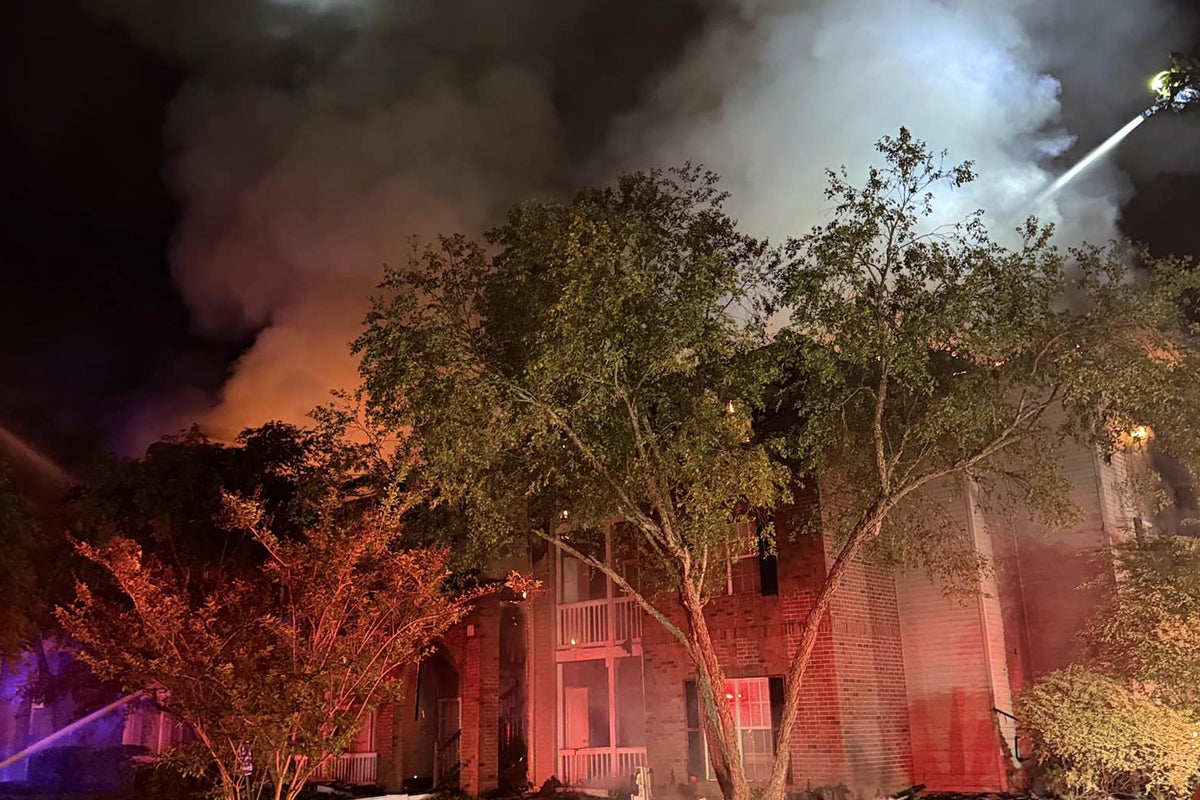
The black smoke rising from the life-safety failure at an apartment complex in Brookhaven, Georgia, did more than just trigger sirens. It created a vacuum where seconds dictated the difference between a tragedy and a miracle. When a mother stood on a second-story balcony with her two children, the building behind her becoming a furnace, she didn't have the luxury of a fire escape or a cushioned landing. She had a choice. Trust the gravity that threatened them or trust the outstretched arms of the officers standing in the Georgia mud.
This was not a calculated move. It was the raw output of a survival mechanism that bypasses the prefrontal cortex. The footage, captured by body-worn cameras, shows the frantic reality of a structure fire that moved faster than the local department’s ladder trucks could arrive. While the headlines focus on the dramatic "toss," the real story lies in the structural failures of modern high-density housing and the split-second coordination between civilians and law enforcement that occurs when every official safety net fails.
The Physics of a Second Story Escape
Most people underestimate the danger of a ten-foot drop. When you add the weight of a child and the unpredictability of a panicked descent, the risk of spinal injury or blunt force trauma skyrockets. In the Brookhaven incident, the mother was pushed to the absolute edge of the balcony by heat levels that likely exceeded 400°F at the ceiling level just behind her.
Fire spreads in apartment complexes through a process called "auto-exposure," where flames break through windows and travel upward to the next floor. Once the oxygen in a room is consumed, a flashover occurs. This mother wasn't just running from fire; she was running from a pressure wave of toxic gas and heat that makes breathing impossible within three to five inhalations.
The officers on the ground, members of the Brookhaven Police Department, moved into what is known as the "hot zone" without turnout gear. Their decision to stand directly under the balcony placed them at risk of falling debris and glass, yet they remained stationary to create a human landing pad. This wasn't a standard operating procedure found in a manual. It was improvised rescue at its most dangerous.
When Infrastructure Fails the Resident
We have to look at why a mother was forced to throw her children to the ground in the first place. Modern building codes are supposed to prevent "single-exit" traps, yet many older or rapidly renovated complexes in the Atlanta metro area rely on exterior wooden stairs. Once those stairs catch fire, the balcony becomes a cage.
The Problem with Garden Style Apartments
- External egress: Many Georgia complexes use wood-frame construction with external walkways. If the fire starts near the front door, the only exit is blocked.
- Lack of Sprinklers: Older buildings often lack automated suppression systems that could buy a resident the five minutes needed for a ladder crew to arrive.
- Rapid Ignition: Synthetic materials in modern furniture burn hotter and faster than the wood and cotton used forty years ago.
The Brookhaven fire moved with such velocity that the primary stairwell was incinerated in minutes. This forced the mother into a vertical evacuation. While the bravery of the officers is undeniable, the necessity of their bravery points to a systemic gap in high-density residential fire safety. If the building had been equipped with a simple monitored alarm or a secondary metal fire escape, the gamble of a twenty-foot toss might not have been the only option on the table.
The Psychology of the Catch
There is a specific phenomenon in high-stress rescue situations where the human body performs at a level of "hysterical strength" or heightened coordination. For the officers on the ground, the visual tracking required to catch a falling child is immense. A child’s body is not an aerodynamic object; it is shifting weight.
One officer recounted the silence of the moment right before the first child was released. In that silence, the professional boundary between "officer" and "rescuer" dissolved. They weren't enforcing a code or making an arrest. They were the final barrier between a toddler and the pavement.
The mother’s role in this is equally significant from a psychological standpoint. To release a child into the air requires a total override of the protective instinct. It is an act of extreme surrender. She had to believe, with zero evidence other than a shouted promise from below, that those arms would hold.
Breaking Down the Rescue Timeline
- 0-60 Seconds: Smoke fills the interior hallway; the front door becomes a thermal bridge that cannot be touched.
- 60-120 Seconds: The resident moves to the balcony. Local police arrive on the scene before the fire engines, which are often delayed by hydrants or narrow complex entries.
- 120-180 Seconds: The "Drop Point." High-heat conditions force an immediate exit.
- 180+ Seconds: Fire crews arrive to find the family already on the ground, suffering from smoke inhalation but alive.
The Burden on First Responders
We often talk about police in terms of crime statistics or policy, but incidents like this highlight their role as the "everything" responders. In many jurisdictions, police arrive three to four minutes before the Fire Department because they are already mobile in the neighborhood. This means they are often the first ones to face a burning building without a mask, a tank of oxygen, or a fire-retardant suit.
The officers in Georgia didn't wait for the specialists. Had they waited for the ladder truck, the internal temperatures of that apartment would have likely caused the children to lose consciousness from carbon monoxide poisoning before the first rung was even extended. The physical toll on these officers—inhaling the same black smoke the family was fleeing—is a reminder of the invisible injuries sustained in "successful" rescues.
Moving Beyond the Viral Moment
The video of this rescue went viral because it touches on a primal fear and a primal relief. But once the views fade, the families in these complexes are left with the reality of total loss. This mother saved her children's lives, but she lost every record of their existence to the flames.
In the aftermath of the Brookhaven fire, the conversation usually shifts to "heroism." While that is accurate, it is also a convenient way to avoid discussing the liability of property management and the need for stricter retrofitting of fire alarms in multi-family dwellings. If we rely on heroes to catch children falling from buildings, we have already failed as a society to provide basic structural security.
Survival is a Multi-Factor Equation
Safety is never a single event. It is a chain of conditions. In this case, the chain held because of a specific set of variables:
- The mother's ability to remain conscious long enough to reach the balcony.
- The proximity of patrol cars to the apartment complex.
- The flat, albeit muddy, terrain beneath the balcony which allowed for a stable stance for the catchers.
If any one of these factors had been different—if the officers had been delayed by a train, or if the ground had been concrete stairs instead of soft earth—the outcome would have shifted from a viral miracle to a lead story on a local tragedy.
The real work begins after the smoke clears. It involves checking the fire doors in your own hallway. It involves demanding that property owners prioritize the maintenance of smoke detectors over the aesthetic of a new clubhouse. We cannot bank on a police officer being in the right place at the right time every time a building goes up in flames.
The Brookhaven mother didn't just throw her children; she threw them into a future they wouldn't have had if she had waited for a perfect solution. Sometimes, the only way to survive is to embrace the terrifying necessity of the leap.