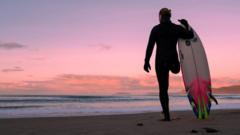
Saltwater tastes different when it carries the weight of a shattered life.
I remember the exact taste of the Pacific on the afternoon everything changed. One moment, the world was a clean line of blue horizon and the familiar, reassuring hum of a fiberglass board beneath my chest. The next, the ocean turned into a heavy, grinding machine. A rogue set wave caught me wrong, driving me down into the reef with a force that felt less like an impact and more like an execution. If you enjoyed this piece, you should read: this related article.
When you wake up in a hospital room smelling of antiseptic and cheap institutional floor wax, the hardest part isn't the physical pain. It is the silence. The abrupt realization that the trajectory you spent your entire youth mapping out has just been erased.
Doctors spoke in careful, measured cadences. They used words like trauma, amputation, and adjustment. They offered rehabilitation schedules, prosthetic consultations, and quiet, pitying smiles meant to cushion the blow. But none of them could answer the only question that actually mattered. How do you stand back up when half of you is missing? For another perspective on this development, check out the latest update from NBC Sports.
For months, the shore was a place of exile. I watched from the safety of a concrete seawall as friends paddled out into the lineup, catching clean rights, carving through the face of the wave with a fluid grace that used to belong to me. Every crashing wave sounded like a personal rebuke. Every sunset over the water felt like a reminder of a door that had been permanently bolted shut.
Bitterness is a heavy anchor. It sits in your chest, dragging you down into the dark, convincing you that survival is enough, that ambition is a cruel joke played on people with broken parts.
Then came the morning I dropped the crutches in the sand.
It was an impulsive, terrified decision. The prosthetic leg stood propped against the porch rail, smelling of warm plastic and sweat. I didn't want the machine today. I wanted skin, bone, and raw nerve against the elements, even if those elements meant humiliation. Hopping across the hot sand on one foot, I felt ridiculous. Small. Exposed.
The shorebreak was messy, churning with foam and hidden rocks. Paddling out with a single leg changes your center of gravity entirely. Every stroke requires a violent, twisting core contraction. My shoulder blades burned. My lungs screamed for oxygen long before I reached the outer channel.
And then, a swell formed.
Instinct took over before doubt could creep back in. I spun the board, dug my hands deep into the water, and paddled hard. The board lifted. The sudden rush of acceleration pushed aside the noise in my head. I popped up—not with the clean, symmetrical mechanics of my past, but with a frantic, compensated lunge that relied on raw upper-body strength and pure defiance.
My foot locked onto the traction pad. The wave peeled open, a shimmering wall of green water racing toward the channel.
In that split second, everything shifted. The missing limb was no longer a void. It was space. It was a blank canvas. Without the old habits, the old stance, and the automatic muscle memory of a conventional surfer, I had to invent a completely new way to read the ocean.
Competitive surfing isn't just about riding waves. It is about geometry, timing, and physics. When you alter the physics of the rider, the relationship with the wave transforms. I had to learn how to weight the board differently, how to use my torso as a rudder, and how to anticipate the break through the vibrations traveling up through the fiberglass rather than down through both ankles.
People look at adaptive sports through a lens of tragic heroism. They want the narrative to be about overcoming adversity, about a brave soul defying the odds to reclaim a normal life.
That narrative is a lie.
I didn't reclaim my old life. My old life is dead at the bottom of a reef in California. What I built instead is infinitely more dangerous, and infinitely more alive.
When you lose a limb, you lose the illusion of invulnerability. You realize with terrifying clarity that the human body is fragile, temporary, and entirely breakable. But once you accept that break, you also lose the fear of breaking again. That fear is what keeps most athletes trapped in safe lines, executing predictable turns, playing not to lose instead of playing to win.
Stripped of standard mechanics, I had to find a deeper fluency with the ocean. Watch a heat from the world adaptive surfing championships today, and you will not see people struggling. You will see evolution in real time. You will see blind surfers reading the pitch of a wave through the acoustic echo bouncing off the cliff face. You will see upper-limb amputees generating speed through kinetic rotation that makes able-bodied surfers look rigid.
Surfing stripped me down to the bone and forced me to rebuild myself from the water up.
Winning a world title wasn't about proving that I could still do what I did before the accident. It was proof that what happened to me was not an ending, but a brutal, mandatory re-education.
The ocean does not care about your tragedies. It does not pause its swells for your grief, nor does it grant mercy to your missing pieces. It offers only water, gravity, and momentum. When you paddle out past the break, you are stripped of every title, every excuse, and every label. There is only you, the board, and the next horizon rushing to meet you.
The scar on my hip is pale now, smoothed out by thousands of hours of friction against wax and neoprene. It looks like a fault line on a map, a reminder of the day the earth moved underneath my feet. But when I look out at the lineup tomorrow morning, waiting for the first pulse of the new swell, I don't see a reminder of what was taken. I see the space where something better was forced to grow.