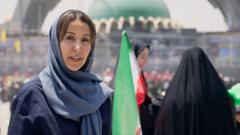
The heat in Tehran does not just rise from the asphalt; it presses down from the sky like a heavy, invisible hand. On a morning where the air itself feels thick enough to choke on, a million people do not gather in one place by accident. They come because a tectonic shift has occurred beneath their feet, and they are trying to anchor themselves to the earth.
From the vantage point of a balcony overlooking the central avenues leading toward the Grand Mosalla, the view is dizzying. It is a shifting, undulating ocean of black chadors and dark suits, moving in a slow, rhythmic tide. The former supreme leader is dead. An era has sputtered to a final, definitive stop.
To watch a nation mourn from the inside is to realize that grief is rarely simple. For the outside observer, a state funeral of this magnitude is a spectacle of uniform devotion. The cameras capture the weeping, the rhythmic beating of chests, the colossal portraits held aloft against a bleached-out sky. But if you step off the curb and walk among the crowd, the monolithic narrative fractures into a thousand complicated, human pieces.
The Heat and the Chants
Consider a man named Dariush. He is fifty-four, his beard flecked with gray, his shoes coated in the pale dust that seems to settle over everything in Tehran. Dariush is not a political operative. He is a shopkeeper from the bazaar, a man who has spent his life measuring out saffron and counting rials while history raged outside his door. He stands on the balls of his feet, straining to see past the shoulders of the men in front of him.
Why is he here?
"Because my father was here when the revolution was born," he says, his voice barely carrying over the low, droning hum of the loudspeakers. He doesn't look at me when he speaks; his eyes are fixed on the distant structure where the coffin will pass. "And because I do not know what my son will see when the next one comes."
That is the quiet, unspoken undercurrent of this entire day. Fear. Not necessarily of the state, though that is always a shadow in the periphery, but fear of the vacuum. When a figure who has occupied the absolute center of a nation’s political, spiritual, and emotional architecture for decades suddenly vanishes, the structure does not just remain standing as it was. It groans under the sudden redistribution of weight.
The loudspeakers begin to wail a lamentation, a rhythmic, mournful poetry that digs deep into the Shia tradition of martyrdom. The sound vibrates in the chest cavity. Around Dariush, a group of young men begin to beat their chests in perfect synchronization. Thump. Thump. Thump. It sounds like a massive, collective heartbeat.
Yet, look closer at the edges of the crowd.
There are young women standing near the shuttered storefronts, their headscarves pushed back just far enough to test the limits of the day’s solemnity. They are not weeping. They are watching. They whisper to each other, their eyes darting between the security forces lining the route and the older generation lost in sorrow. For them, this funeral is not just a farewell to a man; it is a glimpse into a vault that has been locked for their entire lives. They are waiting to see who holds the key.
The Architecture of Power on Display
A state funeral in Tehran is not merely an act of mourning; it is a complex, high-stakes piece of political theater where every seating arrangement, every glance, and every absence is a message.
On the raised dais, the remaining elite of the Islamic Republic gather. The turbans—both black and white—form a stark contrast against the military uniforms adorned with medals. You can see the tension in the way they stand. They are hyper-aware of the lenses trained on them from the international press corps, which has been granted a rare, tightly controlled window into the capital.
Every handshake is parsed. Who is standing closest to the empty space where the leader used to be? Who is looking away?
The official narrative broadcast on state television is one of seamless continuity. The announcer’s voice cracks with rehearsed emotion as he declares that the path of the revolution remains unshakeable. But the economy tells a different story. The rial has been sliding against the dollar for months, a slow-motion disaster that every person in this crowd feels when they buy a loaf of bread or a carton of milk. The sanctions have carved deep grooves into the daily lives of these people, and no amount of ideological fervor can completely mask the exhaustion.
An old woman sits on a plastic stool near a water distribution station. Her hands are gnarled, gripping a framed photograph of the late leader wrapped in a green silk cloth. She has lost two sons to the wars of the past, and for her, the leader was the only thread connecting her immense sacrifice to a grander, divine purpose.
"If we lose our way now," she mumbles to no one in particular, "what was it all for?"
Her question hangs in the hot air, unanswered. It is the question that defines the entire modern Iranian dilemma. The older generation remembers the fervor of 1979, the intoxication of overthrowing a monarchy, and the brutal, unifying crucible of the eight-year war with Iraq. They possess a vocabulary of resistance that feels natural to them.
But go home to the apartments in North Tehran, where the satellite dishes are hidden on the roofs and the internet traffic flows through a labyrinth of VPNs, and you find a completely different world. You find a generation that does not care about the grand narrative of resistance. They want jobs. They want to travel. They want to breathe without feeling the constriction of an ideology designed before they were born.
The Invisible Stakes
The Western world often views Iran through a telescope, seeing only the surface details: the flags, the slogans, the nuclear centrifuges. But a society is not a machine; it is a living organism made of millions of individuals trying to survive the day.
The real friction in Tehran today is not between the crowd and the police. It is the friction between the past and the future, playing out in the minds of the people walking these streets.
As the funeral procession finally moves through the gates, a sudden surge in the crowd pushes Dariush forward. For a moment, there is a flash of panic—the memory of stampedes in holy places is never far from anyone's mind. A young man, perhaps twenty years old, reaches out and grabs Dariush’s arm, stabilizing him. Their eyes meet. The older man, drenched in sweat, nods in gratitude. The younger man merely nods back, his face a mask of absolute neutrality.
In that tiny, fleeting interaction, the entire story of the country is written. They are bound together by geography, by language, by a shared sky, and by an uncertain tomorrow. They will walk the same streets tomorrow when the banners are taken down and the black cloth is rolled up.
The coffin passes, a simple wooden box elevated on the back of a heavily decorated truck, surrounded by a human wall of Revolutionary Guards. The cries reach a crescendo, a wall of sound that seems to shake the dust from the buildings. It is a release of decades of tension, a collective exhalation of a society that has been holding its breath for too long.
Then, as quickly as the climax arrives, the procession moves toward the cemetery outside the city. The crowd begins to fragment. The black sea dissolves into smaller streams, spilling into the side streets, the metro stations, and the alleys.
The loudspeakers click off, one by one. The silence that follows is not peaceful; it is heavy, expectant, and laced with an electric current of anticipation. The stage is empty. The actors have retreated behind the curtain. Outside, the people of Tehran walk home in the fading light, their shadows stretching long across the pavement, waiting for the first line of the next chapter to be read aloud.