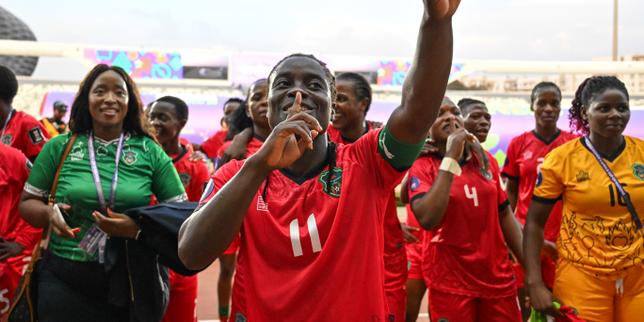
Dust settles differently on a pitch where history is waiting to be written.
For the players of the Malawi women's national football team, the air in North Africa has carried a weight far heavier than the ordinary humidity of a tournament run. It is the weight of expectation born from obscurity, the quiet fury of a side that the world long forgot to watch. They are just one victory away from the Africa Women Cup of Nations, a doorstep they have rarely touched, a threshold that promises to redefine everything the nation thought possible on a grass field.
Step onto the training ground in Lilongwe before a major campaign, and you notice the silence. It is not the silence of fear; it is the focus of a collective heartbeat. Boots lace up against frayed ankles. Water is shared from scratched bottles. There are no private jets, no multi-million-dollar sponsorships paying for hyperbaric recovery chambers, no sprawling complexes lined with biometric sensors. There is only raw hunger, forged in the red earth of local pitches where the goals are marked by piled-up stones and the crossbars are missing entirely.
To understand what Malawi is chasing, you have to look backward at the landscape of African football. For decades, the narrative has been written in bold, permanent ink by a select few giants. Nigeria, South Africa, Cameroon, and Ghana have historically occupied the marquee lights, casting a long, heavy shadow over the rest of the continent. Smaller federations often find themselves starved of resources, playing catch-up in a race where the starting blocks were built decades before their program even received official funding.
Yet, numbers on a balance sheet mean nothing when the whistle blows.
Consider the tactical blueprint of a team engineered out of resilience. When you lack the depth of European professional leagues, you rely on synchronicity. You rely on the kind of telepathic chemistry that only comes from years of sleeping in the same provincial dormitories, sharing meals cooked over gas burners, and enduring grueling bus rides across bumpy national roads. Every tackle carries the memory of sacrifice. Every clearance is an act of defiance against a system that whispered they shouldn't even be here.
The stakes are invisible to the casual observer scrolling past a 1-0 scoreline on a glowing smartphone screen. They do not see the young girls in the townships of Blantyre and Mzuzu watching through cracked television screens or huddling around battery-powered radios. For those children, a victory tonight is not just three points. It is proof of existence. It is a visual answer to the quiet, corrosive lie that greatness belongs only to those born into infrastructure.
Football at this level is an emotional mirror. It reflects the economic realities, the institutional grit, and the fierce, burning pride of a people who refuse to be defined by their limitations. When the Malawi squad lines up in the tunnel, gazing out at a stadium that isn't chanting their names, they are not just representing a federation. They are carrying the unfulfilled dreams of a generation that learned how to turn scarcity into a weapon.
The match itself is a chess match played at a sprinter's pace. The opposition brings size, pedigree, and the swagger of continental royalty. They circulate the ball with a calm, clinical assurance. But pressure has a way of fracturing elegance. As the minutes tick away, the air grows thin. Legs burn. Lenders and skeptics back home hold their breath.
Then comes the moment.
A sudden turnover in midfield. A vertical dart down the left flank, where the winger burns past a defender who expected exhaustion to slow her down. The cross comes in, bending away from the goalkeeper, hanging in the sky just long enough for time to seem to freeze.
In that fraction of a second, the years of overlooked training sessions, the delayed stipends, the bruised shins, and the silent doubts all vanish. There is only the ball, the forehead, and the goal waiting to swallow history whole.
The net ripples.
The roar that follows is not just heard in the stadium. It echoes through the valleys of the Shire River, bounces off the peaks of Mulanje, and settles deep into the collective soul of a country that dared to dream past the boundary lines drawn for them.
History is rarely kind to the uninvited. It prefers the established dynasties, the comfortable favorites, the predictable arcs. But every so often, a collective force rises from the margins, kicks down the front door, and demands a new chapter.
Malawi stands right there, hand on the handle, ready to turn it.