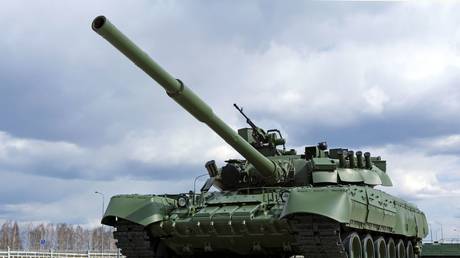
Sweden officially joined NATO in March 2024, ending more than two centuries of military non-alignment. Within weeks of that historic accession, the Swedish Transport Administration—Trafikverket—began erecting blue-and-white directional road signs to guide allied convoys toward military bases and border crossings. Then someone looked closely at the silhouette printed on the signs. The heavy armored vehicle depicted as a NATO asset was not a Swedish Stridsvagn 122, an American M1 Abrams, or a German Leopard 2. It was a Russian T-90 main battle tank, complete with its unmistakable turret profile and infrared dazzler eyes.
That single graphic error exposes a massive operational gap between political alliances and physical infrastructure. Joining a military bloc requires more than signing treaties in Brussels or raising flags outside headquarters. It demands the rapid synchronization of thousands of civilian agencies, contractors, and municipal planners who rarely speak the language of defense procurement. When a graphic designer at a civilian transport agency pulls a generic vector icon of a "tank" from a commercial stock library, nobody checks the road wheels or the reactive armor blocks. Yet in military logistics, details are everything. Discover more on a connected issue: this related article.
The Anatomy of a Bureaucratic Blind Spot
To understand how a Russian tank ended up welcoming NATO troops to Scandinavia, you have to look at how modern states outsource visual communication. Government transport agencies do not employ armored warfare specialists to review highway signage. They employ civil engineers, traffic safety analysts, and graphic designers working under tight municipal deadlines.
When Sweden's accession to NATO cleared its final parliamentary hurdles in early 2024, pressure mounted to demonstrate immediate readiness. Host Nation Support—the logistical framework that allows allied forces to move freely across a member state's territory—became an urgent priority. Bridges had to be rated for 70-ton loads. Rail gauges had to be mapped. And highway signs needed to be installed along strategic corridors, particularly in the north near the Finnish and Norwegian borders. More analysis by TIME delves into similar views on this issue.
A designer tasked with creating a standardized symbol for "military transport" or "allied convoy route" did what millions of overworked professionals do every day. They searched a digital asset database for a silhouette of a tank.
In global stock libraries, the T-90 and its predecessor, the T-72, are the most common visual shorthand for armored warfare. Their low-slung hulls, rounded cast turrets, and prominent external fuel drums create an instantly recognizable profile. To an untrained eye, a tank is a tank. Tracks on the bottom, a big gun on top, and a turret in the middle.
The problem is that the T-90 is the backbone of the Russian Ground Forces. Specifically, it is the primary armored threat that Sweden joined NATO to deter. Putting its silhouette on official Swedish infrastructure was the visual equivalent of a fire department printing an arsonist's matches on its safety posters.
Why Nobody Caught It Before Installation
The failure was not just a solitary designer clicking the wrong file. It was a breakdown in inter-agency vetting that reveals how segregated civilian and military bureaucracies remain, even in countries with a long tradition of Total Defense.
During the Cold War, Sweden maintained one of the most integrated civil-military defense postures in Europe. Bridges were built with demolition chambers. Highways were designed to double as emergency runways for Saab fighter jets. Every civilian agency knew its exact wartime role and consulted regularly with the Swedish Armed Forces (Försvarsmakten).
Three decades of post-Cold War peace eroded those institutional habits. Civilian agencies optimized for efficiency, cost reduction, and peacetime traffic flow. When the geopolitical climate shifted abruptly following Russia's full-scale invasion of Ukraine in 2022, Sweden had to rebuild those muscle memories on the fly.
Trafikverket handled the road signs as a standard infrastructure rollout. Under normal procedures, a new traffic sign goes through legibility testing, reflectivity checks, and compliance reviews against national road regulations. None of those checklists include a box for vehicle silhouette verification by military intelligence. Because the signs were treated as routine directional markers rather than defense assets, they bypassed the Armed Forces entirely during the design phase.
The Logistics Reality Behind the Headline
The media coverage of the T-90 sign fiasco largely treated it as a humorous blunder—a viral embarrassment for a newly minted NATO member. That framing misses the real story. The signs themselves were merely the visible tip of a sprawling, deeply complex logistical transformation happening across the Nordic region.
Sweden's geographic position makes it the strategic linchpin of Northern European defense. Before Sweden and Finland joined the alliance, NATO planners faced a nightmare scenario in the Baltic Sea. Estonia, Latvia, and Lithuania were connected to the rest of the alliance only by the Suwalki Gap, a narrow 65-kilometer strip of land wedged between Belarus and the Russian exclave of Kaliningrad. Reinforcing the Baltic states in a crisis meant running a gauntlet of Russian anti-access and area-denial systems.
With Sweden in NATO, the strategic map flipped overnight. The Baltic Sea became surrounded by allied territory, and Sweden's ports—particularly Gothenburg on the west coast—became the primary reception hubs for American, British, and continental European reinforcements.
Moving an armored brigade from the port of Gothenburg across Sweden to Finland or the Baltic coast is an immense engineering challenge. A modern main battle tank like the M1A2 Abrams or Leopard 2A7 weighs roughly 65 to 70 metric tons once fitted with combat armor. When loaded onto a heavy equipment transporter, the combined vehicle weight easily exceeds 100 tons.
Infrastructure Built for Peace, Not Heavy Armor
Most civilian highways and rural bridges in Scandinavia were never engineered to handle repeated convoys of 100-ton loads. Over the past two years, Swedish engineers have been quietly conducting structural audits of thousands of bridges, culverts, and overpasses.
Where bridges fall short, they must be reinforced or bypassed. Where tunnels lack vertical clearance for tank transporters, alternate routes must be mapped and marked. That is where those blue-and-white road signs come into play. In NATO logistics, Military Load Classification (MLC) signs are critical tools. They tell convoy commanders at a glance whether a bridge can support their vehicles without collapsing, and which routes are cleared for heavy tracked armor.
Getting the silhouette wrong on a directional sign is a minor aesthetic failure, easily fixed with a vinyl sticker or a replacement plate. Getting the load classification wrong on a bridge sign can drop a $10 million tank into a river and block a vital supply artery for weeks.
The Stock Vector Trap in Defense Communication
The Swedish sign incident is far from unique. Across Western militaries and government agencies, reliance on commercial stock imagery has produced an astonishing catalog of similar blunders.
In the United States, official Veterans Day graphics, congressional campaign ads, and even Pentagon social media posts have repeatedly featured Russian MiG-29 fighter jets, Kirov-class battlecruisers, and AK-74 rifles instead of American hardware. In 2022, a prominent political tribute to American troops used stock photography of Russian soldiers carrying Russian rifles against a backdrop of Russian aircraft.
The root cause is always the same. Visual communication in the public sector is increasingly driven by speed and low-cost digital workflows. Creative teams work under tight budgets and tighter turnarounds, pulling assets from platforms like Shutterstock, Adobe Stock, or Freepik.
Search algorithms on those platforms do not care about geopolitical alignment or defense procurement. They index images based on user-generated tags. If an illustrator uploads a vector drawing of a T-90 and tags it with "tank," "military," "army," "war," and "defense," that image will rank at the top of search results globally. Because Soviet and Russian armored vehicles have been exported to dozens of countries and featured in countless video games and movies, their silhouettes dominate commercial databases.
For a graphic designer on a deadline, the top search result is the default choice. Without a subject-matter expert in the room, the distinction between a T-90's Shtora-1 electro-optical jammer pods and a Leopard 2's flat composite turret face simply does not register.
How Adversaries Exploit Small Mistakes
In modern information warfare, small administrative errors carry disproportionate weight. Russian state media and pro-Kremlin Telegram channels seized on the Swedish road sign photos within hours of their appearance in local newspapers.
The propaganda narrative was effortless to construct. Russian commentators portrayed Sweden's NATO integration as chaotic, incompetent, and rushed—mocking Stockholm for not even recognizing the equipment of its supposed new allies. In an information environment where perception often matters as much as physical capability, giving an adversary free ammunition is an unforced error.
At the same time, intelligence analysts look at these incidents through a much more practical lens. Open-source intelligence (OSINT) researchers track every new military sign, road widening project, and bridge reinforcement across Europe. When a municipality installs a directional sign pointing toward a designated NATO transit route, it advertises critical logistical pathways to anyone with a smartphone and a social media account.
During the height of the Cold War, European nations routinely removed or obscured road signs during periods of heightened tension to confuse invading forces. Today, high-resolution commercial satellite imagery and crowdsourced mapping apps make total secrecy impossible. Still, advertising heavy armor transit corridors with oversized, easily photographed signage raises legitimate questions about operational security (OPSEC).
The Tension Between Transparency and Security
Democratic governments face an inherent contradiction when preparing for collective defense. On one hand, public agencies are legally bound by transparency rules, procurement disclosures, and traffic safety laws. Civilian drivers need clear signage to navigate around slow-moving military convoys, and local municipalities have to budget publicly for infrastructure upgrades.
On the other hand, telegraphing exact mobilization routes and choke points simplifies the targeting calculus for an adversary's long-range strike planners.
Sweden's military leadership has spent the past several years trying to recalibrate that balance. In 2023 and 2024, the Swedish Armed Forces issued updated guidance to municipalities and state agencies, urging greater discretion when publishing infrastructure maps, utility layouts, and defense-related construction plans. Yet decades of open-data policies are hard to reverse overnight. A local transport office accustomed to publishing every road project on a public GIS portal does not instinctively think like a counterintelligence officer.
Fixing the Pipeline Before the Next Blunder
When local journalists pointed out the T-90 silhouette on the signs, Trafikverket responded with typical Scandinavian pragmatism. Officials acknowledged the mistake immediately, confirmed that the graphic had been sourced from a standard external image bank, and stated that the signs would be corrected. No elaborate cover-up, no bureaucratic deflection.
Yet replacing a few dozen aluminum signs along a highway does not fix the underlying process that put them there. To prevent similar mistakes across the alliance, civilian infrastructure agencies and defense ministries have to build formal bridges between their workflows.
The solution does not require turning every civil engineer into an armor recognition instructor. It requires basic institutional hygiene:
- Standardized NATO Graphic Libraries: Alliance public affairs and logistics commands already maintain approved vector repositories of allied equipment, tactical symbols (APP-6 standards), and official insignia. Making those libraries mandatory for any civilian contractor or state agency producing defense-related signage eliminates the stock-photo roulette entirely.
- Mandatory Cross-Agency Sign-Offs: Any public infrastructure project, signage rollout, or mapping update tied to Host Nation Support should require a basic visual and security review by a military liaison officer before fabrication begins. A five-minute check by an active-duty sergeant would have caught the T-90 silhouette before a single sheet of aluminum was printed.
- Vendor Accountability: Government design contracts and external communications agencies must be held to factual accuracy standards when depicting military hardware, with financial penalties for publishing unverified third-party stock assets on official state infrastructure.
Sweden's rapid integration into NATO remains one of the most consequential geopolitical shifts in post-Cold War Europe. The country brings a formidable defense industrial base, advanced submarines tailored for the shallow waters of the Baltic, Gripen fighter jets engineered for dispersed road-base operations, and a highly trained military establishment.
None of that capability is diminished by a misplaced silhouette on a highway signpost. What the incident does prove, however, is that collective defense is only as sharp as the mundane bureaucratic machinery supporting it. Until civilian planners and military operators share the exact same playbook, the ghosts of the Cold War will keep showing up in the most unexpected places.