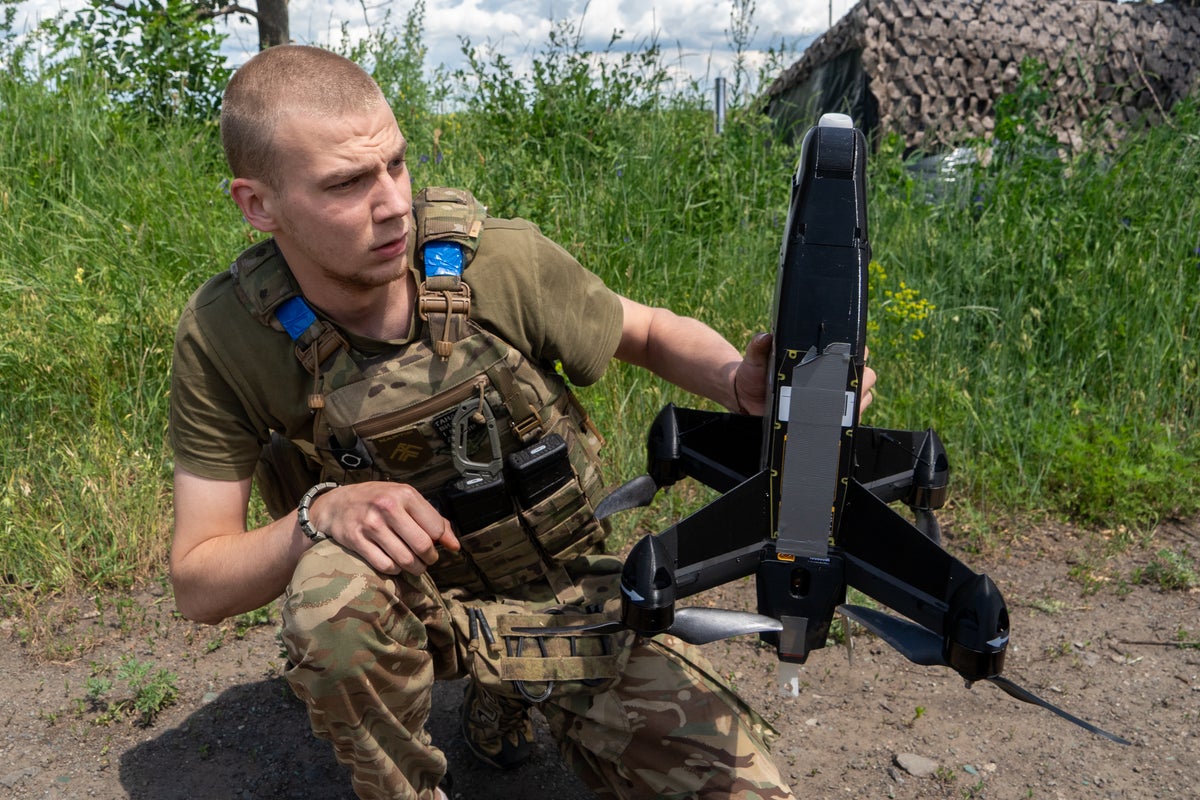
Twenty minutes. That's about the time it takes to grab a coffee, check your messages, and read a few headlines. For a newly deployed Russian soldier arriving at the Ukrainian frontline, it's also the average time they have left to live.
Data from Russian military bloggers and regional sources paints a horrific picture of the current battlefield layout. Once a recruit reaches an active combat zone, their life expectancy plummets to a window of just 20 to 35 minutes. It's a meat grinder on an unprecedented scale, accelerated by a weapon that has completely broken traditional military strategy: the cheap, ubiquitous first-person-view drone.
The math of this war has turned entirely against the infantryman.
The Ten Day Lifecycle of a Modern Recruit
If you sign a contract with the Russian Ministry of Defense today, your clock starts ticking immediately. Pro-war Telegram channels—often called "Z-channels"—have dropped their usual propaganda to sound the alarm on a brutal reality. The total lifespan of a recruit, from the moment they step onto a training ground to the moment they end up dead in a trench, is now averaging between 10 days and three weeks.
Think about that timeline. A few days to process paperwork, a week of basic weapon handling, a long truck ride to the rear staging area, and then straight into an assault. There's no time to teach tactics, no time to build unit cohesion, and certainly no time to learn how to survive a sky filled with autonomous killers.
Worse yet, many don't even make it to those precious 20 minutes of frontline combat. Drone strikes have pushed so deep into Russian rear positions that troops are getting heavily wounded or killed while still waiting in logistics hubs, miles away from the actual trenches.
Why Heavy Armor Can't Save Them
In older conflicts, a soldier could at least count on the armored steel of an infantry fighting vehicle or a main battle tank to get them close to the objective. Not anymore.
Ukraine's massive integration of FPV drones has made heavy artillery and armor incredibly easy to spot and destroy. A $500 quadcopter carrying a strapped-on rocket-propelled grenade can easily disable a multi-million-dollar tank. Because armor can no longer move freely without getting instantly picked off, Russian commanders have pivoted to desperate infiltration tactics.
Instead of massed mechanical assaults, they send small groups on foot, on dirt bikes, or even on cheap Chinese golf carts. They crawl forward in tiny clusters, trying to probe for weak spots in the Ukrainian defensive lines. It's a strategy built purely on a numbers game. If you send enough waves of men on foot, a few might get through. The rest become statistics before they can even orient themselves.
The Drone Saturated Sky
Ukrainian President Volodymyr Zelenskyy noted that drones now account for a staggering portion of Russian battlefield losses, with some sectors seeing up to 80 percent of targets neutralized by unmanned systems. Ukraine has successfully scaled up domestic production to the point where the sky above the trenches is never silent.
It has fundamentally flipped the traditional combat casualty ratio. Historically, wars produce far more wounded soldiers than dead ones. In this conflict, analysts are seeing the opposite trend among Russian assault units. The precision of drone drops and kamikaze strikes means that when a soldier is hit, the strike is frequently lethal. There's no medical evacuation coming for someone pinned down in an open field by a swarm of quadcopters.
British intelligence estimates put the total Russian dead since 2022 near 500,000, with total casualties climbing past the one million mark. To keep those numbers steady, Moscow has to bring in roughly 30,000 new troops every single month just to replace the dead and wounded.
A System Running Out of Steam
You can't hide these kinds of losses forever. The Kremlin's strategy has always relied on financial incentives to keep the volunteer pipeline flowing, offering massive sign-up bonuses and debt forgiveness to men from impoverished regions. But the math isn't working like it used to. Recruitment rates for contract soldiers have dropped by about 30 percent, forcing regional governments to continually jack up the payout amounts to attract anyone willing to take the gamble.
Internal friction is starting to boil over. Some prominent Russian milbloggers have openly accused frontline commanders of treating troops like disposable ammunition, warning that morale is hitting dangerous lows.
If you want to understand how this changes your perspective on the conflict, look at what's happening back in Russia. Families are noticing the empty chairs. Surveys show that a vast majority of Russians now personally know someone killed or wounded in the fighting. The war is no longer a distant television broadcast; it's a local funeral.
What This Means for the Frontline
Despite the terrifying attrition rate, Russia's sheer mass continues to buy small, incremental patches of ground in the Donetsk region. But it's an unsustainable trajectory.
For anyone tracking the security situation, the takeaway is clear: the era of massed infantry dominance without absolute air and drone superiority is officially dead. If you're looking for real-time updates on how tactical drone deployments are shifting these frontlines week by week, checking out the detailed video breakdowns by independent defense analysts is your best bet to see how these small-unit tactics play out in the mud.
Understanding Ukraine's Drone Supremacy
This video report breaks down the specific technical shifts in how FPV drones have systematically dismantled traditional Russian infantry tactics on the frontline.