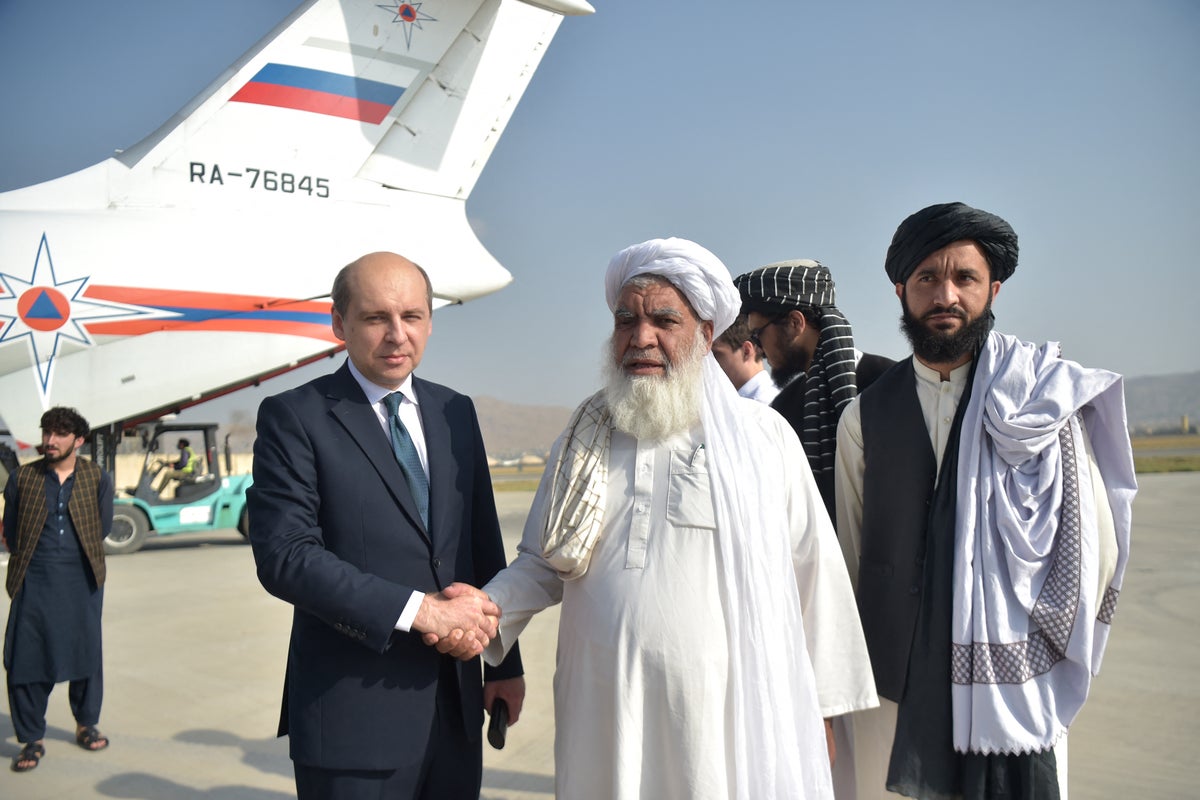
Western media loves a cheap irony narrative. When news broke that a Russian teenager faced a fine under draconian censorship laws for insulting the Taliban, the mainstream press ran with a predictable script. They painted it as the ultimate punchline of authoritarian absurdity: a nation that spent the 1980s fighting a bloody war in Afghanistan now policing its own youth to protect the feelings of Kabul’s new rulers.
It makes for great clickbait. It is also entirely missing the point.
The lazy consensus views this headline as a bizarre symptom of domestic suppression. The reality is far more cold, calculated, and grounded in realpolitik. Moscow is not protecting the Taliban out of sudden ideological affection or bureaucratic incompetence. This is a deliberate, tactical move in a brutal regional security game.
If you are looking at this through the lens of free speech, you are asking the wrong question. The real story is about pipelines, border security, and filling the massive vacuum left behind by the West.
The Illusion of the Bizarre Contradiction
To understand why the mainstream narrative is broken, you have to look at how international relations actually operate when the cameras are off. The common assumption is that a nation's internal laws must perfectly align with its historic identities. Because Russia historically classified the Taliban as a terrorist organization—a designation it has actively moved to lift—the media treats any enforcement of pro-Taliban stance as a hypocritical joke.
It is not a joke. It is statecraft.
In the wake of the 2021 American withdrawal from Afghanistan, Central Asia became an open board. Russia shares massive, porous borders with former Soviet republics like Tajikistan and Uzbekistan. If Afghanistan destabilizes, or if groups like ISIS-K (Islamic State Khorasan Province) gain a dominant foothold, the security fallout hits Moscow directly.
I have spent years analyzing regional security frameworks and watching state apparatuses pivot. When a government shifts its legal weight to punish domestic dissent against a foreign entity, it is sending a loud, unyielding signal to that foreign entity's leadership: We are a reliable partner. We can control our domestic narrative to suit our diplomatic goals.
The fine slapped on a teenager is not about the teenager. It is a diplomatic token offered to Kabul.
Security is a Commodity and the West is Out of Stock
Let us dismantle the premise that Russia’s engagement with the Taliban is a sign of desperation. The West chose isolation and sanctions after the fall of Kabul. Moscow, Beijing, and Islamabad chose geography.
Consider the mechanics of the regional energy and trade corridors. Afghanistan sits as the land bridge between the energy-rich states of Central Asia and the massive consumer markets of South Asia. The Turkmenistan-Afghanistan-Pakistan-India (TAPI) gas pipeline is a multi-billion-dollar project that has been stalled for decades due to instability.
- Russia wants a piece of the South Asian energy market.
- The Taliban needs revenue and legitimacy to prevent total economic collapse.
- Central Asian states need a guarantee that terrorism will not spill across their borders.
When you look at the board through this lens, enforcing respect for the Taliban on social media is a very low-cost investment for a very high-stakes return. It is the price of admission to the New Eurasian trade bloc.
Is there a downside? Absolutely. The risk is massive. Betraying domestic consistency by coddling a group that was previously public enemy number one damages a government's internal credibility. It creates friction among nationalists and veterans of the Soviet-Afghan war. But in the calculus of geopolitics, regional stability and energy dominance routinely trumps internal consistency.
Dismantling the Flawed Questions
If you look at the public discourse surrounding this event, the questions being asked are fundamentally flawed. Let us answer them with brutal honesty.
Why is Russia defending a group it banned?
Because bans are legal fictions designed for specific eras. When the threat was regional spillover from an insurgent group, the ban made sense. Now that the group is the de facto government controlling a state that shares a sphere of influence with Russia, the ban is a bureaucratic nuisance. Governments do not have permanent principles; they have permanent interests.
Does this mean Russia trusts the Taliban?
Not for a second. Trust is not a variable in this equation. Intelligence agencies in Moscow are fully aware of the factions within the Afghan leadership. This is a transaction based on mutual survival. The Taliban needs international recognition and economic lifelines to fight off ISIS-K, which is a direct threat to both Kabul and Moscow. Russia provides diplomatic cover; the Taliban provides a buffer zone.
What should Western policymakers learn from this?
Stop expecting foreign adversaries to act like Western liberal democracies. Sanctions and public shaming do not alter the physical reality of geography. While the West uses moral declarations as diplomacy, its competitors are using raw pragmatism to secure resource pipelines and borders.
The Cold Calculation
Stop looking for irony where there is only strategy. The penalization of domestic social media posts is a standard tool in the authoritarian kit to signal foreign policy alignment. It is happening in energy sectors, it is happening in military alliances, and it is happening on the phones of citizens.
The media will keep feeding you stories about the absurdity of the system. They want you to laugh at the contradiction so you do not notice the consolidation of power happening right beneath the surface. Russia is building a pragmatic, post-Western coalition in Eurasia, and they do not care if a few internet users get bruised in the process.
The West left a vacuum. Someone was always going to fill it.
Do not look at the fine. Look at the pipeline.