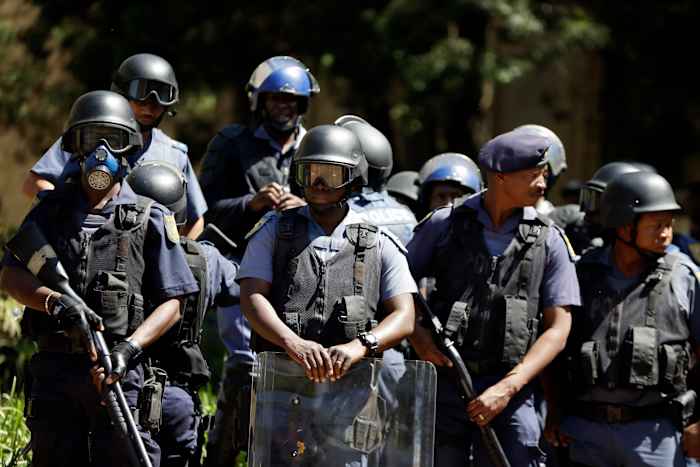
The recent arrest of 12 senior South African Police Service (SAPS) officers in Gauteng is not a triumph of the system. It is a symptom of its collapse. While official police communications framed the pre-dawn raids as a successful "cleanup," the reality is far more grim. These high-ranking officials, including several colonels and brigadiers, are accused of manipulating procurement contracts worth millions of rands. This was not a localized lapse in judgment. It was a sophisticated, multi-year operation that turned the very infrastructure of law enforcement into a private feeding trough.
For years, the South African public has watched the steady erosion of its primary security agency. The National Prosecuting Authority (NPA) and the Investigating Directorate (ID) now face the Herculean task of proving that these officers didn't just take bribes, but actively hollowed out the state’s ability to fight crime. When the people tasked with buying bulletproof vests and maintaining police vehicles are the ones siphoning the funds, the constable on the street is left defenseless.
The mechanics of the heist
Corruption in the SAPS does not happen through simple bags of cash handed over in dark alleys. It is a sterile, bureaucratic process. The 12 officers targeted in this latest sweep allegedly utilized a network of "preferred" suppliers to bypass the Public Finance Management Act. By splitting large contracts into smaller chunks—a tactic known as "subdivision"—they avoided the oversight required for high-value tenders.
This allowed them to award contracts for everything from forensic equipment to basic stationery to companies owned by associates or family members. In many cases, the goods were never delivered. In others, the state paid a markup of 400 percent over market value. The paper trail suggests a deliberate effort to create "emergency" procurement needs. When a department is perpetually in a state of artificial crisis, the rules of competitive bidding are often suspended to ensure "service delivery." This is where the syndicates strike.
The investigation reveals a recurring pattern. A senior officer identifies a budgetary surplus or a critical need. They then draft specifications so narrow that only one specific company can meet them. If a legitimate competitor tries to bid, their application is buried in red tape or disqualified on a technicality. The "winning" company then kicks back a percentage of the profit to the officers involved. It is a closed loop of theft.
A legacy of top heavy failure
To understand how 12 senior officers could operate this way, we have to look at the leadership structure of the SAPS. South Africa has one of the most top-heavy police forces in the world. There are more generals and brigadiers in the SAPS than in many much larger international agencies. This creates a culture of "untouchables" at the provincial and national levels.
When the leadership is bloated, accountability vanishes. These 12 officers felt secure because they were part of a patronage network that extended horizontally across the Gauteng province. They weren't just colleagues; they were co-conspirators who held the keys to internal disciplinary processes. If a junior officer noticed a discrepancy in a procurement file, there was no one to report it to. The person they would report it to was often the one signing the fraudulent check.
The Independent Police Investigative Directorate (IPID) has long complained about a lack of resources and a lack of cooperation from the SAPS itself. When the investigators arrive, files go missing. Hard drives are wiped. Witnesses within the force are intimidated or suddenly transferred to remote rural stations. This latest round of arrests only happened because the Investigating Directorate operated outside the standard police chain of command, using specialized forensic auditors to follow the money rather than the men.
The human cost of a paper trail
We often discuss corruption in terms of numbers and percentages. We talk about the R1.6 billion lost here or the R50 million misappropriated there. But the human cost is visceral. In townships across South Africa, police stations often report that they have no working vehicles to respond to distress calls. Why? Because the maintenance contracts were awarded to "ghost" companies that didn't actually fix the cars.
The officers arrested in this sting were living lives of luxury while the rank-and-file members they led were struggling with broken equipment and crumbling infrastructure. This creates a dangerous feedback loop. When the "boots on the ground" see their superiors getting rich through graft, their own morale evaporates. They start to view the badge not as a symbol of service, but as a license to extract their own "tax" from the public through petty bribery and extortion.
This isn't just a theory. Data from the last decade shows a direct correlation between the rise in irregular expenditure within the SAPS and the decline in the "detection rate" for high-priority crimes like murder and cash-in-transit heists. You cannot solve crimes without forensics, and you cannot have forensics if the money for the chemicals and the lab equipment was spent on a senior officer’s seaside villa.
The myth of the few bad apples
The standard government response to these arrests is to claim that they are "cleansing the stable." They want the public to believe that these 12 officers are "bad apples" in an otherwise healthy barrel. This is a lie. The barrel itself is warped.
The systemic nature of the rot means that for every 12 officers arrested, there are dozens more who either participated or looked the other way. The SAPS promotion system has, for years, prioritized political loyalty and "alignment" over investigative merit. This has allowed individuals with questionable backgrounds to rise to positions of extreme power.
Consider the vetting process. Many of the officers currently under fire had already been flagged by internal audits years ago. Yet, they remained in their posts. Some were even promoted while under investigation. This suggests that the corruption isn't a bug in the system; for many, it is the system's primary function. The arrests are a positive step, but they are a reactive measure in a country that desperately needs a proactive overhaul of how police power is distributed and monitored.
Can the Blue Wall be dismantled?
The NPA has promised a "hard-hitting" prosecution, but the track record of high-level police convictions in South Africa is checkered. These officers have access to the best legal minds, often funded by the very money they are accused of stealing. They know the gaps in the law better than anyone. They know how to stall, how to challenge the admissibility of evidence, and how to outlast the public's attention span.
If the state wants to actually fix this, it has to go beyond the criminal courtroom. It needs to implement a radical transparency model for all police procurement. Every tender, every bid, and every payout should be accessible in a public, searchable database in real-time. The veil of "national security" is too often used to hide mundane theft. There is nothing about the purchase of office furniture or vehicle tires that requires secrecy.
Furthermore, the SAPS needs an external, civilian-led oversight body with the power to fire—not just recommend the firing of—officers who fail lifestyle audits. Currently, the disciplinary process is an internal merry-go-round where officers are suspended with full pay for years, effectively enjoying a state-funded vacation while their cases languish.
The 12 officers in the dock are a warning. They represent a class of civil servants who stopped serving the civil and began serving themselves. If these arrests lead to nothing more than a few years of legal maneuvering and eventual quiet retirements, the message to the rest of the force will be clear: the risk is worth the reward. The only way to break the cycle is to ensure that the cost of corruption is total—the loss of pension, the loss of assets, and a permanent exit from the halls of power.
Check the asset forfeiture records for the Gauteng province to see if the state has successfully frozen the properties of the accused.