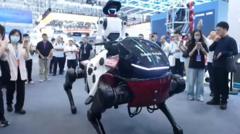
The headlines from that recent Chinese tech conference practically wrote themselves. Tech journalists hyperventilated over a mechanical quadruped outfitted with a metallic saddle, trotting across a stage like a robotic pony at a county fair. They called it progress. They called it an engineering marvel. They missed the plot entirely.
Watching a multi-million-dollar motorized quadruped mimic a beast of burden is not a glimpse into the future. It is a profound failure of imagination. We are taking humanity's oldest mode of transportation—one we mastered on actual flesh and bone thousands of years ago—and recreating it with lithium-ion batteries and brushless motors just because we can. Building on this theme, you can find more in: The Hong Kong Eye Watching Earth Breathe From Four Hundred Kilometers Up.
I have watched corporate boards flush millions of dollars down the drain funding pet projects that look phenomenal on a PowerPoint slide and achieve precisely zero economic utility in the real world. This robotic horse stunt is the exact same corporate theater, just dressed up in aluminum and silicone.
The Lazy Consensus of Stage-Built Engineering
The mainstream tech press bought into the illusion because shiny things on a stage always distract from a complete lack of practical application. The lazy consensus goes something like this: if a machine can balance on four legs and carry a dummy across a flat conference floor, we are one step closer to automated cavalry charges or wilderness navigation. Experts at The Next Web have also weighed in on this situation.
This logic crumbles the second you look at the economics and the physics.
A biological horse runs on grass, water, and oats. It repairs its own torn ligaments, navigates uneven boulder fields through millions of years of evolutionary trial and error, and has an onboard neural network that makes current machine learning models look like pocket calculators.
Meanwhile, your mechanical alternative requires a battery pack that dies after two hours, an array of expensive LiDAR sensors that get blinded by mud, and a cooling system that overheats if you push it up a moderately steep incline.
Imagine a scenario where emergency services try to deploy these mechanical beasts in a rugged mountain rescue. One decent rainstorm shorts out the primary actuator. The recovery mission now involves rescuing a two-hundred-pound heap of scrap metal that cost more than a luxury car.
The Core Fallacy of Biomimicry
Engineers fall into a lazy mental trap called biomimicry fetishism. They assume that because nature settled on a four-legged design for mammals, human engineers must replicate that exact blueprint in steel.
Nature solved locomotion under specific constraints. Horses evolved legs because biological tissue cannot easily incorporate rotating axles or continuous tracks without tearing blood vessels and muscle fibers. Metal and plastic do not have that restriction.
Wheels and continuous treads beat legs on efficiency every single time on prepared surfaces. For unstructured, chaotic terrain, tracked drones or specialized aerial units outclass quadruped designs by orders of magnitude. Forcing a robot to walk on four legs is a masterclass in solving a problem you created for yourself. It is a solution designed purely to trigger a sense of wonder in people who do not understand mechanical engineering.
When you talk to serious robotics researchers behind closed doors, they will roll their eyes at these stage prances. They know the truth. Balance control algorithms are cool thesis projects, but they do not translate to commercial viability when the maintenance costs outweigh the labor savings by a factor of ten.
Dismantling the People Also Ask Illusion
Type "quadruped robotics use cases" into any search engine, and you will find a sanitized list of enterprise talking points. Let us dismantle them one by one.
- Are robotic quadrupeds replacing working animals? No. Unless your farm has an infinite venture capital subsidy and zero profit margin, buying a robot that costs as much as a small apartment to herd sheep is financial suicide.
- Can robot horses navigate rough terrain better than wheeled vehicles? Only in narrow laboratory simulations. Put a quadruped on loose scree or thick brush, and watch the control loop fail as slip-detection algorithms choke on variable friction coefficients.
- Is this technology economically scalable? Not in its current paradigm. The rare earth minerals required for the high-torque actuators make mass production a geopolitical nightmare, not to mention an environmental disaster.
The Uncomfortable Truth About Conference Demos
Trade shows are marketing circuses. What you see on stage is not a production-ready asset. It is a hand-tuned, heavily supervised prototype running on a predetermined path with telemetry engineers holding emergency kill switches just off-camera.
I have seen companies spend six months preparing a three-minute stage demo. Every variable is locked down. The lighting is controlled. The floor is level. The moment you take that same machine out into a real-world environment with unpredictable wind, moisture, and debris, the illusion shatters.
We need to stop rewarding engineering vanity projects. True technological disruption does not look like a circus act designed to viralize on social media feeds. It looks invisible. It looks like infrastructure that quietly works without needing a PR team to explain why it matters.
Stop cheering for expensive toys that solve imaginary problems. Demand machines that do actual work, or accept that the current tech conference circuit is less about invention and more about keeping the funding bubble inflated just a little bit longer.