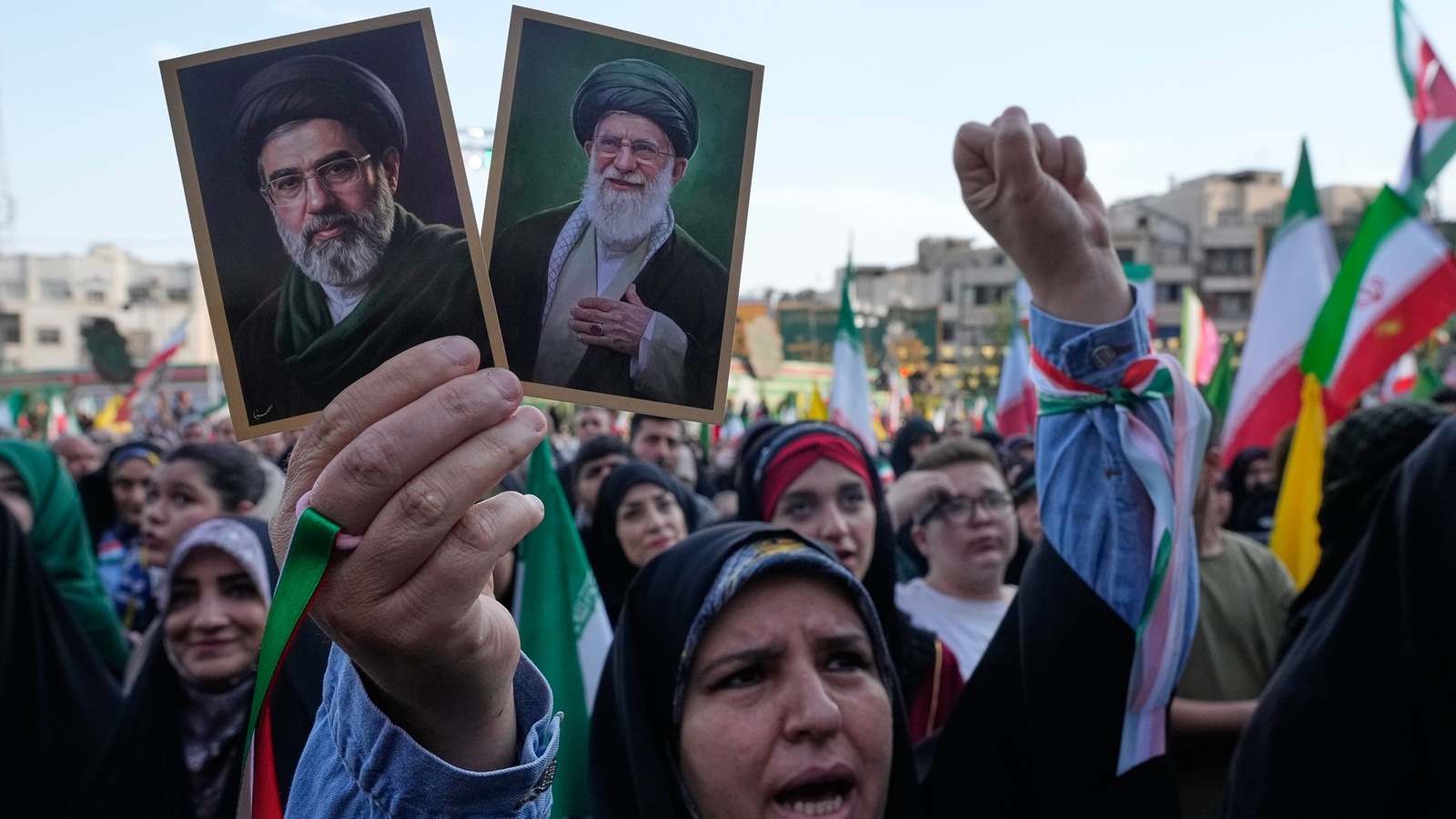
The maritime boundaries of the Middle East have long been defined by oil, but they are increasingly governed by blood and theater. When Supreme Leader Ayatollah Ali Khamenei declares that foreign powers driven by greed belong at the "bottom of its waters," he is not merely recycling the anti-imperialist script of 1979. He is signaling a desperate shift in Iran’s defensive posture. This fiery rhetoric serves a dual purpose: it shores up domestic nationalist sentiment while drawing a literal line in the sand—or rather, the sea—against a growing coalition of Western and regional adversaries.
At the heart of this tension lies the Strait of Hormuz. It is a narrow choke point through which twenty percent of the world’s petroleum flows daily. To the West, it is a global economic artery. To Tehran, it is a hostage. By threatening to consign "greedy" foreigners to the seabed, Khamenei is reminding the world that while Iran may lack a conventional blue-water navy capable of matching a U.S. carrier strike group, it possesses the asymmetrical tools to turn the Persian Gulf into a graveyard for global commerce.
The Asymmetric Arsenal under the Waves
Iran knows it cannot win a traditional naval engagement. History taught them this lesson during the "Tanker War" of the 1980s, when the U.S. Navy decimated the Iranian fleet in a single afternoon during Operation Praying Mantis. Modern Iranian strategy has evolved from that trauma. Instead of large, vulnerable destroyers, they have invested in a swarm-based doctrine designed to overwhelm high-tech defenses through sheer volume.
Thousands of fast-attack craft, often manned by the Islamic Revolutionary Guard Corps (IRGC), are equipped with Chinese-designed anti-ship missiles and heavy machine guns. These boats are small, difficult to track on radar, and expendable. In a narrow waterway, these swarms act like a hornet’s nest. They don't need to sink a carrier; they only need to hit a few commercial tankers to send global insurance rates skyrocketing and freeze the energy markets.
Beyond the surface, Iran has developed a sophisticated mine-laying capability. Sea mines are the "poor man's weapon of mass destruction." They are cheap to produce and incredibly difficult to clear. A single "rogue" mine hitting a vessel would effectively shut down the Strait, forcing the world to choose between an expensive military escort operation or an energy crisis that would dwarf the shocks of the 1970s. This is the "bottom of the water" Khamenei refers to—a floor littered with the wreckage of global trade.
The Shadow of Domestic Fragility
To understand the timing of these threats, one must look inward. Iran is currently navigating one of its most precarious periods since the revolution. The economy is bucking under the weight of systemic mismanagement and relentless international sanctions. The rial has lost staggering amounts of value, and the middle class has seen its purchasing power evaporate.
In this context, the Supreme Leader’s rhetoric acts as a pressure valve. By framing the struggle as a righteous defense against "greedy foreigners," the regime attempts to pivot the narrative away from internal failure and toward external aggression. It is a classic nationalist rallying cry. If the people are hungry, the state provides them with an enemy. Khamenei is betting that the image of a defiant Iran standing tall against "imperialist" navies will carry more weight than the reality of empty refrigerators in Tehran.
The Proxy Chessboard and the Red Sea Connection
The threat is no longer confined to the Persian Gulf. We are seeing a "horizontal escalation" where Iran-backed groups, most notably the Houthis in Yemen, are implementing the Supreme Leader’s vision in the Red Sea. The attacks on shipping in the Bab al-Mandab strait are a proof-of-concept for what a full-scale Persian Gulf blockade might look like.
This regional strategy allows Tehran to maintain "plausible deniability." While Khamenei speaks of the bottom of the waters, his proxies are the ones pulling the triggers. This creates a strategic dilemma for the West. Striking Iran directly risks a total regional war, while striking the proxies does little to degrade the command-and-control centers in Tehran.
The Failure of Traditional Deterrence
For decades, the United States and its allies relied on a "presence-based" deterrence model. The logic was simple: keep a carrier in the region, and the adversary will stay quiet. That logic is failing. The proliferation of drone technology and precision-guided munitions has shifted the cost-benefit analysis. An Iranian "Shahed" drone costs roughly $20,000 to produce, while the interceptor missiles fired by Western destroyers cost millions.
Iran is winning the war of attrition without even entering the battle. By forcing the U.S. and its partners to spend billions on defensive patrols and escort missions, Tehran is bleeding the resources of its enemies. This is the "greed" Khamenei highlights—the idea that the West is only there for the profit of oil, and that Iran can make that profit too expensive to pursue.
The Nuclear Wildcard
Hovering over every naval skirmish and every fiery speech is the shadow of the nuclear program. Iran has moved closer to weapons-grade enrichment than at any point in history. The maritime threats serve as a protective barrier for this development. If the West considers a kinetic strike on nuclear facilities, Tehran can immediately activate its "water bottom" strategy, closing the Strait of Hormuz and launching a swarm attack on regional energy infrastructure.
This creates a stalemate. The international community is effectively held hostage by the geography of the Gulf. Khamenei knows that as long as he controls the spigot of global energy, he has a seat at the table, regardless of how many sanctions are piled on his deputies.
The Mirage of Regional Reconciliation
Recent diplomatic thaws, such as the China-brokered deal between Iran and Saudi Arabia, were supposed to lower the temperature. In reality, they have only shifted the theater of operations. While the rhetoric between Riyadh and Tehran has softened, the fundamental goals of the Islamic Republic remain unchanged. They seek the total withdrawal of Western military forces from the region.
The Supreme Leader's latest comments prove that the regime views any foreign presence as an inherent violation of its sovereignty. This isn't about shared security; it's about total dominance of the waterway. For the regional players, the choice is becoming increasingly binary: align with Tehran's "maritime security" vision or continue to rely on a Western security umbrella that looks increasingly hesitant to engage in another protracted Middle Eastern conflict.
The Technology Gap is Closing
While Iran’s rhetoric is ancient, its tools are increasingly modern. We are seeing the integration of Artificial Intelligence into their drone swarms and the development of hypersonic missiles that claim to be able to bypass Aegis defense systems. Whether these claims are fully accurate is secondary to the psychological impact. The mere possibility of a "carrier killer" missile changes how admirals think about deploying their ships in the Gulf.
The Persian Gulf is becoming a laboratory for the future of naval warfare. It is a place where the massive, expensive legacies of the 20th century meet the cheap, lethal innovations of the 21st. When Khamenei speaks of the bottom of the sea, he is talking about a graveyard of outdated naval doctrine.
The Strategic Miscalculation
There is a danger in this rhetoric that goes beyond the words themselves. The risk of a "spark" incident—a nervous captain on an Iranian patrol boat or a misunderstood maneuver by a Western destroyer—has never been higher. If Iran pushes its luck too far, the resulting conflict would not just sink a few ships; it would likely result in the total destruction of the Iranian navy and the critical infrastructure that the regime depends on for survival.
Khamenei is playing a high-stakes game of chicken with the global economy. He believes the West’s "greed" for stable oil prices will always outweigh its stomach for a fight. It is a gamble that assumes his opponents are as predictable as his own ideology.
The Persian Gulf remains the most volatile stretch of water on the planet. The Supreme Leader’s words are a reminder that for Tehran, the sea is not just a resource; it is a weapon. As long as the world relies on the narrow corridors of the Middle East to power its cities, it remains vulnerable to a regime that views the bottom of the ocean as the only fit place for its rivals.
Watch the water, because the rhetoric is no longer just hot air; it is a blueprint for the next global shock.