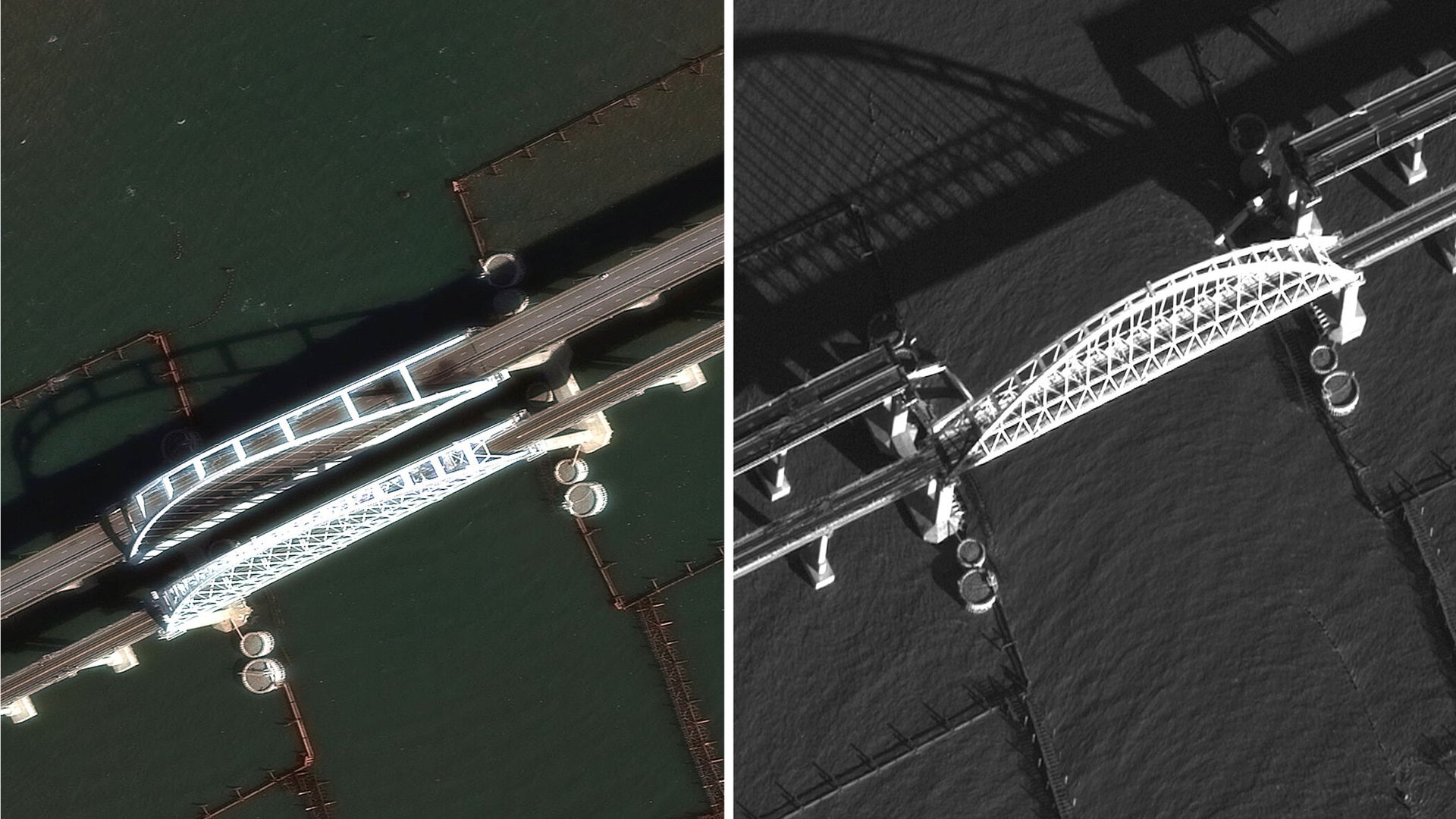
When Ukrainian forces strike the Kerch Strait Bridge three times in four days, the immediate headlines inevitably focus on Vladimir Putin’s promises of retaliation. That framing misses the larger operational reality. The bridge is no longer just a prestige project or a convenient highway into occupied territory; it has become a persistent strategic liability that forces Moscow into an impossible defensive posture across an entire theater of war.
To understand why these repeated hits matter, look past the dramatic footage of smoke rising over the Black Sea. Look instead at logistics, air defense attrition, and the psychological weight of a 12-mile span of concrete and steel that Russia cannot afford to lose—and increasingly struggles to protect.
The Myth of the Impenetrable Fortress
Following the initial 2014 annexation of Crimea, the Kerch Strait Bridge was built to anchor the peninsula permanently to the Russian mainland. Spanning roughly 19 kilometers across treacherous waters, the dual road-and-rail structure was marketed by the Kremlin as an engineering triumph and an unassailable fortress. Layered air defenses, naval patrols, radar-reflecting barges, and specialized anti-sabotage units were deployed to guarantee its safety.
Yet repeated strikes demonstrate a fundamental flaw in static defense. An attacker only needs to succeed once; a defender must succeed every single time.
When Kyiv targets the crossing multiple times within a 96-hour window, the goal is rarely a single Hollywood-style collapse of the entire span. Modern reinforced concrete bridges are notoriously difficult to destroy completely without massive, sustained ordnance. Instead, Ukraine is executing a classic attrition campaign designed to degrade the structure’s load-bearing capacity while exhausting the defensive umbrella surrounding it.
Saturation and Sensory Overload
Every wave of naval drones, aerial unmanned vehicles, or long-range missiles forces Russian air defense batteries to activate their radars, reveal their positions, and expend expensive interceptors. If Moscow fires multi-million-dollar surface-to-air missiles to knock down incoming drones costing a fraction of that price, Kyiv wins the economic exchange even when the bridge remains standing.
Furthermore, sustained tempo creates operator fatigue and command friction. Air defense crews operating under continuous alert status for days on end make mistakes. Decoys draw fire away from real threats. Electronic warfare systems intended to jam incoming guidance signals also interfere with friendly communications, creating brief windows of blindness that subsequent strike packages exploit.
The Logistics Bottleneck Nobody Wants to Admit
Military analysts often debate whether the Crimea bridge remains vital to Russia’s war effort in southern Ukraine. Proponents of the "diminished importance" theory point to the land bridge—the coastal corridor running from Rostov-on-Don through Mariupol and Melitopol into Crimea—along with newly constructed rail lines connecting occupied territories directly to Russian supply hubs.
That argument holds water on paper, right up until artillery or long-range strikes hit those overland routes.
In reality, logistics is a game of redundancy and throughput. Heavy military hardware—main battle tanks, self-propelled artillery, bulk fuel, and massive quantities of artillery shells—moves most efficiently by rail. Even when the Kerch Strait Bridge operates at reduced capacity due to structural damage or security closures, losing unimpeded rail transit forces Russian planners to reroute cargo onto vulnerable overland highways and rail spurs well within range of Ukrainian strike systems.
Every traffic jam at a checkpoint, every ferry delayed by Black Sea storms, and every train diverted onto secondary tracks slows down the tempo of ammunition delivery to front-line units in Zaporizhzhia and Kherson. War rarely turns on a single exploded bridge. It turns on cumulative friction—the steady, grinding tax imposed on an army’s ability to feed its guns.
What Retaliation Actually Looks Like
Whenever the Kerch crossing takes a hit, the Kremlin’s rhetorical playbook is predictable. Officials label the strikes terrorism, promise a severe response, and swiftly launch retaliatory barrages against Ukrainian cities, port infrastructure, or energy grids.
Here is the uncomfortable truth that rarely makes it into breaking news alerts: Russia was going to launch those strikes anyway.
Moscow’s campaign against Ukraine’s electrical grid, grain terminals, and industrial centers follows its own production cycles and targeting schedules. Framing a missile barrage as "retaliation" for the Crimea bridge serves a domestic political function. It allows the Russian state media apparatus to project strength and decisiveness to a home audience rattled by images of strikes on territory Moscow claims as its own.
From a purely military standpoint, however, shifting scarce long-range precision missiles away from front-line operational targets to strike civilian infrastructure in revenge does nothing to repair damaged bridge girders or replace lost air defense radars in Crimea. It is a political reflex masquerading as strategy.
The Strategic Dilemma in the Black Sea
Zoom out from the bridge itself, and a broader picture emerges. Over the course of the conflict, Ukraine—a nation without a conventional blue-water navy—has systematically contested Russian dominance across the Black Sea.
Using asymmetric naval drones, coastal anti-ship missiles, and coordinated intelligence from Western partners, Kyiv forced the Black Sea Fleet to relocate most of its high-value surface combatants from Sevastopol to ports further east, such as Novorossiysk. That withdrawal degraded Russia’s ability to enforce a naval blockade or project amphibious threats against Ukraine’s southwestern coast.
The Kerch Strait Bridge sits at the exact intersection of this maritime shift. Without unchallenged naval control of the surrounding waters, defending a 12-mile maritime chokepoint becomes exponentially harder. Submerged barriers and sunken barges can block surface drones along narrow channels, yet storms wash them away, and adaptable drone designs evolve faster than physical obstacles can be anchored to the seabed.
The High Cost of Holding Crimea
For Moscow, Crimea is non-negotiable. Strategically, it serves as an unsinkable aircraft carrier dominating the northern Black Sea; politically, it represents the crown jewel of Putin’s legacy. Abandoning or downgrading its defense is unthinkable for the Kremlin.
Kyiv understands this political fixation and exploits it ruthlessly. By keeping the Kerch Strait Bridge under persistent threat, Ukraine forces Russia to keep high-end air defense systems—batteries like the S-400 and Pantsir-S1—tethered to static coastal defense rather than protecting troops on the active front lines in Donbas.
Consider a hypothetical scenario common in modern air-land battle planning. If a commander possesses ten advanced air defense batteries and must dedicate four of them to guarding a single symbolic bridge, the remaining six must cover hundreds of miles of active front lines, logistics depots, and command posts. The bridge acts as a magnet, pulling scarce defensive assets away from the exact places where Ukrainian ground and air forces want to operate freely.
Engineering Reality Versus Political Symbolism
There is an inherent tension between how engineers view the Crimea bridge and how politicians talk about it.
To a structural engineer, a bridge is a collection of piers, spans, expansion joints, and tension cables operating within strict load tolerances. Fire damages concrete by boiling the moisture trapped inside it, causing spalling that weakens structural integrity even when the surface looks intact. Shrapnel severs reinforcing steel. Blast overpressure shifts deck segments off their bearings.
Repairs under wartime conditions are patchy at best. Crews can pave over blast craters and replace damaged guardrails in weeks, creating visuals suitable for state television cameras showing traffic rolling once again. Restoring full heavy-freight rail capacity across compromised spans takes months of specialized engineering work—work that becomes nearly impossible when the construction site itself remains under active threat.
To a politician, however, the bridge only needs to look open to serve its narrative purpose. A single lane of passenger cars crossing the strait proves defiance. Yet passenger cars do not carry 152mm artillery shells or replacement tank engines. The gap between political theater and logistical reality widens with every successful strike.
The Gray Areas of Escalation
Evaluating the true impact of these strikes requires acknowledging what remains unknown. Independent verification of structural damage on the Kerch Strait Bridge is notoriously difficult. Satellite imagery reveals scorch marks, missing road sections, and barge placements, yet it cannot measure internal stress fractures in concrete pilings or assess the exact tonnage limits Russian rail dispatchers quietly enforce behind closed doors.
Similarly, there is no guarantee that continued pressure on Crimea will force a rapid collapse of Russian positions in southern Ukraine. Russian engineering units have demonstrated considerable resilience throughout the war, building redundant rail spurs, utilizing heavy military ferries, and dispersing ammunition dumps to survive long-range strikes. War is an adaptive contest; every tactical innovation eventually meets a countermeasure.
Yet adaptation costs time, money, and manpower—resources that are finite even for a state mobilized for prolonged conflict.
A Permanent Vulnerability
The real story of three strikes in four days is not about a single dramatic explosion or a predictable speech from Moscow promising vengeance. It is about the erosion of deterrence.
For years, the Kerch Strait Bridge stood as physical proof that Russia could redraw borders by force and cement those gains in concrete. Today, every alert siren wailing over the strait, every traffic closure backed up for miles on the Taman Peninsula, and every interceptor fired into the night sky tells a different story.
Russia built a monument to permanence in the middle of an active war zone, and now it is trapped paying the endless, compounding price of trying to keep it standing.