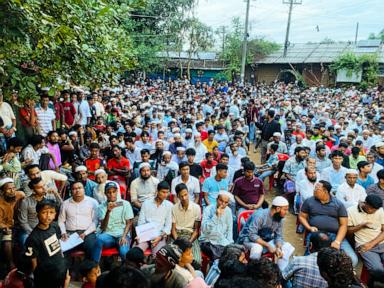
International legal accountability and physical territorial return operate on incompatible timelines, creating an acute structural failure for displaced populations. When a judicial body issues a ruling recognizing mass atrocities or genocide against an exiled group, the immediate diplomatic response celebrates moral validation while ignoring the operational vacuum on the ground. For the Rohingya refugees residing in the Cox's Bazar camps of Bangladesh, a landmark genocide verdict from the United Nations' highest court—the International Court of Justice (ICJ)—generates intense psychological relief without altering a single variable required for safe, voluntary, and dignified repatriation to Myanmar.
To understand why legal vindication fails to trigger physical return, analysts must separate symbolic justice from geopolitical enforcement. A court ruling establishes historical truth and state responsibility under international law, specifically the 1948 Genocide Convention. However, international judicial bodies possess zero kinetic enforcement capacity. They rely entirely on the United Nations Security Council, bilateral diplomatic pressure, and the compliance of the offending state. When the offending state remains under the control of the exact military apparatus that executed the expulsion, legal verdicts function as moral indictments rather than operational blueprints for border crossings.
The Architecture of the Enforcement Gap
The disconnect between a courtroom victory in The Hague and daily survival in southern Bangladesh stems from three structural bottlenecks. Standard human interest reporting frames this dynamic as a simple contrast between celebration and longing. A rigorous strategic breakdown reveals a complex institutional deadlock where legal progress inadvertently hardens the resistance of the perpetrators.
The Sovereignty Shield and Compliance Failure
International law operates on the principle of state consent and sovereign immunity, pierced only under extreme consensus by major global powers. When the ICJ issues provisional measures or a final merit judgment confirming genocidal intent by Myanmar's military (the Tatmadaw), the ruling binds the state legally but leaves the domestic security apparatus intact. Without unified Security Council enforcement—consistently blocked by veto-wielding permanent members with strategic or economic investments in Myanmar—the ruling lacks coercive teeth. The regime absorbs the reputational damage while retaining absolute physical control over Rakhine State, the ancestral homeland of the Rohingya.The Citizenship and Legal Identity Vacuum
Repatriation without legal status is merely deferred expulsion. The root mechanism of the Rohingya crisis is not simply physical violence, but systematic statelessness codified through Myanmar's 1982 Citizenship Law. This legislation stripped the Rohingya of recognition as one of the country's official national races, reducing them to temporary residents or illegal immigrants in their own territory. A genocide verdict addresses the symptoms of state-sponsored violence, yet it does not automatically rewrite domestic nationality statutes. Returning hundreds of thousands of people across the Naf River without restored full citizenship, freedom of movement, and property restitution places them directly back into an open-air internment system.Asymmetric Deterrence and Security Guarantees
Humanitarian doctrine dictates that refugee return must meet three non-negotiable criteria: safety, voluntariness, and dignity. In the absence of an international peacekeeping force or neutral third-party monitors embedded within Rakhine State, the security guarantee relies entirely on the promises of the perpetrator regime. From a game-theory perspective, the refugees face an asymmetric payoff matrix. Remaining in Bangladesh guarantees generational stagnation, aid dependency, and vulnerability to camp violence. Returning to Myanmar without verified security guarantees carries an existential risk of renewed ethnic cleansing. Rational actors will consistently reject repatriation under these conditions, regardless of how many legal victories are secured abroad.
The Economics and Geopolitics of Protracted Displacement
While legal institutions process evidence over decades, the host nation and the displaced population absorb compounding economic and social costs. Bangladesh, a densely populated nation facing severe climate vulnerabilities, has borne the primary operational burden of housing roughly one million refugees since the mass exodus of August 2017.
The financial mechanics of the camps rely on an annual Joint Response Plan (JRP) funded by international donors. Over time, donor fatigue sets in as global crises multiply, causing funding shortfalls that directly translate into reduced food rations, degraded healthcare, and collapsed educational infrastructure inside the camps. When international headlines focus exclusively on a UN court verdict, donor capitals often experience a false sense of mission accomplishment. Political attention shifts away from the unglamorous, recurring costs of camp maintenance and bilateral diplomatic pressure, leaving the host nation managing an indefinite humanitarian containment zone.
Simultaneously, the geopolitical landscape inside Myanmar rarely remains static during multi-year litigation. The 2021 military coup in Myanmar fragmented the country into overlapping zones of civil war, pitting the junta against the National Unity Government (NUG) and various Ethnic Armed Organizations (EAOs). In Rakhine State, the Arakan Army has seized vast swathes of territory from the central military. This shifts the repatriation equation entirely. Negotiating return solely with the military junta in Naypyidaw becomes operationally irrelevant if a non-state armed group controls the actual border crossings and villages in northern Rakhine. A UN court verdict binds the recognized state apparatus, yet the physical territory is increasingly governed by insurgent authorities who are not direct parties to the ICJ proceedings.
The Psychological Utility of Legal Recognition
Dismissing the UN court ruling as completely useless misses its critical function within the displaced community's social cohesion and long-term political survival. For populations subjected to state-led erasure, official denial of their identity and suffering acts as a secondary trauma. The Myanmar military systematically destroyed physical villages, altered place names, and erased census records to prove the Rohingya never belonged to the national fabric.
A formal genocide determination permanently counters this erasure in the international historical record. It establishes an irrefutable legal baseline that future administrations in Myanmar—whether civilian, military, or federal—cannot legally bypass. Within the camps, this validation prevents total psychological collapse and counters radicalization narratives. When young men and women see that the international legal order acknowledges the reality of their expulsion, it reinforces faith in non-violent, institutional advocacy over armed insurgency.
This psychological capital has a strict expiration date. Validation sustains morale in the short term, but it cannot substitute for civil rights, economic agency, or physical security. If five years pass after a historic verdict with zero tangible movement toward repatriation or third-country resettlement, the resulting disillusionment accelerates camp instability, human trafficking across the Andaman Sea, and forced recruitment by armed factions operating along the border.
Strategic Limitations of Current Diplomatic Frameworks
Every conventional mechanism currently deployed to resolve the Rohingya crisis contains built-in structural flaws that prevent a durable solution. Practitioners managing refugee crises must account for these operational ceilings rather than assuming linear progress.
- Bilateral Repatriation Agreements: Memoranda of understanding signed directly between Bangladesh and Myanmar consistently fail because they exclude the refugees from the negotiation table and lack international enforcement mechanisms. Pilot repatriation projects repeatedly stall when refugees inspect the proposed transit camps in Myanmar and recognize them as fortified detention centers rather than their original villages.
- Targeted Economic Sanctions: Western sanctions against military-owned conglomerates (such as Myanmar Economic Holdings Limited) restrict hard currency flows to the generals, yet they fail to alter core survival behaviors. The military regime prioritizes regime preservation and territorial control above macroeconomic health, insulating itself through regional trade partners that ignore Western financial restrictions.
- Universal Jurisdiction Cases: Parallel legal tracks—such as cases filed in Argentina under universal jurisdiction or investigations by the International Criminal Court (ICC) into the crime of deportation—build pressure on individual commanders. However, arrest warrants remain purely theoretical until those individuals travel outside protected jurisdictions or lose domestic political power.
Operationalizing the Verdict
To prevent the UN genocide verdict from becoming a dead letter, international actors, host nations, and legal advocates must pivot from celebratory rhetoric to coercive operationalization. Legal rulings are raw material; they require deliberate diplomatic engineering to produce physical outcomes on the ground.
First, donor nations and multilateral institutions must tie all future development aid, trade preferences, and diplomatic normalization with any governing authority in Myanmar—including the National Unity Government and the Arakan Army—to explicit, verifiable milestones on Rohingya citizenship and land restitution. Recognition of emerging political actors in Myanmar cannot be granted unconditionally; it must be purchased through binding commitments to repeal or amend the 1982 Citizenship Law.
Second, legal teams and UN investigative mechanisms must weaponize the ICJ ruling to freeze sovereign assets and block international financial clearing for any entity linked to the administration of Rakhine State. Financial isolation must expand beyond individual generals to encompass the entire administrative infrastructure benefiting from the confiscation of Rohingya land and resources.
Third, Bangladesh and international humanitarian agencies must transition the Cox's Bazar camps from emergency containment zones to skill-building and formal education hubs. Keeping a million people in indefinite legal and economic limbo guarantees generational trauma and regional instability. Investing in portable human capital—accredited education, vocational training, and formal economic integration—equips the population to rebuild Rakhine State when political conditions finally shift, rather than returning as a traumatized, under-educated underclass.
A genocide verdict settles the moral argument of the past, yet the physical return of the Rohingya depends entirely on altering the balance of power in the present. Until diplomatic leverage forces structural changes to citizenship laws and security governance inside Rakhine State, the refugees will remain trapped between a courtroom victory in Europe and a closed border in Asia.