The ink on a voter’s index finger in India is stubborn. It is a thick, violet-black stain made of silver nitrate, designed to resist soap, sweat, and scrubbing for weeks. For nearly one billion people, that smudge is the single most tangible proof that they exist to the state. It is the receipt for a quiet transaction: you give the Republic your trust, and the Republic counts your voice.
Now, picture that same stain fading while a question hangs in the humid New Delhi air. Did the person holding the stopwatch actually keep fair time? Also making news recently: La fable des volontaires baltes masque une faillite stratégique majeure de l'OTAN.
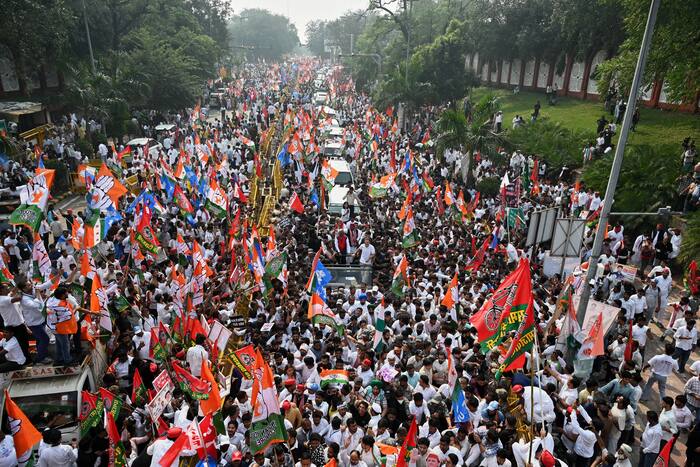
Outside the red sandstone walls of Nirvachan Sadan—the headquarters of the Election Commission of India—a familiar theater has been playing out. Opposition lawmakers, draped in white cotton and carrying placards, have been marching, chanting, and demanding answers from the nation’s Chief Election Commissioner. Standard news reports treat these demonstrations like routine weather. Another protest. Another press conference. Another cycle of predictable political friction.
They miss the point entirely. Further details into this topic are covered by Associated Press.
When opposition parties take to the streets to challenge the neutrality of India’s top election official, the story is not about parliamentary posturing or partisan noise. It is about the slow, terrifying erosion of an invisible agreement that holds the world’s largest democracy together.
The Architecture of a Miracle
To understand why a protest against an unelected bureaucrat matters more than almost any parliamentary debate, you have to appreciate the sheer improbability of an Indian election.
Consider a hypothetical voter—let’s call her Sunita—living in a remote village perched along the foothills of the Himalayas. To reach her polling booth, election workers trek for days carrying Electronic Voting Machines on the backs of mules, crossing suspension bridges over glacial rivers just to ensure one household gets a say. Meanwhile, three thousand kilometers south, in the sprawling, chaotic heart of Mumbai, another voter stands in a schoolyard queue beside a billionaire industrialist.
For seven decades, the Election Commission of India was the rare institution that commanded near-religious awe from both of them. Created in 1950, a day before India officially became a republic, it was designed as a constitutional firewall. The founders knew that in a country fractured by caste, language, religion, and staggering wealth gaps, democracy would survive only if the referee remained entirely above the fray.
And for a long time, the referee held the line. In the 1990s, a fierce, uncompromising Chief Election Commissioner named T.N. Seshan turned the commission into a household name, famously declaring that he ate politicians for breakfast. He enforced spending limits, delayed polls when violence flared, and forced towering political figures to obey rules written by civil servants. Voters didn't just accept the results; they revered the process.
That reverence is fragile. Trust takes decades to build and a handful of unanswered questions to fracture.
Where the Friction Begins
So, what has brought opposition parties back to the barricades against the elections chief?
Look closely at the grievances piling up on the desk of the Election Commission, and a pattern emerges—one that feels less like an administrative hiccup and more like a creeping tilt in the playing field.
First, there is the question of how the referee is chosen. For decades, the prime minister and cabinet simply recommended a name to the president. In 2023, recognizing the obvious conflict of interest in letting the players pick the umpire, India’s Supreme Court stepped in. The court ruled that a three-member panel—comprising the prime minister, the leader of the opposition, and the Chief Justice of India—should select election commissioners until Parliament passed a formal law.
Parliament passed that law months later. In doing so, it removed the Chief Justice from the panel and replaced the seat with a cabinet minister nominated by the prime minister.
Think about that as a simple analogy. Imagine walking onto a cricket pitch for a championship match, only to discover that the team captain batting first now holds a two-to-one majority vote on who gets to stand behind the stumps as umpire. Even if the umpire makes fifty accurate calls in a row, every close leg-before-wicket appeal will trigger a riot in the stands. The appearance of bias is just as lethal to a democracy as bias itself.
Then come the operational flashpoints that keep opposition leaders awake at night:
- The Silence on Hate Speech: During recent campaign cycles, opposition parties filed dozens of formal complaints accusing ruling party leaders of violating the Model Code of Conduct—the sacred rulebook banning appeals to religious or communal hatred. When notices were finally issued, they were often addressed not to the speakers themselves, but to their party presidents, softening the blow. Meanwhile, opposition figures faced swift, individual reprimands for far milder infractions.
- The Missing Voter Data: In the age of instant digital verification, civil society groups and opposition lawmakers asked a straightforward question: why does the final voter turnout percentage jump significantly days after polling ends, and why aren't the exact absolute numbers of votes polled at each booth immediately published on the commission's website? The commission pushed back, arguing that publishing raw forms could invite mischief and that delays were merely logistical. To critics, withholding granular data looked like locking the scoreboard room while the judges tallied the points.
- The Timing of Schedules: When multi-phase election calendars stretch across six or seven weeks in blistering summer heat, every phase boundary becomes a strategic weapon. Opposition leaders have repeatedly questioned why states where they hold strongholds are sliced into multiple phases, allowing national ruling-party heavyweights to carpet-bomb constituencies with rallies, while other states are wrapped up in a single day.
None of these complaints, taken in isolation, proves a rigged election. India’s Electronic Voting Machines remain standalone, non-networked devices protected by layers of physical and cryptographic seals. Ballot stuffing on the scale seen in the 1980s is largely a ghost of the past.
Yet a modern election is rarely won or lost solely inside the black box of a voting machine. It is shaped months earlier—by whose bank accounts are frozen by tax authorities, whose campaign helicopters are denied landing permits, which speeches are penalized, and how long it takes for a citizen’s question to receive an honest answer.
The Cost of a Shrug
I remember standing outside a counting center in northern India a few election cycles ago, watching party agents huddled over cups of sweet, over-boiled chai at five in the morning. They were exhausted, eyes red from dust and sleeplessness, clutching carbon copies of Form 17C—the slip of paper recording the exact number of votes cast at their local polling station.
Inside, the steel trunks were unsealed. As the machines beeped and displayed the tallies, those tired local workers checked the digits on the screen against the ink on their crumpled slips. When the numbers matched, a quiet nod passed between bitter political rivals. One man’s candidate lost by four thousand votes. He folded his paper, tucked it into his shirt pocket, and walked home without a single word of protest.
That moment—that quiet, unglamorous acceptance of defeat—is the true miracle of democracy.
Ask yourself what happens when that man stops trusting the commission overseeing the room.
If the opposition believes the Election Commission has become an extension of the executive branch, they do not stop fighting; they simply stop fighting within the system. Street protests replace parliamentary debates. Every electoral loss is dismissed as a heist rather than a mandate. And when the opposition cries foul constantly, even legitimate grievances begin to sound like sore losing to an exhausted public.
Worst of all is what happens to the ordinary voter. Cynicism is a quiet poison. It does not make people storm the gates; it makes them stay home. Why stand in the scorching May sun for three hours, sweating through your shirt, if you suspect the outcome was nudged before the first ballot was cast?
What Real Accountability Looks Like
Defenders of the current system often argue that the Election Commission cannot possibly please everyone. In a hyper-polarized political climate, whoever loses will inevitably blame the referee. There is truth in that. Referees are meant to be unpopular.
But popularity is not the metric. Transparency is.
If the Election Commission wants to drain the oxygen from opposition protests, the path forward does not require a constitutional revolution. It requires radical, almost boring openness.
- Publish the raw numbers immediately. Uploading scanned copies of booth-level turnout logs on the night of polling eliminates ninety percent of post-poll conspiracy theories before they can take root on social media.
- Enforce the rulebook blindly. A violation of the Model Code of Conduct must carry the exact same weight and speed of punishment whether it falls from the lips of a prime minister or a first-time municipal candidate.
- Revisit the appointment process. A referee chosen without genuine consensus from across the political aisle begins every match already trailing on credibility. Restoring an independent judicial voice to the selection committee would signal that the institution answers to the Constitution, not the cabinet.
Until those shifts happen, the marches outside Nirvachan Sadan will continue. Policemen in riot gear will keep dragging lawmakers into waiting buses. Television anchors will keep shouting over split screens while public trust quietly leaks away.
Back in that Himalayan village, Sunita will eventually wash the last trace of silver nitrate from her finger. The stain always disappears after a few weeks. The real test of a democracy is whether the faith behind it stays behind.


