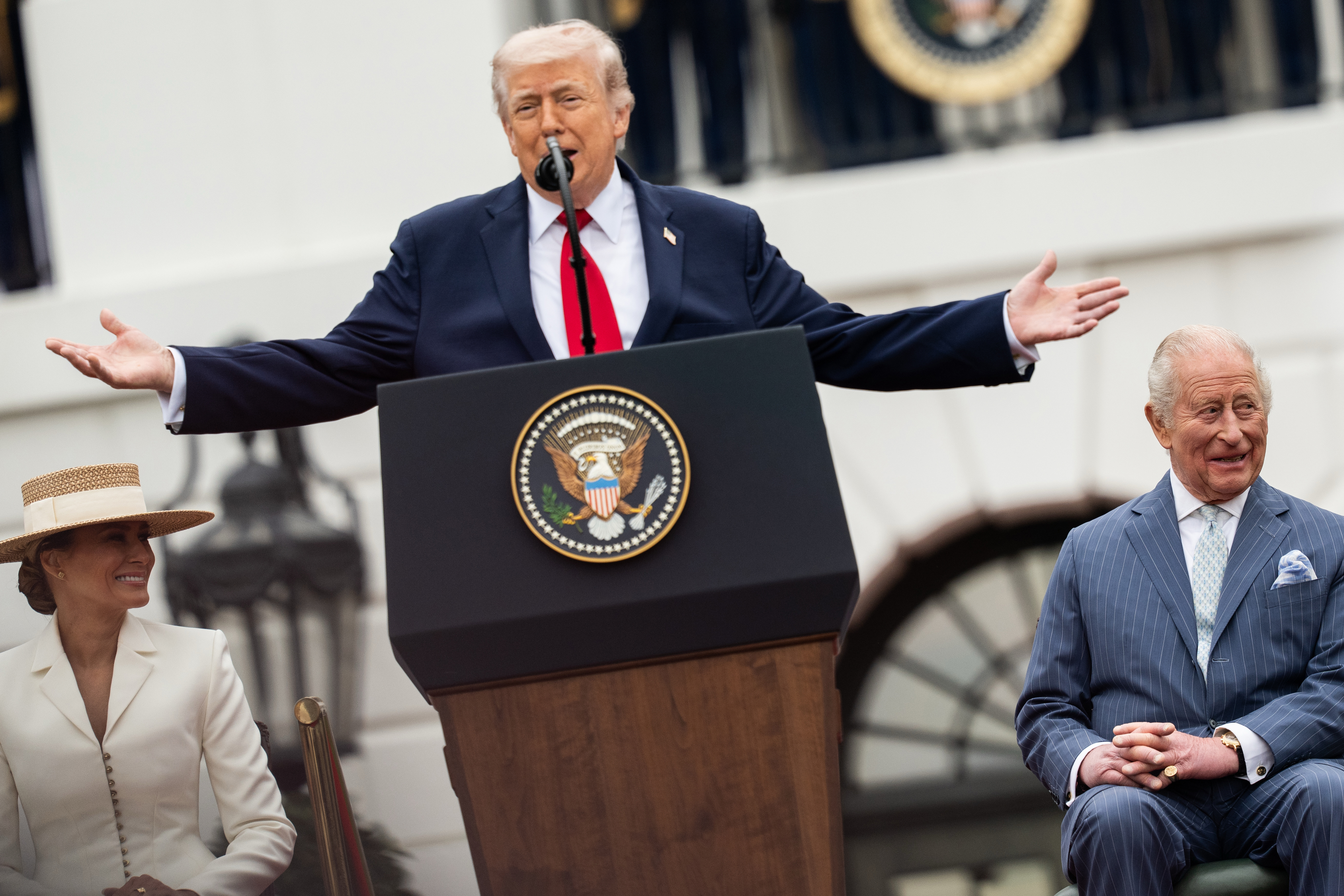
The air inside a royal reception room usually carries the scent of expensive beeswax, old parchment, and the stifling weight of unspoken rules. It is a place where every movement is measured, where the flick of a wrist or a misplaced glance is cataloged by historians and scrutinized by a global public. But at a recent gathering meant to bridge the Atlantic divide, the carefully curated silence of the British monarchy didn't just crack. It turned a very visible shade of crimson.
King Charles III has spent seventy-four years mastering the art of the poker face. He is a man who was trained from birth to be a vessel for the state, an individual whose personal feelings are secondary to the dignity of the institution he represents. Yet, there is a specific kind of American energy—boisterous, unpredictable, and entirely indifferent to the subtle cues of St. James’s Palace—that can bypass decades of royal conditioning in a single heartbeat.
Donald Trump is that energy personified.
The scene was set not by policy papers or diplomatic breakthroughs, but by a peculiar brand of anecdotal lightning. As the former President held court, he leaned into a story that was less about the mechanics of government and more about the strange, magnetic pull of personality. He spoke of a "crush." Not a geopolitical alignment or a shared vision for trade, but a raw, human admission of admiration that seemed to catch the King entirely off guard.
Watch the footage closely and you see it. The King’s composure doesn't fail, but it shifts. The blood rushes to his cheeks. It is a moment of profound vulnerability for a man who is rarely allowed to be "just a man."
The Weight of the Unscripted
In the theater of international relations, we are used to the script. We expect the joint statements. We anticipate the dry handshakes and the hollow praise for "enduring legacies." We rarely expect the blush.
A blush is an involuntary betrayal of the self. It is the body’s way of admitting that the mask has slipped. When Trump recounted his anecdote, he wasn't just talking to a head of state; he was poking at the human being beneath the medals and the sash. He was using a vernacular of intimacy in a space defined by distance.
Consider the hypothetical courtier standing in the shadows of that room. Let’s call him Alistair. Alistair has spent his life ensuring that the King’s tie is straight and that no guest overstays their welcome. For someone like Alistair, a moment like this is a nightmare. It is an intrusion of the "real world" into the sanctuary of the symbolic. Trump’s storytelling style is a sledgehammer to the delicate glasswork of British protocol. He speaks in superlatives. He uses words like "love" and "crush" to describe the gravity of social interactions.
For Charles, who grew up under the stoic, iron-clad shadow of Queen Elizabeth II, this kind of verbal intimacy is alien. It is a linguistic collision. On one side, you have the British tradition of understatement—where "quite good" means "extraordinary"—and on the other, the American tradition of the "Big Show," where everything is the greatest, the most beautiful, or the most intense.
The Invisible Stakes of a Smile
Why does this matter? Why does a flushed face in a gilded room resonate more than a white paper on carbon emissions?
Because we are starving for the authentic. In a world of deepfakes and PR-managed personas, the sight of a King losing his cool, even for a second, reminds us that the levers of power are still held by people who feel embarrassment, pride, and awkwardness.
The "crush" anecdote functions as a sort of social disruptor. By framing their relationship in such high-octane emotional terms, Trump effectively forces the King out of his role as an icon and into the role of a participant. It is a power move, intentional or not. It asserts a level of familiarity that the royal structure is designed to prevent.
The British Monarchy survives on "the mystery." Walter Bagehot, the great Victorian constitutionalist, famously warned against letting "in daylight upon magic." He knew that if the public saw the royals as just another family, the spell would break. Trump, perhaps more than any other world leader, is a creature of the daylight. He thrives on the exposure of the personal.
When the King blushes, the magic is momentarily replaced by biology.
A Study in Contrast
The interaction serves as a vivid map of our current cultural moment. We see the tension between the Old World, which values the preservation of form, and the New World, which values the impact of the individual.
- The King: Represents continuity, silence, and the heavy burden of the past.
- The Former President: Represents disruption, volume, and the immediate gravity of the present.
These two figures are bound by history, yet they speak different emotional languages. When Trump speaks of his "crush" on the King’s charisma or his mother’s legacy, he is attempting to bridge that gap with the only tool he trusts: personal branding. To Trump, everything is personal. To Charles, almost nothing is allowed to be.
The blush is the sound of those two philosophies grinding against each other. It is the friction of a world that is becoming increasingly informal meeting a world that is the last bastion of the formal.
The Human Core of the Headline
If you strip away the political baggage, what remains is a story about the discomfort of being seen.
Most of us have been there. You are in a professional setting, holding your breath, playing the part of the "Expert" or the "Professional," and someone says something so jarringly personal that your internal defenses collapse. Your face heats up. Your heart thumps against your ribs. For a few seconds, you are no longer a CEO, a teacher, or a King. You are just a person who has been called out in the light.
This is the hidden cost of the crown. It is the requirement to be a statue in a world that is increasingly full of photographers and storytellers. Charles has spent his life preparing for the throne, but no amount of training can prepare a human being for the sheer, unfiltered charisma of an American populist who decided that today, he was going to tell the world how much he liked you.
The blushing didn't just happen because of the words used. It happened because the words were an invitation to step out of the shadows.
The Ripple Effect
In the days following the event, the "blush" became the story. It outperformed the official press releases. It traveled further than the photos of the state dinner. This tells us everything we need to know about what the public actually craves. We don't want to see two symbols shaking hands. We want to see two people reacting to each other.
We live in an age of performance. Social media has turned every one of us into a mini-monarch, carefully curating our "brand" and our "image." We post the highlights and hide the hiccups. We are all, in our own way, trying to avoid the blush.
But the blush is where the truth lives.
When the King’s face changed color, it was the most honest moment of the entire visit. it was a signal that, despite the centuries of tradition and the layers of security, there is still a pulse beneath the velvet. There is still a man who can be flattered, who can be shocked, and who can be made to feel the awkward, beautiful weight of being the center of attention.
The anecdote will fade. The political cycles will turn. The specific words of the "crush" will be archived and eventually forgotten by the general public. But the image of the King, momentarily stripped of his royal armor by a stray comment, remains. It is a reminder that power doesn't make you immune to the human condition. It just makes the reaction more visible.
He stood there, the weight of the Commonwealth on his shoulders, unable to stop the blood from rushing to his skin. In that moment, the King was more relatable than he has ever been in his entire life.
The crown stayed on, but the man was finally in the room.
The room grew quiet as the story ended, the echoes of the laughter and the sharp, sudden intake of breath lingering in the air. The King adjusted his cufflink, a small, rhythmic motion he has performed a thousand times before. The redness was already beginning to recede, the mask sliding back into its permanent, regal place.
The moment was over. The daylight was gone. But for one brief, unscripted second, the magic had been replaced by something much more interesting: a heartbeat.
The world watched a King become a man, and for once, the silence said everything.
The red tie and the blue blood had met in the middle, and the result was a color neither of them could have predicted.
Imagine the quiet ride back to the private quarters, the heavy doors closing behind the royal party. The King, finally alone with his reflection, might have looked at those cheeks in the mirror. He might have smiled, or he might have sighed with the exhaustion of a man who has had to be a symbol for too long.
We will never know. The palace walls are thick, and the secrets they hold are older than the country Trump once led. But the blush belongs to the public now. It is a small, crimson piece of history that proves even the most carefully guarded life can be interrupted by the truth of a human reaction.
The story wasn't about a crush. It was about the impossibility of being a statue in a world that is still very much alive.
Charles is King. But he is also, quite clearly, still human. And in the end, that is the only thing that actually matters.
As the sun set over London, the palace lights flickered on, casting long shadows across the mall. The tourists moved on, the guards changed position, and the machinery of state continued its relentless, rhythmic grind. Everything was back to normal. Everything was as it should be.
Except for that lingering warmth in the air, the ghost of a story that made a monarch turn red.
It was a reminder that no matter how high the throne, the person sitting on it is still vulnerable to the sudden, sharp sting of an honest moment.
The King had blushed. And the world, for a brief moment, had stopped to breathe with him.
The silence returned to the reception room, heavy and certain. But the air was different now. It carried the faint, electric charge of a secret shared in public, a human connection that had survived the crushing weight of protocol.
The King walked toward the next engagement, his stride steady, his face pale once more.
The mask was back.
But we had seen what was underneath.
We had seen the man.
The crown was just a hat again.
And that was enough.



