The sirens in lower Manhattan always sound different when a foreign delegation rolls through. They have a sharper, more urgent bite, cutting through the heavy hum of idling yellow cabs and the rustle of lunchtime crowds. For decades, these motorcades were a routine theater of power. Black SUVs with tinted windows would glide past the barricades, carrying men and women who shaped the geography of the modern world. The city merely watched, held back by blue plastic police barriers and the unspoken agreement that New York is the world’s neutral stage.
But agreements break.
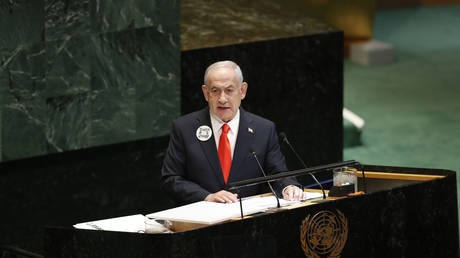
Imagine a room deep inside a municipal building, far from the polished marble of the United Nations General Assembly. In this hypothetical office, a mid-level bureaucrat stares at a piece of paper. On it is a name that dominates global headlines daily: Benjamin Netanyahu. Beside that name is an international warrant, a legal ghost that has haunted the halls of European parliaments and global courts for months. Suddenly, that ghost has a flight itinerary. It is landing at JFK Airport.
The announcement from City Hall dropped like a sudden anvil into a glass pond. The mayor, standing before a thicket of microphones, stated the unthinkable plain and simple. If the Israeli Prime Minister steps foot in New York City, he could be arrested.
It was a statement that rewrote the geometry of international diplomacy in a single breath. For generations, the concept of diplomatic immunity was a holy vestment. It wrapped around leaders like an invisible shield, protecting them from the laws of the lands they visited, ensuring that the wheels of global statecraft could turn without the interference of local handcuffs. To suggest that a municipal police force—the same officers who ticket double-parked delivery trucks and patrol the subway platforms—could intercept a sovereign leader is a profound shift in the tectonic plates of global authority.
The air in the city grew instantly heavier.
Consider the sheer mechanics of such a moment. A Boeing 777 touches down on the asphalt. The engines whine down. The stairwell rolls out. Under normal circumstances, the protocol is a ballet of handshakes, Secret Service details, and state department liaisons. But now, an invisible line has been drawn across the tarmac. On one side is the sovereign authority of a nation at war. On the other is a city government grappling with a mandate that transcends its own zip codes.
This is no longer just a story about treaties or geopolitical alignments. It is a story about the fragile, human friction that occurs when abstract international law suddenly demands a physical zip code.
The international community has spent decades building institutions meant to hold the powerful accountable. These courts sit in quiet, bloodless chambers in Europe, filled with binders, high-backed chairs, and judges speaking in measured, translated tones. They issue declarations that feel distant, almost academic, to the people living through the dust and chaos of the actual conflicts. For a long time, the cynical consensus was that these warrants were merely symbolic. They were legal statements without teeth, meant to soothe the conscience of the world rather than alter the course of history.
Then came the declaration from New York.
Suddenly, the distance between the bloodless chambers of the law and the concrete reality of a New York street vanished. The city became a crucible.
Think of the patrol officer assigned to the detail outside the diplomatic residence. He does not spend his nights reading treatises on international humanitarian law. He worries about his shift length, the cold coffee in his cup, and the swelling crowd of protestors gathering at the edge of the barricades. Yet, by virtue of a mayor’s public declaration, that officer’s uniform now carries the weight of a global argument. If the order comes down, does a local badge override a diplomatic passport? The question is a legal maze that could trap the highest courts for years, but the decision would have to be made in a fraction of a second on a crowded sidewalk.
The tension is not confined to the halls of government. It spills out into the delis, the law offices, and the bodegas. New York is a city built on diasporas. It is a living archive of global grief and global ambition. Every conflict in the world has a heartbeat here. When news of the mayor's statement broke, the conversation shifted from political abstraction to an immediate, visceral debate.
Arguments flared across diner tables. One side spoke of accountability, of a world where no one, regardless of their title or the power of their military, is above the reach of justice. They spoke of the thousands of lives altered by decisions made in Tel Aviv, and how a failure to enforce the law here would render the very concept of international justice a mockery. They saw the mayor's words as a long-overdue moment of moral clarity.
The other side spoke of chaos. They argued that targeting a leader during a diplomatic mission destroys the very mechanism required to negotiate peace. If a leader cannot travel to the United Nations, the ultimate forum for global dispute, then the final avenues for dialogue are closed. They saw the move as a dangerous piece of political theater, an overreach by a municipal government playing at global chess without understanding the pieces.
But the real problem lies elsewhere. It rests in the terrifying ambiguity of what happens if someone actually tries to cross that line.
Picture the scene. The motorcade moves through the city. The federal government, operating through the State Department and the Secret Service, is legally bound to protect foreign dignitaries. They operate on the doctrine of sovereign immunity, a foundational pillar of American foreign policy. Meanwhile, the local police force answers to a city executive who has publicly acknowledged the validity of an arrest threat.
You have two distinct arms of American power, standing on the same asphalt, looking at the same man, with completely contradictory instructions. One is trained to shield him with their bodies. The other is told he is a fugitive from international justice.
This is where the grand theories of political science break down into raw, human nerves. The potential for a jurisdictional standoff in the heart of America’s financial capital is not just a logistical nightmare; it is a symptom of a deeper, systemic fracturing. The old rules are no longer holding. The institutions that once guaranteed order are buckling under the weight of an era that demands absolute reckonings.
The Israeli Prime Minister himself is no stranger to high-stakes political survival. His career has been defined by an ability to navigate the sharpest corners and turn apparent dead ends into new avenues of control. But flying into an American city where the local leadership has openly discussed his detention is a different kind of gamble. It turns a standard diplomatic trip into a high-wire act over a canyon of unpredictable legal precedent. Every public appearance becomes a calculated risk. Every route chosen by his security detail must map around not just potential protests, but potential legal traps.
We often view history as something written in textbooks, a series of inevitable conclusions reached by great forces. We forget that history is actually made of moments like this—tense, quiet rooms where people weigh the consequences of a single action against the momentum of the entire world.
The mayor’s statement might ultimately remain a rhetorical volley, a piece of political posturing designed to satisfy a vocal constituency or make a point on the global stage. It is highly possible that diplomatic maneuvers behind closed doors will ensure the Prime Minister never finds himself in a position where a local officer can approach him with a pair of cuffs. The federal government has immense, overriding power to dictate foreign policy and suppress local actions that interfere with national interests.
But the words cannot be unsaid. They hang in the air above Manhattan like a low-lying fog.
By simply stating that the arrest is a possibility, the boundaries of what is thinkable have shifted. The invisible shield of diplomatic immunity has been chipped. Future leaders, looking at the itinerary of their next international summit, will no longer see New York as a guaranteed sanctuary. They will see it as a place where the local laws and global grievances can converge at any moment to challenge their freedom.
As the sun sets over the Hudson River, casting long shadows between the skyscrapers, the city continues its relentless pace. The sirens still wail in the distance. The crowds still push through the turnstiles. But beneath the familiar noise, there is a new, uneasy vibration. The world is watching a city that has suddenly become larger than itself, waiting to see if a single piece of paper will turn a routine diplomatic visit into the moment the old global order finally snapped.