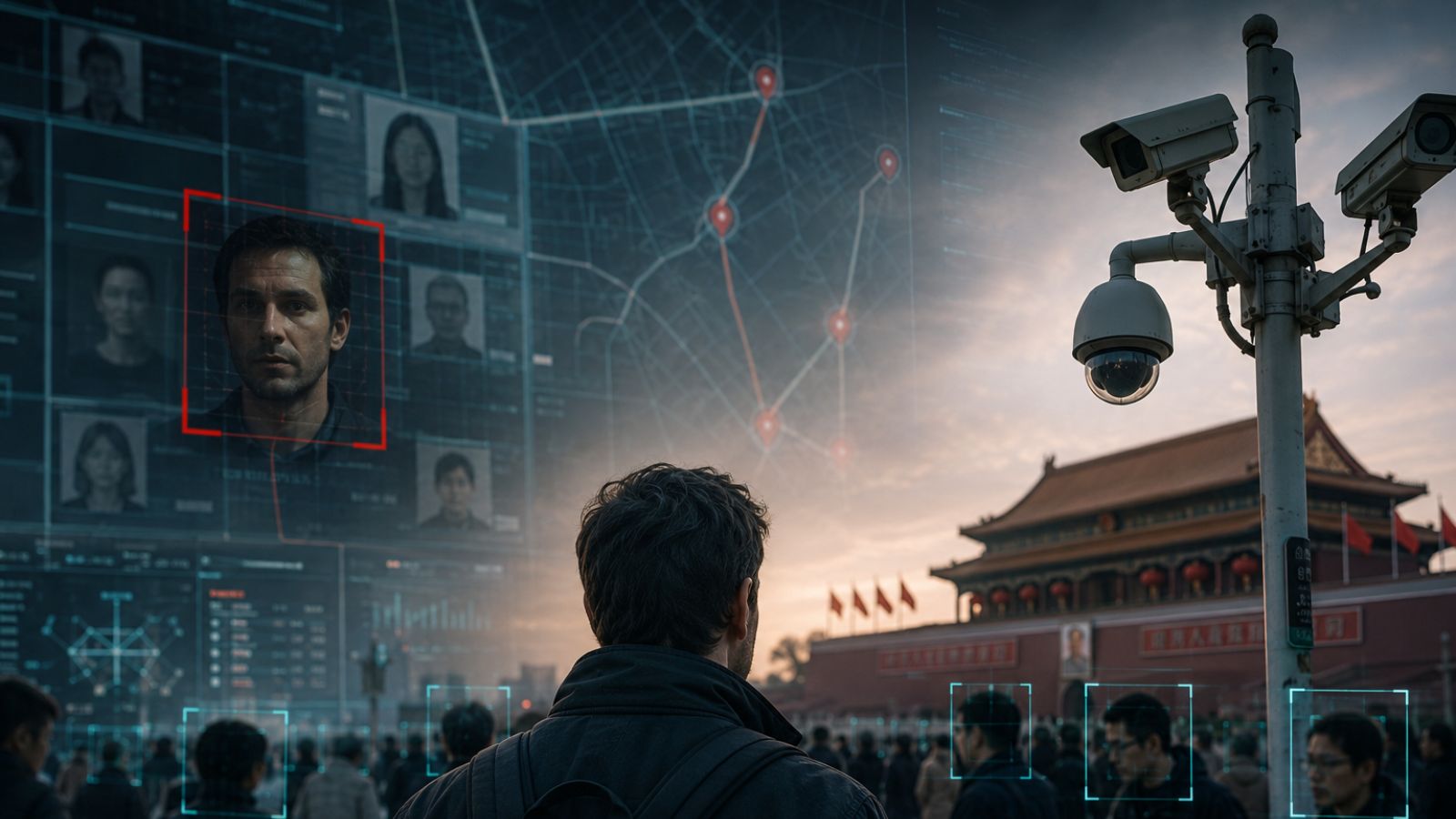
The coffee at the regular spot in Shanghai tasted like damp cardboard, but it was the only place with a reliable power outlet near the window. Outside, a light drizzle blurred the neon signs of Nanjing Road. People walked with their heads down, huddled under a sea of black umbrellas. To a casual observer, it looked like any bustling global metropolis rushing through a rainy Tuesday.
But if you looked closer, at the exact point where the pavement met the glass facade of the shopping center, you would see it. A small, black dome. No larger than a teacup. It did not swivel. It did not blink. It just stared.
For a long time, expatriates, foreign executives, and visiting journalists operated under a comfortable illusion. We believed that the vast, intricate web of digital surveillance spreading across China was meant for someone else. We watched the deployment of facial recognition gates, the mandatory phone apps, and the real-time tracking grids through a lens of academic detachment. It was a domestic policy, we reasoned. We possessed foreign passports. We were the guests, shielded by international norms and the invisible buffer of our citizenship.
That buffer just evaporated.
The Day the Grid Learned Your Name
Consider a hypothetical traveler named David. He is a supply chain auditor for a mid-sized German automotive firm. He has lived in Shenzhen for six years, speaks conversational Mandarin, and prides himself on navigating the local culture with ease. He uses WeChat to buy his morning baozi, pays his rent via Alipay, and logs his morning jogs on a local fitness app. He feels integrated. Safe.
Last month, David walked into the Futian checkpoint to take the train to Hong Kong. He scanned his passport at the automated gate, expecting the familiar green light and the mechanical chime.
Instead, the gate remained locked. A sharp, high-pitched beep pierced the humid air.
A young officer in a crisp blue uniform gestured for David to step aside. There was no anger in the officer’s demeanor, only a flat, bureaucratic certainty. He pointed to a small screen on his handheld device. It displayed David’s face, captured three days prior at a metro station he barely remembered visiting, cross-referenced with a bank transaction that the system flagged as "anomalous."
The system did not care that David held a German passport. To the algorithm, he was not a foreign guest; he was simply a data point that failed to compute.
What David experienced was the practical application of China’s upgraded, unified surveillance architecture. For years, the country’s security apparatus operated in silos. The public security bureaus had their camera networks, the immigration departments had their entry logs, and private tech giants held the keys to consumer data. They were powerful, but they were fragmented.
Not anymore. The walls between these digital fiefdoms have been systematically dismantled. Today, the data flows downward into a central reservoir, where machine learning models stitch together a terrifyingly complete picture of human movement, financial transactions, and digital behavior. And for the first time, this system has been fully calibrated to track the foreign population with the exact same granular scrutiny once reserved for domestic monitoring.
The Architecture of Absolute Compliance
To understand how this functions, one must abandon the cinematic cliché of a smoke-filled room where agents watch monitors in real time. The reality is far colder. It is entirely automated, driven by an interconnected ecosystem of three distinct pillars.
First, there is the hardware overhaul. The older generation of closed-circuit cameras relied on simple video recording. The new units deployed in major transport hubs, business districts, and diplomatic quarters are edge-computing devices. They do not merely record; they analyze. They extract facial geometry, gait characteristics, and even the brand of your clothing before the data ever hits a server. They can identify an individual walking away from the camera simply by the rhythm of their stride.
Second, the structural integration of the banking system has closed the final loophole. The transition to a cashless society is complete. Cash is not merely obsolete; it is viewed with deep suspicion. When a foreign traveler registers for a local digital wallet using their international credit card, that financial profile is instantly tethered to their biometric data collected at the border. Every high-speed rail ticket, every cup of tea, every shared bike rental forms a breadcrumb trail.
Third, and perhaps most critically, is the weaponization of the daily digital routine. Foreigners living in China rely heavily on virtual private networks (VPNs) to access the global internet. For years, authorities tolerated this as a necessary evil for international commerce. Now, the network detection tools have grown sophisticated enough to identify VPN signatures in real time. The system no longer just blocks the connection; it logs the device, logs the user, and matches that data against the physical location of the cellular tower providing the signal.
The trap is elegant because it is invisible. You do not know you have crossed a line until the line moves to surround you.
The Illusion of Distance
Back in the Shanghai coffee shop, the rain began to hammer harder against the glass. A notification buzzed on my phone. It was an automated alert from a local neighborhood committee mini-program, reminding all residents—specifically addressing foreign nationals in the district—to update their residential address within twenty-four hours of returning from any domestic travel.
The message arrived precisely forty-two minutes after my train pulled into Hongqiao station. I had not checked in anywhere. I had not shown my identification to a human being since leaving my hotel in Hangzhou that morning. The system simply knew.
It is easy to look at this from a distance and dismiss it as a localized problem. One might think, I don’t plan on visiting Beijing, so why should I care?
But the real problem lies elsewhere. This is not a localized experiment; it is an exportable blueprint. The infrastructure being perfected on the streets of Shanghai and Guangzhou is currently being packaged, sold, and implemented in cities across Central Asia, Africa, and Latin America. The smart-city initiatives promised to reduce traffic and curb urban crime in dozens of developing nations are built on this exact foundational code.
When you normalize the total digital encapsulation of human beings in one part of the world, you lower the threshold for its adoption everywhere else. The technology does not stop at national borders. It waits for the cultural and legal guardrails to soften.
The Weight of the Unblinking Eye
Living under this level of scrutiny changes a person in ways that are difficult to quantify. It is a slow, psychological erosion.
In the beginning, you feel a sense of defiance. You try to outsmart the system. You leave your phone at home when you go for a walk. You wear a wide-brimmed hat. You take circuitous routes to meet friends for a quiet dinner.
But human beings are creatures of convenience. Eventually, the friction of resistance becomes too heavy to bear. You need the phone to buy groceries. You need the face scanner to enter your apartment building. You need the app to call a taxi in a downpour.
Slowly, almost imperceptibly, you begin to self-censor. You stop clicking on articles that might flag your internet traffic. You decline an invitation to a gathering that seems vaguely political. You modify your tone of voice when speaking near a smart speaker. You become your own warden, policing your thoughts and actions to ensure your digital profile remains a soothing, unblemished green.
The true efficacy of absolute surveillance does not lie in its power to catch dissidents. It lies in its power to make the very concept of dissent unthinkable. It creates a profound, existential loneliness, where you realize that every interaction is monitored, every relationship is mapped, and your safety depends entirely on your ability to remain utterly unremarkable.
The officer at the Futian checkpoint eventually handed David back his passport. There was no explanation, no apology, just a curt nod. The gate clicked open. David walked through, his heart hammering against his ribs, his palms slick with sweat. He was free to go.
But as he stepped onto the platform, he realized something fundamental had shifted. The passport in his jacket pocket, with its gold embossed eagle and its promises of diplomatic protection, felt suddenly light. Flimsy. Like a relic from a bygone era that no longer possessed the power to protect him from the unblinking eye of the machine.
The rain outside the station had stopped, leaving the asphalt slick and reflective, mirroring the thousands of glowing screens rushing toward the trains, each one a beacon reporting back to the center, steady and true.